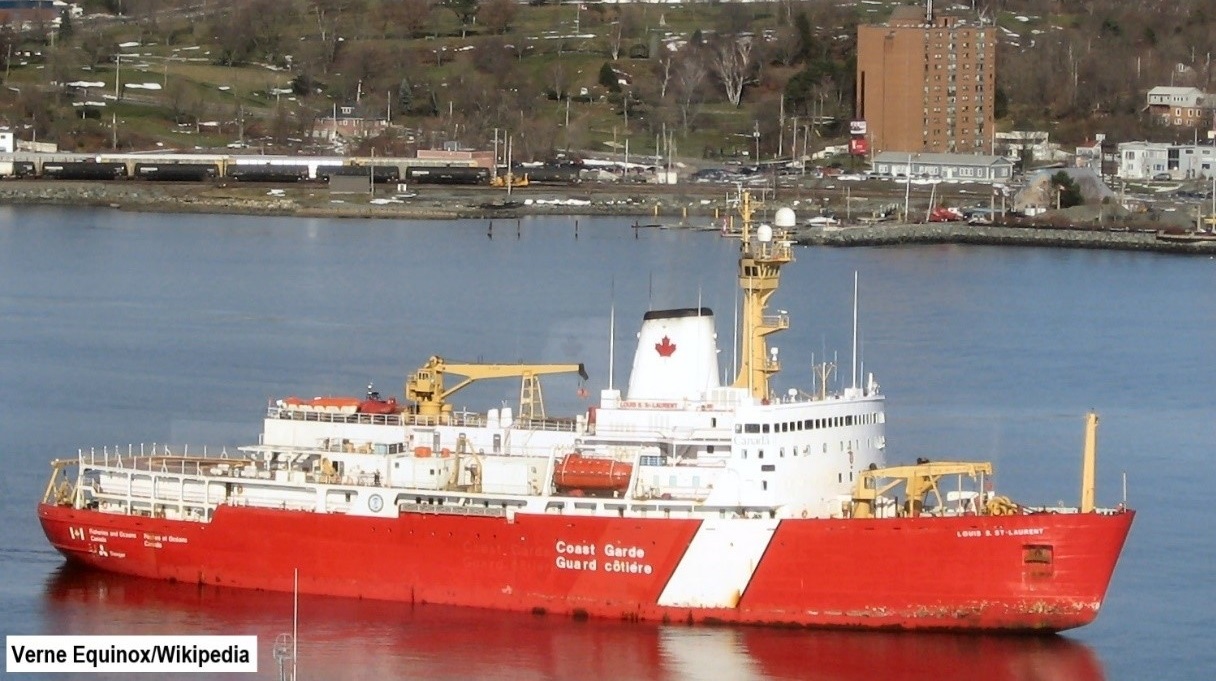
Canada has two sea-going services – the Royal Canadian Navy (RCN) and the Canadian Coast Guard (CCG). Why two? They operate different ships and, while their tasks sometimes overlap and […]
Among other things, the new government of Prime Minister Justin Trudeau has announced that it will place emphasis on renewing the Canadian Coast Guard fleet. See the CBC news article here: http://www.cbc.ca/news/canada/british-columbia/coast-guard-fleet-refresh-top-priority-security-1.3318575
Michael Byers and Stewart Webb have authored an interesting report published by the Canadian Centre for Policy Alternatives and the Rideau Institute entitled “Titanic Blunder: Arctic/Offshore Patrol Ships on Course […]
* Moderator’s Note: This article was originally published in the Halifax Chronicle-Herald on 03 December 2011. It is reprinted here with the permission of the author. Eight of Canada’s provinces […]
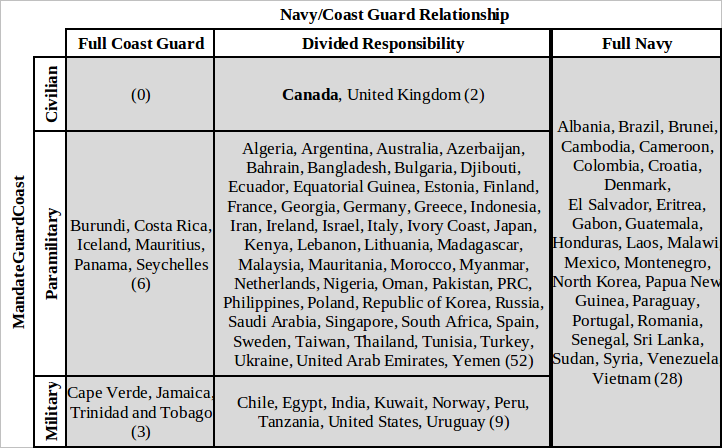
CFPS is pleased to announce that the paper written by Mr. J. Matthew Gillis entitled The Global Navy Coast Guard Relationship: A Mandate Based Typology is now freely available. You […]
In a short paper entitled “The Canadian Navy and the Canadian Coast Guard: Cooperating Sea Services of Co-existing Federal Fleets,” published through the CDFAI last June, Vice-Admiral (ret.) Jean-Yves Forcier […]
The question posed in the second post in this thread by ‘R.M.’ is crucial: “Is our current multi-departmental model for domestic maritime safety/defence/enforcement the one that will meet our future […]
There has been considerable press coverage of the U.S. Government Accountability Office (GAO) report – Border Security: Enhanced DHS Oversight and Assessment of Interagency Coordination Is Needed for the Northern Border – and […]
The announcement of the new arctic patrol vessels brings with it the inevitable discussion on whether the Canadian navy or the Canadian Coast Guard should be Canada’s sovereign marine presence […]
Cookie Consent
At Canadian Naval Review (CNR), we are committed to respecting your privacy. When visiting our website for the first time you can either “Accept all” cookies (including ‘non-essential cookies’) or “Customize” your cookie preferences, which allows you to make individual choices and get details on the cookies we use.
Contains information related to marketing campaigns of the user. These are shared with Google AdWords / Google Ads when the Google Ads and Google Analytics accounts are linked together.
90 days
__utma
ID used to identify users and sessions
2 years after last activity
__utmt
Used to monitor number of Google Analytics server requests
10 minutes
__utmb
Used to distinguish new sessions and visits. This cookie is set when the GA.js javascript library is loaded and there is no existing __utmb cookie. The cookie is updated every time data is sent to the Google Analytics server.
30 minutes after last activity
__utmc
Used only with old Urchin versions of Google Analytics and not with GA.js. Was used to distinguish between new sessions and visits at the end of a session.
End of session (browser)
__utmz
Contains information about the traffic source or campaign that directed user to the website. The cookie is set when the GA.js javascript is loaded and updated when data is sent to the Google Anaytics server
6 months after last activity
__utmv
Contains custom information set by the web developer via the _setCustomVar method in Google Analytics. This cookie is updated every time new data is sent to the Google Analytics server.
2 years after last activity
__utmx
Used to determine whether a user is included in an A / B or Multivariate test.
18 months
_ga
ID used to identify users
2 years
_gali
Used by Google Analytics to determine which links on a page are being clicked
30 seconds
_ga_
ID used to identify users
2 years
_gid
ID used to identify users for 24 hours after last activity
24 hours
_gat
Used to monitor number of Google Analytics server requests when using Google Tag Manager