By John Walsh, 12 February 2026
[This is an excerpt of an article in Vol. 21, No. 3 of Canadian Naval Review. For the full article, click on the link below.]
This reflection has its genesis in an exchange during a recent Canadian Leaders at Sea (CLaS) experience aboard HMCS Regina. To open a briefing, Captain (N) Kevin Whiteside posed what seemed like a straightforward question: why does Canada have a navy? At first, the answer appeared self-evident. Canada is bordered by three oceans, and the national motto – a mari usque ad mare – proclaims a country defined by maritime horizons. And yet, like all good questions, this one lingered. To be fair, it was unsettling, not in tone, but in the sobering truth at which it hinted: that many Canadians may no longer know how to answer such a question, or might even be inclined to say that the country no longer needs a navy at all. If either is true, then the society the Royal Canadian Navy (RCN) protects may well require a renewed conversation. This conversation would need to re-articulate the values and commitments that sustain not only the institution, but the democracy in whose name it serves. In that spirit, I offer these reflections, joining, in my own way, the larger dialogue that moment on Regina invited.
As a Classics professor, I spend my days immersed in the political and moral thought of earlier societies, studying how power has been exercised, legitimacy earned and civic freedom maintained. Captain Whiteside’s question stayed with me not only as a Canadian, but also as a scholar of the ancient world. What does it mean, in a democratic society, to maintain instruments of national power? How do those instruments remain connected to the people they are meant to serve? And how does naval force contribute to safeguarding not only national territory, but the civic agency and democratic legitimacy of the country itself? The CLaS experience, and especially Captain Whiteside’s challenge during his briefing, helped me begin to answer those questions and to see the navy not just as a strategic tool, but as a living expression of democratic will.
In times of peace – or even the relative peace of today – some may be tempted to view the navy as ornamental, a relic of a bygone age or merely a ceremonial symbol of statehood. But to adopt that view is not only mistaken, it is dangerous. It misjudges the political character of military power in a democracy. For a sovereign, self-governing country such as Canada, naval power is not a vestige, but a vital instrument – one that both defends the state and affirms who belongs to it.
This principle has deep roots in Western thought. In Aristotle’s Politics, the structure of a political order is shaped by the kinds of power upon which it relies. Naval power, he argued, supports the foundations of constitutional self-government. It demands broad participation, fosters equality of contribution, and allows a polity to project influence without territorial conquest. The emergence of Athens as a naval power in antiquity was not merely a matter of military innovation, it was a catalyst for political transformation towards democracy. As Aristotle observed, the rise of the Athenian navy fostered a civic order grounded in participation and reciprocity. The triremes, small ships powered by oars, were not crewed by coerced subjects but by free citizens whose shared labour at sea embodied the egalitarian ethos of the polis.
…
Captain Whiteside’s question reminds us that the ability to defend a country rests not on force alone, but on a shared understanding of the principles that make such defence necessary and just. When the rationale for national defence is lost – or when, as in this case, citizens cannot explain why they have a navy – it reveals more than a lapse in knowledge, it signals an erosion of the civic literacy that sustains democratic life. In a democracy, the articulation of that rationale is not a by-product of defence, but its precursor. It is an act of civic responsibility that must precede and sustain the will to act. For without it, a country cannot validate its own exercise of power, nor justify the strength it claims in arms. If a country cannot – or will not – defend itself, it signals to the world that its sovereignty is conditional, and its future negotiable. Just as the rights of citizens are affirmed by their visible willingness to uphold the state, so too is a state’s voice among other states, even among allies, determined by its demonstrable capacity to assume the burdens of its own defence.
….
Read the full article at https://www.navalreview.ca/wp-content/uploads/public/vol21num3/cnr_vol21_3_Walsh.pdf
Image:
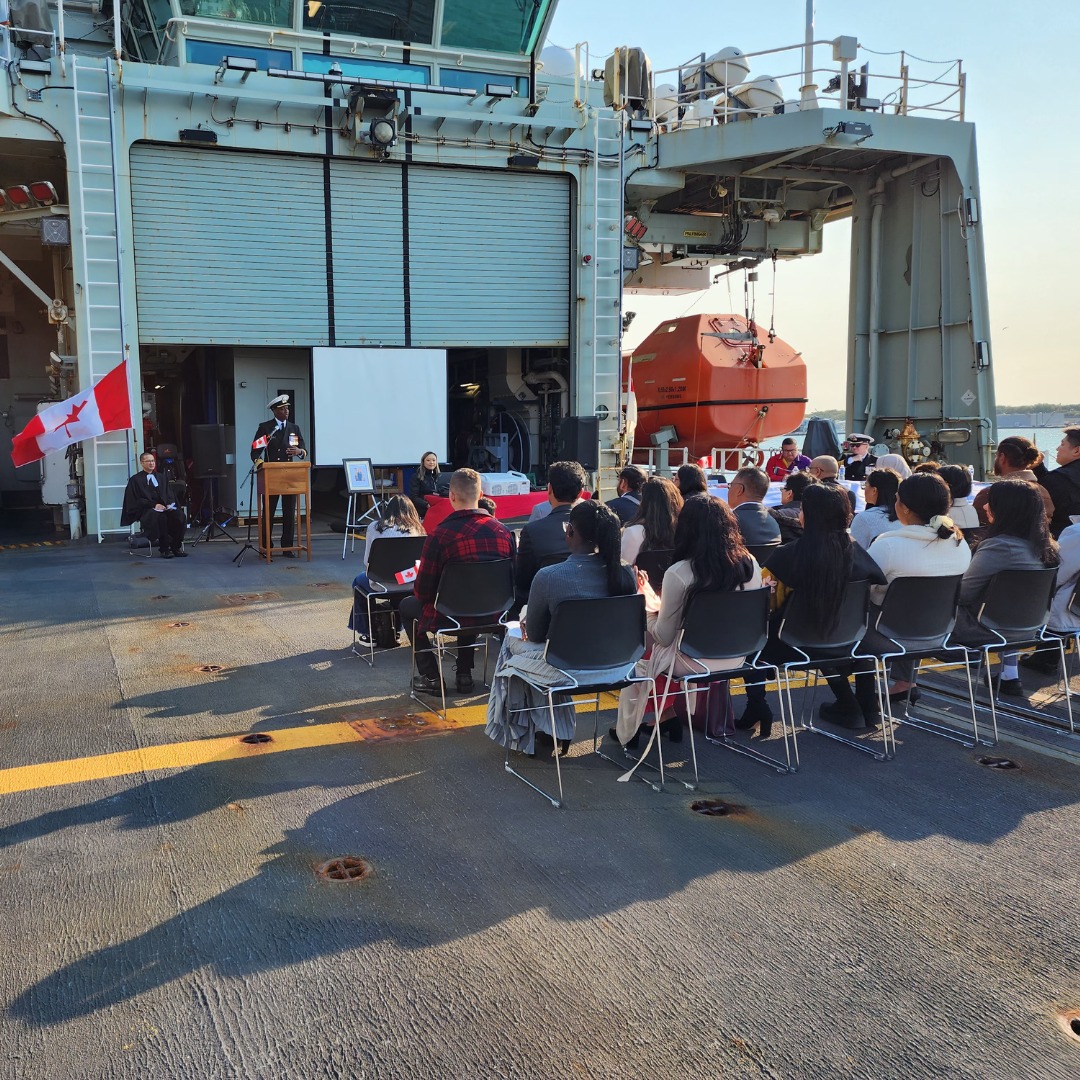
The flight deck of HMCS Harry DeWolf was used for a citizenship ceremony in October 2024 off Toronto. Credit: S1 Mendes Bernardo



One thought on “Why Does Canada Have a Navy? Reflecting on the Canadian Leaders at Sea Program”
History.