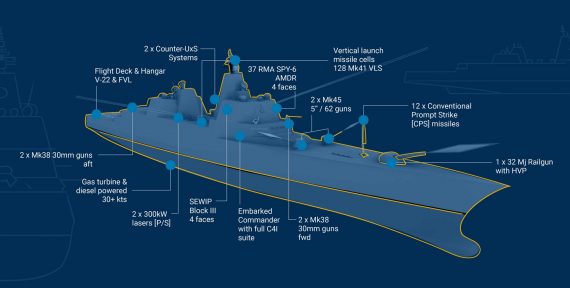
By Mikaȅl Perron, 2 May 2026 The cancellation of the Constellation-class frigate should be reconsidered by the US government. The proposed FF(x) frigate based on the Legend-class Security Cutter actually […]
By Jeff G. Gilmour, 11 January 2026 In December 2025, President Trump announced that two new battleships were to be built in the United States – what he’s calling the […]
By Peter M. Sanderson, 15 October 2025 According to the White House, President Trump has authorized the construction of up to four Arctic Security Cutters (ASCs) abroad. The President also […]
By Dan Middlemiss, 31 May 2024 A highly critical report just released by the US Government Accounting Office (GAO) offers more insight into the currently delayed frigate program in the […]
Moderator. 2 January 2020. Canada is no stranger to the politics of naval procurement. We have all wondered about a procurement decision. Naval projects usually involve huge sums of money […]
21 June 2018. After a lull in shipbuilding over the past 20 years, many countries are now beefing up their naval fleets. Canada is in the process of recapitalizing both […]
The photographs of the US Navy’s new destroyer USS Zumwalt embedded in the article are interesting. She is clearly a controversial addition to the US Fleet, particularly in view of the […]
Moderator’s Note: This article originally appeared on the Information Dissemination website, dated Wednesday, 24 August 2011. It is especially relevant for Canadian readers because of the projected reductions in the […]
The announcement on Wednesday by Representative Murtha that the House Defense Appropriations subcommittee will approve funds for five more ships to this year’s defence programme, at least one of which […]
Our earlier discussion about the sensibility of addition another SSN to the appropriations this year, and the lack of clear direction on surface fleet plans, seems to have more substantiation […]
Both political parties in the United States have recognized three key elements of a balanced defence policy. First, despite the high costs of their Iraq and Afghanistan commitment, their leaders […]
Cookie Consent
At Canadian Naval Review (CNR), we are committed to respecting your privacy. When visiting our website for the first time you can either “Accept all” cookies (including ‘non-essential cookies’) or “Customize” your cookie preferences, which allows you to make individual choices and get details on the cookies we use.
Contains information related to marketing campaigns of the user. These are shared with Google AdWords / Google Ads when the Google Ads and Google Analytics accounts are linked together.
90 days
__utma
ID used to identify users and sessions
2 years after last activity
__utmt
Used to monitor number of Google Analytics server requests
10 minutes
__utmb
Used to distinguish new sessions and visits. This cookie is set when the GA.js javascript library is loaded and there is no existing __utmb cookie. The cookie is updated every time data is sent to the Google Analytics server.
30 minutes after last activity
__utmc
Used only with old Urchin versions of Google Analytics and not with GA.js. Was used to distinguish between new sessions and visits at the end of a session.
End of session (browser)
__utmz
Contains information about the traffic source or campaign that directed user to the website. The cookie is set when the GA.js javascript is loaded and updated when data is sent to the Google Anaytics server
6 months after last activity
__utmv
Contains custom information set by the web developer via the _setCustomVar method in Google Analytics. This cookie is updated every time new data is sent to the Google Analytics server.
2 years after last activity
__utmx
Used to determine whether a user is included in an A / B or Multivariate test.
18 months
_ga
ID used to identify users
2 years
_gali
Used by Google Analytics to determine which links on a page are being clicked
30 seconds
_ga_
ID used to identify users
2 years
_gid
ID used to identify users for 24 hours after last activity
24 hours
_gat
Used to monitor number of Google Analytics server requests when using Google Tag Manager