By Brian Santarpia, 20 November 2026
Since retiring from the Royal Canadian Navy (RCN) three years ago, I have often reflected on whether I was successful, in my small part, in preparing my successors for the responsibility of designing, generating and operating the navy that Canada needs and deserves. While I would never presume to claim an outsized share of either the credit or the blame for the navy’s current state, I have reached some conclusions about where those preparations are succeeding and where they are lacking. These reflections are grounded in my close observation of young officers and sailors in the navigation and bridge simulators at HMCS Venture and in the operations simulators at the Naval Fleet School Atlantic.
On the positive side of the ledger, the RCN continues to produce sailors and officers with strong seamanship and navigation skills. Despite reduced availability of ships at sea due to an aging fleet, the navy has made effective use of bridge simulators to ensure that capable young recruits can learn and practise the skills required to operate their ships safely and competently. Likewise, in tactical training, shortages in sea days are mitigated through simulators and participation in international synthetic training events where RCN personnel benefit from exposure to allied practices. Preparing mariners and tactical operators remains a challenge that demands constant effort, but in this area the navy can take justified pride in its achievements.
Where the balance shifts is in the realm of strategic preparation. With the benefit of time in retirement for formal study and reflection, I have come to recognize that the RCN dedicates relatively little effort to professional education in the foundations of strategic thought. This is not to suggest that the navy has failed to produce strong leaders. I was fortunate to serve with many outstanding strategic thinkers. However, their development owed more to personal curiosity, intellectual discipline and individual initiative than to any systematic program of education. Over the course of my 37-year career, I was rarely exposed to sustained, formal study of the foundations of sea power, geopolitics, or the historical analysis of naval and military campaigns.
While the service rightly emphasizes technical competence, seamanship and leadership, it has done so at the expense of a deeper intellectual foundation in history, strategic theory and fleet tactics. The prevailing paradigm, which treats almost any undergraduate degree as equally applicable and relies on in-career training focused on procedural and platform-specific proficiency, risks producing officers and senior ratings who are highly capable operators, but insufficiently prepared thinkers. This imbalance is not merely academic; it goes to the heart of what a navy is for, and how it fights.
History offers a clear warning. The most effective naval forces have never relied on technical excellence alone. They have cultivated professional cultures of inquiry, in which officers and senior ratings are expected to study past conflicts, engage with strategic theory and think critically about the application of force at sea. This intellectual tradition enables adaptation under uncertainty, innovation under pressure, and sound judgement when doctrine proves insufficient.
The RCN risks drifting from this tradition. By treating undergraduate education as a box-checking exercise rather than as the foundation of a professional world view, the navy forfeits an opportunity to shape how its officers think before they ever set foot on a bridge or in an operations room. The result is a cohort that must learn not only how to fight, but how to think about fighting, often too late in their careers and under operational constraints.
Strategic theory is particularly under-emphasized. Officers are rarely required to grapple in a sustained way with fundamental questions, such as the relationship between political objectives and military means, the nature of deterrence and coercion, or the dynamics of escalation and risk. Without this grounding, discussions of contemporary challenges, whether great power competition, maritime denial strategies, or alliance interoperability, risk becoming superficial. Officers may understand the ‘what’ of their missions, but not the ‘why.’
The study of naval history suffers a similar fate, too often treated as optional enrichment rather than a core component of professional competence. This is a mistake. History is not anecdote; it is the empirical record of how naval power has been used, misused and transformed. It provides the only laboratory in which officers can examine the interaction of technology, doctrine, leadership and chance in war. Without it, the RCN is condemned to relearn old lessons at unnecessary cost.
…
Read the rest of the free access article at https://www.navalreview.ca/wp-content/uploads/public/vol22num2/cnr_vol22_2_Editorial.pdf
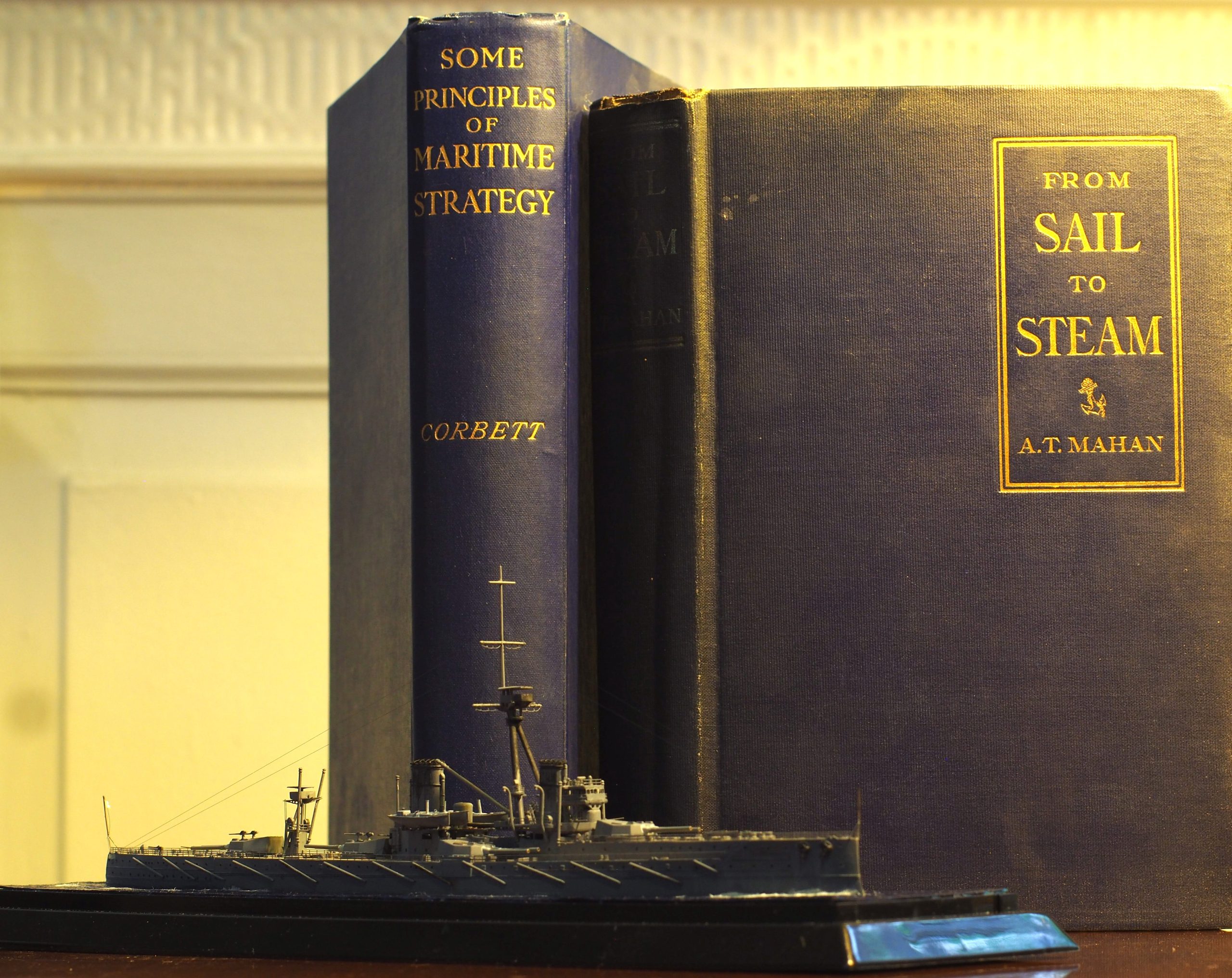
Image: A 1/700 scale model of HMS Dreadnought sits in front of works by two famous naval theorists: a prioritization of the technical over the strategic? Credit: Model and photo by Timothy Choi