By Poseidon, 8 September 2026
There was a huge amount of adverse publicity recently in the media stemming from complaints from some members of the crew of the aircraft carrier USS Abraham Lincoln to family members in the USA. My understanding is that most of those complaints were from young sailors complaining to their parents about conditions onboard and general poor morale. The carrier had been deployed from its home port in San Diego for over nine months, broken up only by a one-day stop in Guam en route to the operating area in the Northern Arabian Sea. It should come as no surprise to readers that young sailors are not happy to be at sea in an aircraft carrier continuously for nine months in a high-stress environment of 24/7 flight ops with 5,600 other sailors and naval aviators.
Unexpectedly, war against Iran had commenced 28 February 2026 with attacks mounted from a range of American ships, including Abraham Lincoln. It would not have helped that the President added uncertainty to the duration and nature of the mission, by stating that the war would be over in 5-6 weeks and five months later they were still on station, launching strikes against Iran. Meanwhile several support facilities in the area had been attacked by Iranian missiles and drones, particularly the US Fifth Fleet Headquarters in Bahrain in the Persian Gulf. Food supplies apparently suffered greatly, and still there was no rest and recuperation (R&R) for the carrier and its complement.
The sudden decision to commence operations against Iran, and lack of robust contingency plans to respond to the many ‘what ifs’ had the knock-on effect of causing problems for the crew of the Lincoln. Although they might have understood when they sailed that there were no guarantees as to when they would return, there would have been expectations of a six- or seven-month deployment. Based on that supposition, it would have been reasonable to plan weddings, family time, recreational trips, etcetera. The confusion as to American plans for the conflict may have been targeted at the Iranian government, but it very likely adversely impacted morale at sea too.
Naval leadership is very aware of the importance of good morale in individual ships as well as the fleet as a whole. Good and plentiful food, R&R when possible, and being able to make reasonable future plans are important for personnel – poor food and other supplies, no R&R, and continually changing plans cause problems and poor performance. In the case of Lincoln, there will likely be impacts throughout the US Navy for years, such as poor recruiting numbers and personnel requesting early release or not re-engaging. It is difficult today to recruit young people into the navy and retain them – any navy. People like the freedom to choose what they do, and deploying for nearly a year, which was the case with the USS Gerald Ford, and nearly as long now with Lincoln before it returns home, is demanding a lot.
While on the way home to San Diego, the naval leadership wisely diverted Lincoln to Pattaya in Thailand for some R&R in early September, which I can affirm is a ‘good run ashore.’ That should leave some good memories and hopefully help with morale and retention too!
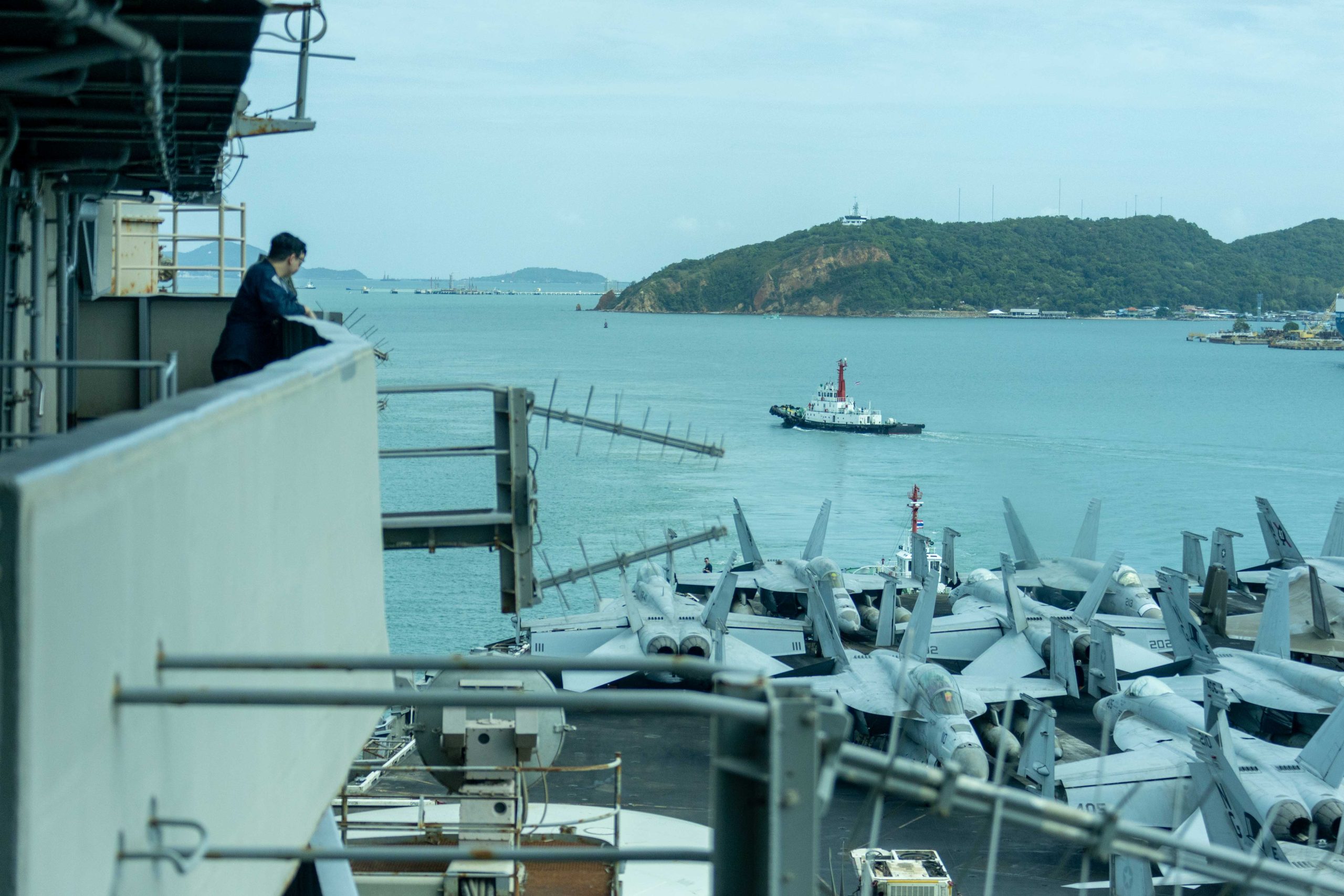
Image: U.S. Sailors observe Thailand aboard Nimitz-class aircraft carrier USS Abraham Lincoln (CVN 72), as Abraham Lincoln pulls into Laem, Chabang, Thailand on Sept. 2, 2026. Credit: U.S. Navy photo by Mass Communication Specialist Seaman Hannah Tross


9 thoughts on “USS Abraham Lincoln Saga”
There is much in Poseidon’s piece that is fair. Spending roughly 264 consecutive days at sea during combat operations is an extraordinary burden on sailors and their families. Good food, some predictability, communications home and opportunities for port visits all matter. After that long at sea, I would have been surprised if sailors were not complaining. That does not automatically mean morale had collapsed, nor does it mean the complaints were invalid.
Where I think the argument becomes less convincing is when those complaints are treated as evidence of poor contingency planning or as a predictor of years of recruiting and retention problems. Abraham Lincoln was not conducting a normal peacetime deployment. It was supporting sustained combat operations in a region where shore facilities and logistics nodes were themselves under threat. Once war begins, deployment schedules and port visits become secondary to operational requirements. Logistics chains have to adapt, plans change, and sometimes ships stay at sea far longer than anyone expected. That is not necessarily evidence that nobody planned for contingencies. It is often simply the reality of war.
There is also the modern information environment to consider. Complaints that once would have remained between sailors, families and mess decks can now be circulating globally within minutes. Social media rewards the most dramatic interpretation, while AI generated content, manipulated imagery, synthetic audio, anonymous accounts and misleading summaries make it increasingly difficult to separate an original complaint from the story that develops around it. Some of this is simply click driven nonsense, but some can also be deliberately amplified by non state actors and influence networks with an interest in portraying Western militaries as exhausted, incompetent or incapable of sustaining operations. A sailor saying, “the food is terrible and we have been at sea too long,” can very quickly become, “the carrier is running out of food and the crew is near collapse.” Those are very different claims.
That does not mean negative stories should be dismissed as propaganda. Real problems existed, and naval leadership should learn from them, particularly in how deployment extensions are communicated and how logistics are sustained during long operations. But we should be equally cautious about turning individual complaints into sweeping conclusions about the condition of the entire U.S. Navy. Predicting years of recruiting damage from one difficult deployment is speculation unless there is evidence to support it.
The larger lesson is fairly simple. Navies have an obligation to look after their sailors, but sailors also understand that ships go to sea and that war has a habit of destroying carefully prepared programmes. Abraham Lincoln remained at sea because it was conducting combat operations, not because someone had forgotten sailors enjoy port visits. The remarkable part of the story is not that tired sailors complained after months without a proper break. The remarkable part is that thousands of sailors and Marines kept an aircraft carrier and its air wing operating through one of the most demanding deployments in decades. In today’s social media and AI driven information environment, that achievement deserves at least as much attention as the complaints.
Left unsaid in both Poseidon’s original piece and Ted Barnes’ response is the larger context. The sailors aboard Abraham Linoln were expecting a normal peacetime deployment. No disaster or imminent threat emerged to alter that. The President of the United States simply made an arbitrary and capricious decision to attack a foreign state. This decision was almost certainly illegal, since it was neither authorized by Congress nor a response to clear and present danger.
Military personnel are required to be blindly loyal, but nothing can compel them to be blind. They will be feeling shame and doubt about their role in this conflict, negative emotions which they are forbidden to express publically. In such a context, the complaints they can express without appearing to be disloyal will grow louder, even if there is nothing so unusual about the conditions.
Very well said Michael.
Thank you.
Ubique,
Les
Michael, I think you are making a very large assumption about the motivations of 5000 thousand sailors and airmen without much evidence to support it.
There is certainly a legitimate debate to be had about the President’s authority to initiate military action without specific congressional authorization. But that is a constitutional and political argument. It does not establish that the sailors aboard Abraham Lincoln regarded the operation as illegal, nor does it provide evidence that their complaints were some disguised expression of opposition to the war.
More importantly, I see no evidence for the leap from that debate to the assertion that the sailors aboard Abraham Lincoln were privately consumed by “shame and doubt” and therefore displaced those feelings into complaints about food, living conditions and deployment length.
There is another rather obvious point being missed here. Abraham Lincoln did not deploy simply to cruise around during peacetime. A deployed carrier strike group is forward positioned precisely so that it can respond if a crisis or war develops. Deterrence, presence and being prepared to conduct combat operations are fundamental reasons it is there in the first place.
Yes, the ship may have sailed from San Diego during what was technically peacetime, and the sailors undoubtedly expected something closer to a normal deployment. But it is rather naive to suggest that because a deployment begins during peacetime, everyone should reasonably expect it to remain peaceful until the ship returns home. Warships deploy armed, trained and ready for combat because governments may call upon them to fight. That possibility is not an unfortunate administrative surprise. It is the entire reason a carrier strike group exists.
If every naval deployment came with a guarantee that no hostilities would occur, there would be considerably less reason to deploy an aircraft carrier, its air wing, escorts, weapons and thousands of trained personnel halfway around the world.
That certainly does not mean sailors cannot be exhausted, frustrated or angry after an exceptionally long deployment. They can be all of those things. Months at sea, sustained combat operations, limited port visits, disrupted logistics, separation from families and uncertainty about when they will return home will grind people down. Anyone who has spent significant time at sea should understand that without requiring an elaborate political explanation.
Nor are American service members required to be “blindly loyal.” That is a rather unfortunate characterization of military service. Military personnel swear an oath, operate under military law and are required to obey lawful orders. They are not required to surrender their ability to think, nor are they required to have some personal political loyalty to whoever happens to occupy the White House.
The suggestion that sailors are therefore silently ashamed but forbidden from saying so goes even further into speculation. Some undoubtedly have political opinions about the conflict. With a crew numbering in the thousands, those opinions will almost certainly span the political spectrum.
Sometimes a sailor complaining about being stuck aboard ship for nine months is simply a sailor complaining about being stuck aboard ship for nine months.
We can debate whether the war was wise, necessary or lawful. But we should be very careful about using sailors as political props by inventing motives for them that they themselves have not expressed.
They deployed in a warship prepared for war. Unfortunately, on this occasion, war happened. That is not evidence that thousands of sailors are secretly ashamed of their service. It is evidence that naval deployments sometimes become exactly what navies train for.
You know I sincerely believe that Abraham Lincoln’s long journey into the abyss was flawed right from the start. The RCN has also had numerous long deployments in the past (even over Christmas periods), but every single sailor knew what their job was and what the deployment was all about before they deployed with no ‘near’ mutinies like that of the Abraham Lincoln. You know why. It all starts with the ‘Command Structure’ and keeping your sailors constantly informed and, telling them the truth! It was quite obvious that AL’s deployment was doomed from the start because of P*#ss Poor Planning (PPP) by Command Staff right from the Commander-in-Chief on down through Admiral & Fleet Staff. What was wrong with having another Carrier Group ‘working up’ the very day that AL left port for relief. Have another Carrier Wing Group of F-18s 7 F 35 A/Bs forward deployed somewhere in the area at a safe base so that AL could stand-down for a few days of R&R at least.
I wouldn’t blame the CO of AL for most of what happened except for one thing: keeping his sailors constantly informed and making morale aboard more tolerable. On that score, he gets an F! A good Morale Officer would know how to keep the crew reasonably content and would always be in constant discussions with the CO. The CO should have been on the ‘blow-horn’ every day talking with his crew and in constant touch with the home front to keep the families informed as much as possible. In that respect, video conferencing is a wonderful tool! The adage that “A Sailor’s Place is at Sea, and Land is Just a Navigational Hazard” certainly has some merit, but on a long voyage like that with no relief in sight for the men & woman aboard, it was bound to fail, and would not work, without good planning and communication! This did not happen on old AB! I’m quite sure that the rest of the Battle Group of ships/Submarines also had some grumblings from their sailors with no mutiny in sight. I wonder why?
David, there is simply no valid comparison between an RCN deployment and what USS Abraham Lincoln and its carrier strike group were tasked to do. The scale, operational responsibility, strategic consequences and personnel demands are entirely different. An RCN ship conducting exercises, reassurance missions or maritime security operations cannot be equated with a nuclear-powered aircraft carrier at the centre of an American carrier strike group.
This was technically a peacetime deployment, but one conducted in a region where events could escalate rapidly. The ship had to remain operationally ready, protect sensitive information and respond to changing national tasking. It was not a routine peacetime sail with guaranteed port visits, predictable schedules and a firm return date.
From what I have read, the ship went to considerable lengths to communicate with the crew, support morale and provide entertainment whenever circumstances permitted. It is therefore unfair to conclude that the commanding officer failed simply because sailors became frustrated or exhausted. A CO can communicate what is known and support the crew, but cannot disclose classified information, promise an unauthorized return date, create a relief carrier or remove the strain of an extended deployment.
There may be legitimate questions about the decisions that prolonged the deployment, but blaming the ship’s command team and comparing the situation with an RCN deployment misses the central issue. The RCN does not operate nuclear-powered aircraft carriers, carrier air wings or globally tasked strike groups of this scale. These were fundamentally different missions under fundamentally different conditions, and the commanding officer could only do so much while carrying out the orders given.
Ted. USS Abraham Lincoln’s tasking was no different than any other tasking from any NATO country (including Canada). Don’t forget that the RCN has been on just as many (if not more) high-risk taskings in recent years than most Canadians will ever know, or should know about. USS Abraham Lincoln’s tasking was like any other one. It just got more scaled up as the deployment quickly ramped up. As with any operational ship or TG at sea, taskings can change at a moment’s notice and that is something that all RCN ship Commanders and crews are well aware of.
That is why the RCN is ready every single time the Canadian Government has to unexpectantly send our men & women into harm’s way. The RCN is ready for that eventually every time they go to sea on any mission. That is why the CAF & RCN ‘practice’ every single day in order to be ready for any eventuality. You seem to imply that the RCN has had ‘soft landings’ compared to others. Tell that to Dusty Miller and his brave sailors during their deployment in the Middle East.
Most RCN ships have been deployed under USN TG’s command at one time or another. Ask any USN TG Commander if they would like to have an RCN ship or submarine as part of their group. Without a doubt, they all would say “ABSOLUTELY”! I have spent almost 45 years in the RCN as a Senior Combat Information Coordinator, so I know a thing or two about Commanders, Staff and the Ops Room (CIC) personnel. In my opinion, the RCN, in general, have the best trained sailors anywhere in the world!
You say that “From what I have read, the ship (USS Abraham Lincoln’s CO) went to considerable lengths to communicate with the crew, support morale and provide entertainment whenever circumstances permitted.” Anything you’d care to share, Ted, or can’t share, with CNR SMEs?
The CO of AL might have had the best intensions of his crew’s welfare in mind, except for this one flaw. In my opinion I still contend he (or she) rates poorly when it comes to his (or her) sailors’ well-being. Nuclear-powered carrier, to scale or not, the CO must always know the crew he/she commands and promote their welfare! The ship’s CO was just ‘carrying-out-orders,’ yes, but orders that were almost criminal from POTUS! The Admiral Staff as well, seemed to be compliant with his orders. The missions and conditions, might have been different, Ted, but to say that the CO of Abraham Lincoln “could only do so much,” seems to be a defeatist attitude.
David, your 45 years of RCN experience deserve respect, but they do not give you supernatural insight into the internal command climate aboard USS Abraham Lincoln.
Your argument contradicts itself. First, you say the deployment was no different from any other NATO tasking. Then you say it rapidly escalated under orders that were “almost criminal.” Which is it? A routine deployment whose tasking evolved, or an unprecedented abuse of the crew? You cannot claim both simply to preserve your criticism of the CO.
Nobody suggested that the RCN receives “soft landings,” and invoking Dusty Miller and the bravery of Canadian sailors is a red herring. Their professionalism is not in question. Nor is the excellent reputation Canadian ships and submarines have earned while operating with American carrier groups. None of that proves the commanding officer of Abraham Lincoln neglected the crew.
By the accounts available, the command team communicated with the ship’s company, supported morale and provided recreation whenever operational circumstances allowed. A commanding officer can advocate for the crew, keep sailors informed and manage conditions onboard, but cannot simply disregard lawful national tasking, abandon an operation or sail home because a deployment has become longer and more dangerous than expected.
Calling the orders “almost criminal” without identifying what law was supposedly violated is rhetoric, not evidence. Suggesting that the admiral and CO were merely “compliant” with those allegedly criminal orders is an even more serious accusation, again offered without evidence.
The harsh reality is that a warship is not a cruise ship and an operational deployment is not governed by a guaranteed return date. Circumstances change, threats escalate and sailors can be asked to remain at sea longer than planned. Saying that the CO “could only do so much” is not defeatist. It is an acknowledgement that even a carrier captain does not personally control presidential decisions, global events, operational requirements or the availability of a relief force.
You may dislike the political decision, but blaming the captain because you dislike the orders is shooting the messenger from the comfort of shore. Unless you possess evidence that the CO withheld information, ignored welfare problems or failed to advocate through the chain of command, your condemnation is mere speculation.
Ted. Thank you for your acknowledgement of my CAF/RCN service. I would go back and do it all over again in an instant. However, my experience and knowledge is not “super-natural insight” into the internal Command Structure of the USN. My knowledge exists from what the RCN must abide by before any deployment, be that any ship/unit or a Canadian Task Group (TG) Command. What the RCN normally calls their “marching orders”. There are Standard Rules-Of-Engagement (ROEs) and Standard-Operating-Procedures (SOPs) that must be adhered to by every unit before any deployment and will be augmented by more specific ROE orders from NDHQ as to what to do in the event of higher tensions which could put the units in harm’s-way. If the Canadian ship or TG is to join an International Tasking/Group with their own ROEs, these new ROEs would then be in effect except if these new ROEs conflict with Canadian ROEs then the Canadian ROEs would take precedence for all deployments.
I am not sure exactly when the Abraham Lincoln Task Force sailed, but I can assure you that their Command Structure would have issued similar types of ROE orders to the TG as well. Similar to Canadian Units/TGs, their own Standard ROEs were probably in effect and would also have more specific ROEs issued just before sailing as with Canadian units.
I did not say, as you seem to be insinuating, that Abraham Lincoln’s Commanding Officer neglected his crew…., enough said! If you have anything to add to your “accounts available”, as you say, please feel free to be more specific to the CNR SMEs, if you can. Yes, POTUS has issued orders to “his” Fleets. He simply has “his” military attack with the stroke of his felt-tip pen with executive orders without going through Congress which, by the way, is illegal in the US System. Yes, there are harsh realities with escalating threats however, once all the dust-has-settled (Mid Terms) from the USS Abraham Lincoln Saga, a Congressional hearing will be able to fully investigate the President’s, ROEs/SOPs and past operational decisions!