By Al Vigier, 27 August 2026
Jeff Gilmour's 7 August post asked whether Canada can afford 15 River-class destroyers and 12 submarines, and the responses from David Dunlop and Ted Barnes argued fleet mix, rotation cycles and timelines. It is a good debate. It is also being conducted entirely in the currency of hulls and dollars, and I want to suggest the thread is missing the variable that will actually determine whether these ships are worth what we pay for them in 2045.
Software.
Consider what a River-class destroyer is, functionally. HMCS Fraser, whose keel was laid on 12 June, will carry an Aegis-based combat system paired with the SPY-7 radar, integrated by Lockheed Martin Canada, on a hull derived from BAE Systems’ Type 26 design. That is three design authorities on one warship, none of them Canadian, on a platform intended to serve into the 2050s and beyond. The steel will be cut in Halifax. The question nobody in this thread has asked is who holds the pen on the code.
The Halifax-class experience is the cautionary tale, and this readership knows it better than I do. The frigates received one great mid-life combat system modernization, a $4-billion investment, because the combat system was treated the way the hull was treated: fitted once, upgraded in a block, decades apart. That model is dead. A modern combat system is not a fitted system. It is a continuously updated one, with threat libraries, sensor fusion logic and fire control software revised on cycles measured in months. The US Navy manages Aegis as a living baseline for exactly this reason. A ship whose software is current is a different weapon from the same ship two baselines behind.
Which raises questions that are contractual, not technical, and that get settled now, while the ink is still wet, or never.
Who holds update authority over the River-class mission software? When a new threat emerges, does the Royal Canadian Navy receive the revised baseline on Canada’s schedule or on a release schedule set in Washington and Moorestown? Can Canada modify the combat system of its own warship, integrate a Canadian sensor or a Canadian weapon, without entering a foreign approval loop? What technical data rights did Canada secure: source access, interface documentation, the ability to test and certify changes in a Canadian facility? And is any of this scored in the industrial benefits attached to the program, or did the obligations count the steel and leave the software to the annexes?
I do not know the answers. That is partly the point. The public record on this program is rich in displacement figures, cell counts and delivery dates, and nearly silent on software governance. When the design refinements were presented in March, the coverage counted the vertical launch cells. Nobody asked who certifies the software that fires them.
The submarine decision multiplies the question. The selection of TKMS in July adds a fourth foreign design authority to the future fleet, with contracting to be completed by the end of 2027. Every clause about combat system data rights, update authority and Canadian integration capacity is being written in the next 18 months. After signature, those rights are bought back at monopoly prices or not at all.
Three things would answer the concern, and all three are cheaper than a single ship.
First, negotiate software data rights and update authority as capability, with the same seriousness applied to radar performance, and say publicly that it has been done. Allies extract these rights when they insist. Canada is a Type 26 partner alongside the United Kingdom and Australia, both of which have fought and partly won this fight on their own programs.
Second, build the sovereign shore capability to use those rights: a Canadian land-based integration and certification facility where combat system changes can be developed, tested and accredited. Rights without the means to exercise them are decoration.
Third, count software sustainment in the industrial obligations. Canada’s revised industrial benefit rules now reward intellectual property transfer. Applying that to combat system sustainment, deliberately and visibly, would put Canadian engineers inside the update cycle for 30 years, which is worth more to the Navy and to industry than another machined assembly.
Gilmour asked whether we can afford the fleet. Fair question. But the $84-billion argument is an argument about acquiring hulls, and a hull is the part of a warship that ages slowest. Whether these ships are still relevant weapons in 2045 will be decided by whether Canada can keep their software current, and on whose authority. That is the bill nobody in this debate has priced, and unlike the hulls, the price is being set right now.
Al Vigier is the founder and CEO of Caseway, a Vancouver-based AI company. He served seven years in the Canadian Army.


5 thoughts on “The River-class debate is about hulls. The long bill is in the software.”
Al Vigier raises a legitimate point about software sovereignty, data rights and through-life combat system support. Unfortunately, he then builds his argument around the assumption that nobody involved in the River-class program has thought about any of it.
The claim that the River class involves “three design authorities, none of them Canadian” is simply wrong. Lockheed Martin Canada is the design team lead and combat systems integrator, while BAE Systems is the warship designer. Lockheed Martin Canada developed CMS 330 for the Royal Canadian Navy, integrated the combat systems aboard the modernized Halifax-class and has exported that Canadian developed system overseas. The River-class will use the Aegis Combat System with the Lockheed Martin Canada Canadian Tactical Interface. That Canadian layer connects Aegis with the wider collection of Canadian and allied sensors, weapons and ship systems.
It is also incorrect to suggest that the Halifax-class received one great combat system upgrade and was then left frozen for decades. The midlife modernization was certainly the largest block upgrade, but CMS 330 has continued to receive maintenance, software updates and new capabilities. In 2024, Canada awarded another support contract extending those services to 2034, with options potentially carrying them to 2047. The work includes shore based engineering, testing and training and is performed in Halifax, Esquimalt and the National Capital Region.
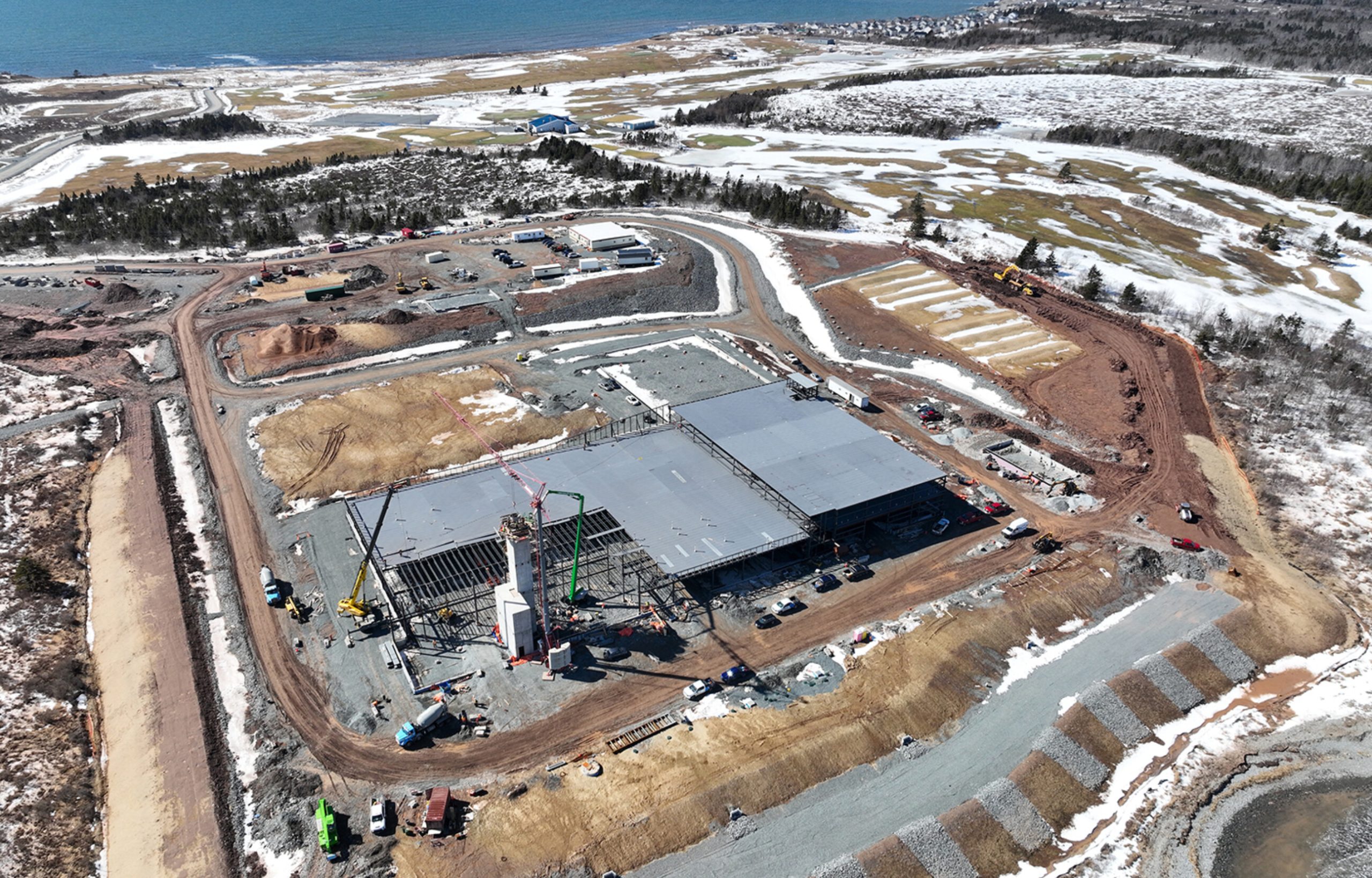
More importantly, Vigier’s second recommendation is for Canada to build a land-based integration and certification facility. Canada is already doing exactly that. The RCN opened its Aegis Combat System Integration Centre at the US Navy Combat Systems Engineering Development Site in Moorestown on 21 November 2024. That is where the River-class Aegis software is being developed and tested before delivery to Canada. The software will then go to the River-class Land Based Test Facility at Hartlen Point in Eastern Passage, Nova Scotia, for full combat system integration, testing, trials and training.
Construction of the Hartlen Point facility began in November 2025 and is expected to finish in early 2028. This is not a small laboratory hidden in an office park. It is a 12,567 square metre facility containing the ship’s combat system environment and a representative topside, with a 130 degree live transmission arc over the ocean. Its design progressed alongside the River-class specifically because the combat systems must be integrated and commissioned before they are installed aboard ship.
In other words, the supposedly missing shore capability is already under construction, while the dedicated RCN Aegis software centre has been operating for nearly two years.
The argument also confuses sovereignty with isolation. Canada will not receive unrestricted ownership of the entire Aegis source code, nor should anyone pretend that Washington will allow every allied navy to alter sensitive Aegis fire control software independently. Canada is buying into an operational Aegis enterprise used by the United States and several close allies because common baselines, certification and interoperability provide enormous military value. Cooperative Engagement Capability, integrated air and missile defence and access to continually developed threat responses are benefits of that relationship, not evidence that Canada forgot to read the software annex.
Hopefully this discussion does not now deteriorate into claims about American kill switches, Washington remotely disabling Canadian ships or Canada surrendering its sovereignty. These discussions too often become exercises in reflexive anti-American bias rather than serious examinations of software governance, configuration control and military interoperability. Canada should scrutinize its agreements and protect its interests, but dependence on allied technology is not the same thing as surrendering operational control.
Canada must still negotiate appropriate interface control, technical data, integration rights, cyber support, configuration management and assured access to future baselines. Those are entirely reasonable concerns. Canada does not, however, need the unilateral ability to rewrite every line of Aegis code to integrate Canadian equipment. It needs a clearly defined Canadian integration layer, certified interfaces, shore-based testing capacity and a durable arrangement for receiving and incorporating Aegis updates. Much of that architecture is already visible.
It is also entirely reasonable that the RCN could reconsider the combat system fit in later production tranches. The River-class will be constructed over several decades, during which technology, threats, budgets and alliance requirements will change. Later ships could adopt a substantially evolved Aegis architecture, a different combat management arrangement or potentially move away from Aegis altogether if another solution better meets Canadian requirements. The government could also limit the number of River-class destroyers and introduce a different surface combatant rather than building all 15 to an identical configuration. A planned class of 15 ships does not require every ship delivered over 25 years to be technologically identical.
That possibility makes sovereign integration capacity and open interfaces even more important. It does not prove that the current Aegis decision was wrong. The first River-class ships require a mature, supportable system capable of integrated air and missile defence now, not a hypothetical Canadian system that might become available decades from now.
The same caution should certainly be applied to the future submarine contract. Combat system integration rights, shore support, Canadian training, mission data, weapons integration and software sustainment must be negotiated before the contract is signed. But repeating that sound principle does not demonstrate that the River-class program failed to address it.
Vigier is correct that software will determine whether these ships remain effective in 2045. He is wrong to present that observation as something the Navy, DND and industry have somehow missed. Canada already has a Canadian combat systems integrator, a Canadian developed combat management pedigree, a dedicated RCN Aegis software integration centre and a major land-based integration facility under construction in Halifax.
The software bill is real. So are the facilities, contracts and Canadian engineers established to deal with it. The debate would be more useful if it examined whether those arrangements are sufficient.
Good afternoon Ted,
Thank you for providing this useful information.
How will the Canadian system compensate and be able to carry on should the US Department of Defense ever decide to no longer provide the RCN with Aegis updates and software fixes?
Ubique,
Les
Les,
I think you already know my answer. I’m unsure what your game is here but I’ll bite.
If the United States suddenly decided to abandon Canada, NORAD and one of its closest NATO allies by withholding contracted Aegis updates, Canada would have a serious capability and foreign policy problem. There is no magical Canadian software patch that makes the prime contractor, the US Navy and the entire Aegis support enterprise unnecessary. Nobody has claimed otherwise.
The RCN would continue operating the last supported baseline while Canada pursued contractual, diplomatic and technical remedies. Our sovereign CMS 330 elements, Canadian sensors, weapons interfaces and national networks would not simply evaporate, but replacing or independently sustaining the complete Aegis combat system would require time, money and a deliberate transition plan. That is the honest answer.
It is also an extraordinarily contrived scenario. The United States would have to decide that degrading the air and missile defence of Canadian warships integrated into NORAD and allied task groups somehow advanced its own security. It would simultaneously damage its defence industry, its export credibility and confidence among every other Aegis operator. Possible in the abstract? Certainly. So are an American withdrawal from NATO, a collapse of the Five Eyes partnership or Washington refusing to support virtually every other major US built system in Canadian service. Defence procurement cannot be based on whichever geopolitical apocalypse is fashionable online this week.
Every advanced combat system creates dependencies. Replacing Aegis with a European system would merely exchange American dependencies for European ones. The sensible approach is to negotiate access, sustainment rights, sovereign interfaces, data ownership and contingency arrangements while maintaining enough Canadian expertise to manage integration and any future transition. It is not to pretend Canada can reproduce the entire Aegis enterprise domestically or that choosing a less capable system somehow creates ‘sovereignty.’
Good morning Ted,
My “game” was seeking understanding of the RCN’s “residual” AEGIS capability, which I actually did not possess. You have provided it.
Thank you.
Ubique,
Les
Well it’s not going away so we better get used to using it. We structured a whole new trade around it.