By Jeff Gilmour, 26 August 2026
An article (“Out of the Shadows”) published in The Economist in July reported that last December, over 1,000 fishing vessels from China’s eastern seaboard lined up in an inverted L-shape in the seas north of Taiwan and held this formation for more than 12 hours and then dispersed.[1] Over the next four months, these fishing boats formed up again four times, in a similar formation, in the East China Sea.
As noted in this article, China is unusual in having three separate maritime forces at its disposal, the navy, the coast guard and its fishing fleet. These fishing boats are often sent to disputed reefs and islands to press China’s sovereignty claims. Chinese defence officials have praised this ‘third force’ as ‘irreplaceable’ based on its wide distribution, disguised identities, familiarization with the maritime conditions and knowledge of the areas.
Some fishing boats received subsidies and traded their role in fishing to become full-time militia, crewing large, steel-hulled vessels equipped with big water cannons and communications gear. Particularly in the South China Sea, they swarm around the shoals and reefs China claims, carrying out surveillance and harassing foreign vessels.
In 2015, CSIS, an American think-tank, counted 241 Chinese vessels it believes were militia fishing boats operating in the South China Sea region every day. This fleet shows a high degree of political control, which is unusual in a civilian fleet.
As noted in the article, in an invasion of Taiwan, this fishing fleet might help the navy with reconnaissance, logistics, and/or cutting undersea cables. As well, a large number of these vessels could impose a blockade on the island.
[1] The Economist, “Out of the Shadows” July 25, pp. 31& 32.
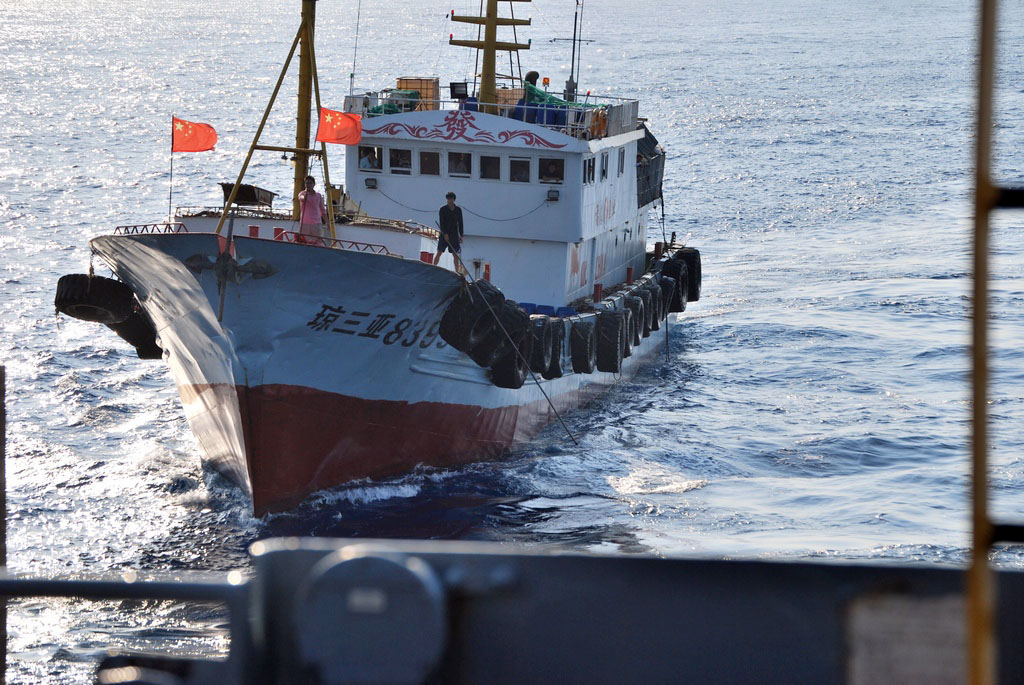
Image: (March 8, 2009) A crewmember on a Chinese trawler uses a grapple hook in an apparent attempt to snag the towed acoustic array of the military Sealift Command ocean surveillance ship USNS Impeccable (T-AGOS-23), 75 miles south of Hainan Island. Credit: U.S. Navy

One thought on “The PLA(N)’s Third Fleet”
Jeff raises an important issue, but describing China’s maritime militia as the PLA Navy’s “third fleet” risks understating what actually makes it effective. The People’s Armed Forces Maritime Militia is not simply a collection of fishing vessels waiting to become an improvised navy. It is a state organized and subsidized auxiliary force that operates alongside the PLA Navy and China Coast Guard while retaining the outward appearance of civilian maritime activity.
Nor should every Chinese fishing vessel automatically be labelled militia. China employs both purpose built professional militia vessels and commercial fishing vessels that can be recruited, subsidized and mobilized for particular tasks. CSIS research identified more than 120 specific militia vessels and assessed that roughly 300 suspected militia vessels could be operating around the Spratly Islands on an average day. Many are large steel hulled ships with reinforced construction, powerful water cannons, military communications and crews trained to operate under government direction. They may look civilian, but their coordinated behaviour is anything but normal fishing activity.
The formations observed in the East China Sea are especially significant. Organizing well over a thousand vessels into deliberate geometric formations, holding them there for hours and then dispersing them demonstrates command, control, communications and the ability to mobilize civilian shipping on a remarkable scale. That does not mean fishing boats could independently impose a militarily effective blockade of Taiwan. They are slow, vulnerable, lightly equipped and incapable of defeating a modern navy. Their value lies in creating mass, confusion and political hesitation while the PLA Navy and China Coast Guard provide the actual coercive power.
In a Taiwan contingency, these vessels could obstruct shipping lanes, complicate identification, report naval movements, move personnel and stores, lay obstacles, interfere with commercial traffic and force opposing commanders to distinguish between innocent fishermen and vessels supporting military operations. They could also serve as expendable physical barriers. Even forcing merchant ships to alter course or insurers to declare the area unsafe could contribute to a quarantine without China initially having to announce a conventional naval blockade.
That ambiguity is the real weapon. Beijing uses ostensibly civilian vessels to change conditions at sea while daring another country to be the first to use force against “fishermen.” Once a vessel accepts military tasking, conducts surveillance, carries military communications or deliberately obstructs another country’s operations, however, the civilian disguise should not grant it unlimited protection from the consequences of its actions.
There is also a Canadian lesson here. Maritime security is no longer divided neatly between warships and harmless commercial vessels. Canada needs persistent maritime domain awareness, intelligence sharing, clear legal authorities and enough RCN and Coast Guard presence to identify coordinated activity before a mass of civilian vessels creates a fait accompli. That applies in the Pacific, but it also has obvious implications for the Arctic and Canada’s approaches.
China’s maritime militia is not a substitute for the PLA Navy and it is not a conventional fleet. It is arguably more troublesome than either description suggests: a huge, state directed grey zone instrument designed to make aggression look civilian, collective action look accidental and an effective response appear disproportionate.