By Lee Matheson, 23 August 2026
Canada has selected TKMS and its Type-212CD AIP/lithium battery submarine as preferred supplier for the Canadian Patrol Submarine Project. AIP is a game changer for conventional submarines, but not, by itself, a game changer for Arctic operations. It extends submerged endurance, but not enough to cover Atlantic-Pacific transit distances through the Canadian Arctic Archipelago, once route uncertainty, ice conditions and block-ice maneuvering are factored in. At present there are no forward Arctic replenishment options for AIP reactants, and ice conditions can restrict or preclude snorkeling or surface transit for diesel operation.
The Strategic Need and the AIP Endurance Wall
For decades, foreign nuclear-powered submarines have garnered attention in Canadian Arctic waters. Canada’s previous O-boats and current Victoria class (conventional diesel-electric, lead-acid battery boats) have historically had limited Arctic capability, due to the engineering limits of their conventional propulsion.
The RCN’s planned Type-212CD AIP boats are a major step forward in stealth and underwater endurance. But AIP submarines remain constrained by stored reactants: for the Type-212CD, liquid oxygen (LOX) and hydrogen in metal-hydride assemblies. Unlike nuclear submarines, AIP endurance depletes continuously if used while submerged.
The Canadian Arctic has hundreds of miles of confined, ice-choked channels where, if surface transit is impractical, a conventional submarine is limited to underwater transit with its AIP system and batteries. This has historically confined non-AIP submarines to ice-edge chokepoints, ceding polar presence to nuclear powers. AIP does not remove the constraint as the Arctic exceeds AIP’s range. Without external logistic support, Arctic under-ice operation remains out of reach.
AIP reactants are normally replenished at specially equipped naval bases. Such replenishment for Canada’s Arctic-deployed submarines could come from a fixed Arctic base, a mobile support ship, or both. Of these, this author knows of no navy operating a mobile submarine support ship able to replenish AIP reactants at sea, likely because reactant stowage aboard a supply ship is complicated. A mobile base ship able to generate and replenish reactants could change AIP submarine deployment duration and range.
Commercial systems may exist that can both generate LOX and replenish hydrogen in metal-hydride assemblies. If so, embarking such systems on an Arctic-capable supply ship — given adequate power, water and safety provisions — could extend Type-212CD reach and Arctic presence considerably.
To provide such Arctic support, the RCN could examine a fixed Arctic base, a future Joint Support Ship (JSS)-derived hull, the conceptual Arctic Mobile Base concept, or the industry-proposed G-LAAM amphibious ship. Of the ship options, a Polar Class 2 (PC2)-certified variant with reactant replenishment capability could extend RCN submarines well beyond standalone range. Such a ship could include workshops, aviation facilities, medical support and additional temporary submarine crew accommodations for rest between patrols.
A flight deck could link to northern airfields for parts, medevac and personnel transfer; embarked drones could survey ice around the ship and any submarine on approach. Coast Guard icebreakers could support the ship as needed, clearing sheltered rendezvous points where natural polynyas are unavailable.
If RCN submarines carry low-profile SATCOM masts linked to a LEO constellation such as the proposed Telesat Lightspeed, a submarine could come to periscope depth at a polynya to confirm rendezvous details and obtain updated ice charts en route.
Investigation should assess whether a support ship can use commercial off-the-shelf modular systems — specifically, whether megawatt-scale PEM water electrolysis units paired with cryogenic liquefaction equipment, producing hydrogen and LOX, could be supplied as ISO-containerized modules within a support ship’s mission bays. The ship’s generators would need capacity to continuously generate and safely transfer high-purity LOX and hydrogen into a submarine’s storage during an Arctic rendezvous.
Conclusion and RCN Implications
Arctic sovereignty cannot rest on the assumption that AIP submarines can patrol the Arctic without logistics support. Meaningful subsurface presence across Canada’s northern approaches and the Northwest Passage, using platforms like the Type-212CD, could significantly benefit from pre-positioned logistical support.
For the RCN, I recommend giving serious thought to investigating the feasibility of Arctic AIP reactant replenishment, whether via fixed base, or auxiliary ship, or both. If practical, such a capability could be a strategic game-changer, turning the High Arctic from a barrier impenetrable to conventional submarines into an operationally accessible domain to Canada’s planned new submarines.
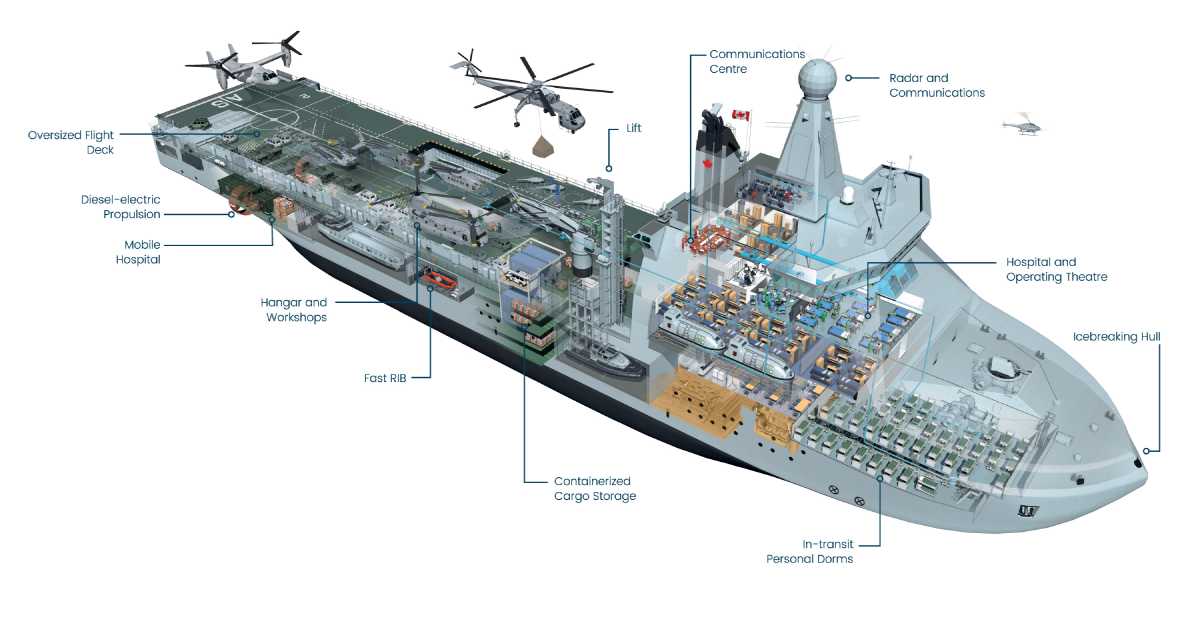
Image: The Global Logistics, Aviation, and Medical Support platform concept proposed by Davie includes an icebreaking hull for Arctic operations. Credit: Chantier Davie



14 thoughts on “Building Upon Sovereign Under-Ice Power”
Hello Lee. Be careful what you wish for. An Arctic Mobile Base (AMB) as conceptualized by VCDS Admiral Topshee in December 2025 in the Ready-Aye-Ready magazine (see below) seems to be exactly what Canada and the RCN need to support the TKMS 212 CD fleet. I would envision a fleet of 3-4 of these Polar Class 2 vessels that could be outfitted as Submarine Tenders to support the TKMS fleet.
https://readyayeready.com/canadian-navy-eyes-ice-capable-amphibious-landing-ships-for-arctic-defence/
David, that is quite a leap. Vice Admiral Topshee described a still conceptual Polar Class 2 amphibious ship able to move personnel, vehicles and supplies ashore without prepared port infrastructure. He did not propose a fleet of three or four Arctic submarine tenders, nor did he say the concept was designed to support Type 212CD submarines. You have taken one unfunded concept and bolted another unfunded concept onto it. As far as I know and I do know people, this is not being looked at either a Arctic Mobile Base or submarine tender. In the future perhaps.
A submarine tender is not created simply by putting workshops and a few tanks aboard an ice capable hull. Supporting a Type 212CD would require specialized facilities, trained technicians, spare parts, weapons handling, secure communications and safe storage and transfer systems for oxygen and other consumables. Performing those evolutions beside a submarine in moving ice, darkness and extreme cold would introduce risks and costs that are being conveniently ignored. Polar Class 2 describes the ship’s ability to operate in ice. It does not magically make every alongside submarine replenishment evolution safe or practical.
Canada’s priorities should be acquiring the submarines, training and retaining enough crews, rebuilding east and west coast submarine infrastructure, establishing maintenance and supply chains and actually generating operational boats. Somewhere far below those necessities sits the idea of building three or four enormous PC2 amphibious ships and turning them into floating Arctic submarine bases.
If occasional forward replenishment is eventually required, a properly equipped shore facility at Iqaluit or Nuuk, or even a far cheaper commercial support vessel meeting a submarine discreetly in a sheltered Labrador fjord, would be more practical than constructing an entire fantasy fleet of nuclear icebreaker sized submarine tenders. Canada has struggled for years to complete a seasonal fuel facility at Nanisivik. Suggesting that we now build three or four vastly more complicated floating bases and give our record of these projects not exactly stellar.
Ted. I Did Not Say that this “conceptualized” design would have a fleet of 3-4 Submarine Tender type vessels. Nor did I say that this design was an Admiral Topshee requirement for any AMB. If you assumed that, you would be incorrect and I would never knowingly put words in the Admiral’s thinking. A conceptualized design is just that, and nothing more. If you had looked at my reply to both Lee Matheson & Les Mader you would know that this PC-2 LHD (Arctic) concept would be a fleet of perhaps 4 LHDs/LHD (A) and would have at least 1-2 of these ships fitted out with a Submarine Tender component per coast (1 Reg LHD/1 LHD (A)). A fleet of 4 LHDs would most likely cost around $5B CAD per unit. A G-LAAM type vessel would not be what would be required for both Canada & the RCN. Yes, an eye-watering design concept that may very well surpass $20B CAD, but to have this capability over a 40 year life span will be well worth the effort.
Good evening Lee,
Thank you for the interesting idea that has potential.
Do you see the ship-based option being single role?
Ubique,
Les
Hi Les. I honestly don’t have a preference for shore based, or based on a dedicated submarine tender or on a multi-role ship. Rather it is just something I believe is best considered now during the current or subsequent tranche procurement negotiations with TKMS.
Why? I believe during the negotiations with ThyssenKrupp Marine Systems (TKMS) as the preferred supplier for the Canadian Patrol Submarine Project (CPSP), the Royal Canadian Navy (RCN) may have a potential window during current, or during subsequent tranche contract negotiations to address the operational enhancement of more persistent Arctic sustainment.
As noted, I think if it is desired to transform the Type 212CD from being an Arctic choke point defender into an Arctic capable patrol asset, Canada likely requires either a fixed base or a mobile, expeditionary Air-Independent Propulsion (AIP) replenishment capability in the Arctic. For a mobile approach, the RCN could assess the viability to include a dedicated contract option tasking TKMS to act as the Prime Systems Integrator and Certification Authority for a deployable, containerized Canadian AIP replenishment system – which might later be embarked in an RCN ship of choice – for potential future Arctic deployment.
Domestic Canada’s Industrial and Technological Benefits (ITB) framework
Under Canada’s Industrial and Technological Benefits (ITB) framework, this suggestion offers a possible mechanism for TKMS to fulfill some economic offset obligations. Canadian industry possesses mature commercial expertise in proton exchange membrane (PEM) water electrolysis, pressure swing adsorption (PSA) oxygen generation, industrial gas handling, and cryogenic liquefaction. Ontario, for example, has significant PEM electrolyzer expertise through the former Hydrogenics operation acquired by Cummins, alongside an established industrial-gas sector with cryogenic air-separation and oxygen-production capability. Under a speculated contract clause, Canada would develop and supply the expeditionary generation, storage and handling architecture, subject to a TKMS-defined submarine interface. TKMS would be contracted to retain design authority for the submarine-specific AIP reactant storage, conditioning and transfer interfaces, while Canadian industry would provide the shore side generation, storage, handling and containerized support infrastructure.
Naval Certification & Platform Interoperability
In essence my idea is a contract option would direct that TKMS manage and execute the formal naval safety, shock, and hazard certification (e.g., DNV / NATO STANAGs) for the complete containerized suite. Ideally the certification would extend beyond pier-side operation to cover embarkation and sheltered Arctic waters transfer across multiple Canadian host platforms such as (but not restricted to):
• Joint Support Ships (JSS / Protecteur class): Certifying the ISO-containerized modules for installation on the JSS upper deck or modular cargo bays, turning them into mobile AIP tenders capable of supporting forward-deployed Type 212CDs in sheltered Arctic anchorages. Such embarkation may or may not be feasible.
• Commercial / Dedicated Submarine Tenders: Establishing standardized ISO power, structural tie-down, and gas-transfer interfaces to allow rapid embarkation onto chartered or leased ice-strengthened auxiliary vessels without permanent internal hull modifications.
• Future Modular Amphibious/Logistics Vessels: Ensuring full structural and safety certification for integration into the modular container bays of potential future Arctic-capable logistics platforms (such as Chantier Davie’s proposed G-LAAM concept).
Operational Benefit for Canada
By securing this certified capability through TKMS, the RCN gains Arctic logistical agility. Individual container modules could potentially be sent to forward operating locations if such were to be established in the Arctic. This potentially provides the RCN with an Arctic AIP replenishment method, with the intent to allow Type 212CDs to replenish their LOX and hydrogen reactants near a marginal ice zone and return immediately to Arctic patrol without executing multi-week transits back to southern bases of Halifax and Esquimalt.
Trilateral NATO Interest (Germany & Norway)
This expeditionary approach may hold strategic value for Canada’s partners in the trilateral 212CD user group. The Royal Norwegian Navy may face similar high-north operational demands in the Barents Sea and around Svalbard, and could gain a deployable, dispersed logistics footprint capable of operating out of isolated fjords to mitigate the vulnerability of fixed bases like Haakonsvern. For the German Marine, adopting a NATO-standardized, containerized replenishment suite certified by TKMS could create a plug-and-play capability that may be embarkable on Berlin-class replenishment ships (EGV) to support expeditionary Northern Flank deployments. Establishing this architecture, initially within the Canadian contract, creates a shared, fully interoperable NATO logistics asset, with a long-term objective of allowing Canadian, German, and Norwegian supply ships to cross-replenish allied 212CD hulls across the North Atlantic and High North.
Hi Lee,
Thank you for your response and a valuable concept to which you have obviously given considerable thought. I hope that something like it comes to pass.
With regard to the shore- or ship-based options, I would simply mention that the ship-based answer would provide a more flexible, responsive, and harder-to-disrupt resupply solution – for both the AIP and other material, such as consumables – than a purely shore-based approach. I think that having both ship-based and some shore-based capabilities would be the best of all worlds.
Ubique,
Les
Another alternative, and very speculative Arctic Air Independent Propulsion (AIP) reactant replenishment concept to consider, is to see if it is credible to use a mix of already existing or planned Canadian Government assets to provide such, focused instead on the development of modular payload technology, rather than focusing on acquiring a brand-new class of ships.
Instead of a fixed Arctic base for AIP replenishment or a purpose-built polar auxiliary fleet ship, an alternative approach to assess could be to look at a combined “JSS + CCG Escort” approach, using ships Canada is already building.
This idea depends entirely on the feasibility of taking current Canadian commercial expertise to adapt and safety-certify existing commercial hydrogen/LOX generation containers, and create what could be a 3-container manufacturing suite (for water purification, hydrogen electrolysis, and LOX separation and cryogenic cooling), such that it can be used for mobile naval use, for a submarine AIP reactant replenishment.
The idea is these containers would temporarily be embarked on the open cargo deck of a Protecteur-class Joint Support Ship (JSS), exclusively for an Arctic deployment during part of the seasonal July-to-September window. This assumes the JSS has the deck space. When replenishing, the JSS would need to be stationary at anchor alongside a Canadian Patrol Submarine. I believe the JSS, as designed, has the necessary multi-megawatt generation of power needed to power the containerized reactant generation.
Because the standard JSS does not have a heavy hull ice rating, it is proposed that it would be accompanied by a Canadian Coast Guard (CCG) icebreaker. The CCG vessel’s task would be to clear a temporary open-water lane to and within a protected anchorage like Resolute Bay (for example), creating a safe, localized area in the Arctic for the JSS and the Canadian Patrol Submarine to conduct their alongside replenishment, away from drifting ice. Dependent on ice conditions, the CCG icebreaker wouldn’t need to remain in Resolute for the full July to September time window. It could be deployed nearby on its core commercial ice-breaking mandate, and returning on an as needed basis to clear the Resolute Bay area and guarantee open water to support the submarine’s arrival and ensure the JSS is not locked in ice. Given global warming and the seasonal selection, this could prove to be very doable. Similar it may be appropriate for the JSS and CCG Icebreaker to remain in the Arctic only for as long as necessary one or possibly two AIP reactant replenishments.
By having such, the Canadian Patrol submarine could have a sustained Arctic presence, during a large part of the July to September time frame.
The technical, safety, and institutional barriers here are not to be underestimated, and an investigation might well prove them not solvable. Furthermore, the summer season heavily stretches the CCG’s heavy ice-breaking fleet tasking. Any scheduling conflict between its typical Arctic mission and an RCN replenishment window to escort a JSS would need to be resolved.
Finally, with only two planned JSS hulls, that in itself likely makes this a non-starter today, as I suspect neither can be spared from RCN surface fleet support. However, if an operational analysis proves that containerized, mobile Arctic reactant replenishment is practical, this concept could provide a further justification (to already good justifications) for Ottawa to fund an additional one or two hulls for the JSS “production line”.
This also shifts the concept away from building a new ship for AIP reactant replenishment to instead maximizing the modular utility of the ships the RCN already has planned.
Clearly there are a lot of ‘ifs’ in this speculative concept – where such a concept could be studied. But I believe there are advantages if financially, technically and institutionally feasible.
Hello Les. I could not help but address your question to Lee. If, and only if, VCDS Admiral Topshees’ “conceputalized” Arctic Mobile Base (AMB) comes to pass with a fully funded project, this ship design will not just be a one-shot Polar Class 2 AMB just for our new TKMS 12 fleet Submarine-Tender style vessel of 3-4 ships. They will also be a very effective command and control, and Humanitarian Assistance/Disaster Relief (HA/DR) and yes, a very good LHA/LHD type ‘carrier’ for troop transport as an Amphibious Assault Ship as well. They could have the ability to safely store liquid oxygen (LOX) and hydrogen metal-hydride assemblies to replenish the TKMS Type 212 CD AIP Reactants, including workshops, aviation facilities, full medical/dental support/field hospital facilities and additional temporary submarine crew accommodations for rest between patrols.
This ship would also have enough flight-deck/below-deck space for various types of helicopters linking to northern airfields for parts/medevacs and personnel transfers, with ship-to-shore connectors. One other important vessel it must carry, is a NATO equipped Rescue Submarine. The ship’s generators would also need enough capacity to safely transfer high-purity LOX and hydrogen into the subs’ storage during AMB/SUB Arctic rendezvous. This AMB vessel as a PC-2 vessel will be well north of 30,000+ tons, over 200 meters long, a beam of 30 meters and a draft of around 7 meters with bow thrusters fore-aft. It will have a Gas Turbine engine and twin shafts with 2 DG’s with top speeds of 26+ kts and cruise at 15 kts. It should have dual RAM 116 fore-aft with 16/32 MK 41 VLS for air defence, 2 X 4 NSMs, and various UUVs and UAVs (possibly Skeldar V-200) drones. A crew size of 200+ with room for at least battalion strength with a full load of vehicles.
Hi David,
I very strongly share your belief in the value of such a ship.
My concern is that 3-4 LHD(A)s such as you describe would be too expensive to purchase and own for the RCN. I believe that a mixed fleet of LPAs and LSI(A)s that have as many of the capabilities that you seek as possible would be the best achievable solution. Even it would be a very significant investment and effort for the RCN to bring to fruition.
Clearly, though, buying the Type 212CDs without a resupply capability such as Lee has described would greatly limit their strategic utility.
Ubique,
Les
Les, that question goes directly to the central weakness of the proposal. If these Polar Class 2 vessels are single role submarine tenders, then Canada would be buying three or four extremely expensive, highly specialized ships to support a future submarine fleet during an occasional and still largely theoretical Arctic requirement. If they are made multi-role, then the submarine support equipment, cryogenic systems, workshops, stores, accommodations and safety arrangements must compete with every other mission for space, weight, crew and funding. The result would likely be an oversized, overcomplicated vessel that performs several tasks but none particularly efficiently.
Before contemplating a fleet of polar submarine tenders, Canada still has to acquire the submarines, build trained crews, establish shore infrastructure, develop maintenance capacity and restore a sustainable submarine service larger than four boats. Arctic replenishment ships belong near the bottom of that priority list. A modest commercial support vessel operating from an existing port such as Iqaluit or Nuuk, with containerized equipment and the ability to meet a submarine discreetly along the Labrador or Greenland coast, would probably provide most of the practical benefit at a fraction of the cost. Calling an expensive ship “multi-role” does not make the underlying requirement any less speculative.
Good afternoon Ted,
Clearly, the RCN needs to focus its near-term energies on getting the Type 212CD SSK(A)s, DDGHs, and CDCs into service properly. However, the real challenges posed by such an implementation effort do not give the navy and CAF permission to avoid thinking about the future.
Therefore, I hope that someone is already developing plans for:
– the shape of the fleet for which we will start contracting once the DDGHs, AORs, CDCs, and SSK(A)s have begun joining the AOPS in service.
– addressing, earlier rather than later, the real issue that Lee has raised about resupplying the SSK(A)s in the Arctic with at least the ‘fuel’ needed by their AIP systems.
Ubique,
Les
Les,
I think you and Lee are confusing prudent future planning with the premature adoption of an unproven logistics concept.
Of course the RCN plans beyond the Type 212CD, River-class, JSS, CDC and AOPS. However, that does not make Arctic AIP replenishment a “real issue.” It remains a hypothetical requirement that neither of you has demonstrated. The submarines have not yet entered service, their final Canadian configuration and concept of operations are still being developed, and no evidence has been presented that they will need AIP reactants replenished while deployed in the Arctic.
You appear to be starting with the proposed solution, mobile Arctic LOX and hydrogen replenishment and working backwards to manufacture the requirement. That is not sound force development.
If operational analysis eventually establishes a need for forward AIP replenishment, the RCN and TKMS will address it. Until then, repeatedly describing Lee’s speculation as a “real issue” does not make it one.
Good afternoon Ted,
I am not sure of the steaming distances involved but it seems to me that a round-trip SSK(A) patrol from Halifax into the Canadian Arctic and back would be similar in distance traveled to a major overseas surface ship deployment. Those deployments benefit normally from friendly ports for refueling/resupply and we still argue for the requirement to have AORs. A similar patrol from Esquimalt would be far longer. Given that full AIP ‘tanks’ provide greater endurance and operational flexibility, I cannot understand why the need to be able to provide AIP resupply (at least) in the Arctic is even questioned.
The shape of that resupply could be shore-based (Iqaluit?), significant ships such as David Dunlop has suggested, smaller AO(A)s such as you mentioned, or a combination.
Ubique,
Les
Hi Ted.
I think you are on the right track to ask about the requirement. I believe that then leads to the question, is there a need for Arctic deployment of the Canadian Patrol Submarine? So, independent of any views I may have, I asked myself, what is the Canadian government and the Canadian military saying in meetings and press releases? In truth, there are many more references than what I can include in the number of words allocated to a CNR Broadsides post but here are some:
There are general words in Canada’s 2024 defence policy, “Our North, Strong and Free” such as :
“Submarines allow Canada to covertly detect and deter maritime threats, control our maritime approaches, and project power and striking capability further from our shores, at a time when Russian submarines are probing widely across the Atlantic, Arctic and Pacific Oceans and China is rapidly expanding its underwater fleet.”
Further, the Canadian government’s 2024 submarine announcement ( https://www.canada.ca/en/department-national-defence/news/2024/07/canada-launching-process-to-acquire-up-to-12-conventionally-powered-submarines.html ) states: “Canada’s key submarine capability requirements will be stealth, lethality, persistence and Arctic deployability – meaning that the submarine must have extended range and endurance.” and later regarding submarines it states “Canada can detect, track, deter and, if necessary, defeat adversaries in all three of Canada’s oceans.”
Then the January 2026 Deputy Minister of National Defence transition material ( https://www.canada.ca/en/department-national-defence/corporate/reports-publications/transition-materials/welcome-package-deputy-minister-nationa-defence-january-2026-supplemental.html ) says: “We are renewing its submarine fleet to enable the RCN to project a persistent deterrent along our North, East and West coasts, with under-ice capable submarines.”
and
“The next fleet of submarines must meet a three-ocean requirement. The fleet will be capable of conducting operations in the Indo-Pacific region, executing NATO missions in the North Atlantic, and enduring sustained operations in the high Arctic.”
Also worth pointing out is that in December 2025, DND told the Standing Committee on National Defence ( https://www.canada.ca/en/department-national-defence/corporate/reports-publications/proactive-disclosure/2026/nddn-supplementary-estimates-b-december-4-2025.html ) where under the document’s “NATO Investment Pledge” section, there is the point “Major investments range from modern aircraft to submarines capable of patrolling our three coastlines.”
From that document:
“The next fleet of submarines will project a persistent deterrent on all three coasts with under-ice capable, conventionally powered submarines.” and further “This means that the fleet will be capable of conducting operations in the Indo-Pacific, executing NATO missions in the North Atlantic, and conducting sustained operations in the High Arctic”.
Then there is the July 2026 Government of Canada CPSP backgrounder which says the submarines will:
“ensure a sustained presence in the Atlantic, Pacific and Arctic oceans.” and “Maintaining a sustained Canadian presence in the Arctic.
…
This means that the fleet will be capable of conducting operations in the Indo-Pacific, executing NATO missions in the North Atlantic, and conducting sustained operations in the High Arctic.”
and
“The renewal and expansion of the submarine fleet will contribute to defending Canada, the Arctic, and the collective defence of North America.”
Under the CPSP section it states:
“The key submarine capability requirements will be stealth, lethality, persistence and Arctic capabilities, meaning that the capability will have extended range and endurance.”
I am running out of the allocation in words for a Broadside’s post. But I think I made my point — these top level government documents and announcements refer to sustained operations in the Arctic, including under-ice operations, where the Canadian Patrol Submarine is included in that sustained Arctic operation description. Those documents don’t state the submarine should not enter the Arctic, nor do they suggest only resting at a couple of choke points to/from the Arctic (via Atlantic/Pacific) which others have proposed. Note that Russia need not transit those choke points to enter the Arctic.
Given these are to be Air Independent Propulsion (AIP) submarines, and given the limitations of AIP, it leads me to believe that “maintaining a sustained presence in the Arctic” is not credible with these AIP submarines, without some form of AIP reactant replenishment in the Arctic.
That is how I interpreted requirements and statements made regarding potential Arctic presence which supports the case for Arctic replenishment.