By Les Mader, 24 March 2026
The Broadsides Forum post of 18 February 2026 at the link below strongly called into question my suggestion that Canada should consider the United States of America (USA) as a potential security threat and prepare to be able to resist military coercion by it.
The resultant, limited discussion led to a de facto understanding that it was not changing anyone’s mind and that an agreement to disagree would be appropriate. This understanding occurred just as the 2026 Iranian War started.
The outbreak of this war has provided new information that is relevant to the original discussion. Specifically, the Iranian war has shown that:
- A President of the USA (POTUS) can launch an expensive (Link 1 below), world-impacting (Link 2 below) conflict/war based on the sketchiest of strategic planning (Links 3 and 4 below) and with unrealistic expectations about the war's key goals being met “… in as little as “two or three days.”” (Link 5 below).
- Militaries can always find the needed individuals to start a shooting war, even if the required actions are morally questionable.
- Once started, wars take on an unpredictable logic of their own, in part because “the enemy gets a vote on how they will unfold” (Link 6 below). Thus, the war’s initiator cannot simply stop the fighting whenever they want; events often spiral significantly out of control, especially once deaths have occurred.
Trump’s conduct of the Iranian war as POTUS has been so chaotic that a wise and very knowledgeable person recently told me “[With respect to Iran] ... we've entered an alternative universe. Trump obliterated Iran's nuclear weapons in June and yet he had to go to war because of Iran's nuclear weapons; right now Iran's military has been decimated, but the US/Israel need to keep bombing; the Iranian people should rise up and replace their government, but the US should pick the new leader; the US won't hit energy facilities but, wait, it might just "for fun"; the US has the Strait of Hormuz under control but NATO countries will suffer the consequences if they don't help in the Strait of Hormuz ...”
I feel that all of the above is extremely relevant to any discussion about the potential for an American threat to Canada. Unless the USA radically curtails POTUS’ power to launch military conflicts by themselves, Canada will always have to worry about some POTUS deciding to apply the “Donroe Doctrine” to it and conducting “quick military excursions” to gain advantages or to “punish” Canadian actions.
Such military excursions could involve (among other options):
- “Quarantining” Canada’s coasts to stop its seaborne trade.
- Intervening physically in Canadian politics, perhaps in the context of a failed provincial separation referendum.
Given such a possible future, I believe that the Canadian government and the CAF leadership must consider how to deal with such risks, even if they seem implausible at any given moment, and make appropriate (and extremely discrete) preparations. POTUS come and POTUS go and we have no control over how wise, competent and stable each new one is.
Link 1: White House seeks $200bn in military funding in wake of Iran war
Link 2: Wary allies show there's no quick fix to Trump's Iran crisis
Link 3: Inside Trump’s decision to attack Iran and the scramble to contain the fallout | CNN Politics
Link 4: Analysis: Trump demands help from European allies to resolve Strait of Hormuz crisis | CNN Politics
Link 5: An air power expert explains why Iran is more powerful now than before the war
Link 6: Analysis: Trump faces legacy-defining dilemmas in Iran | CNN Politics
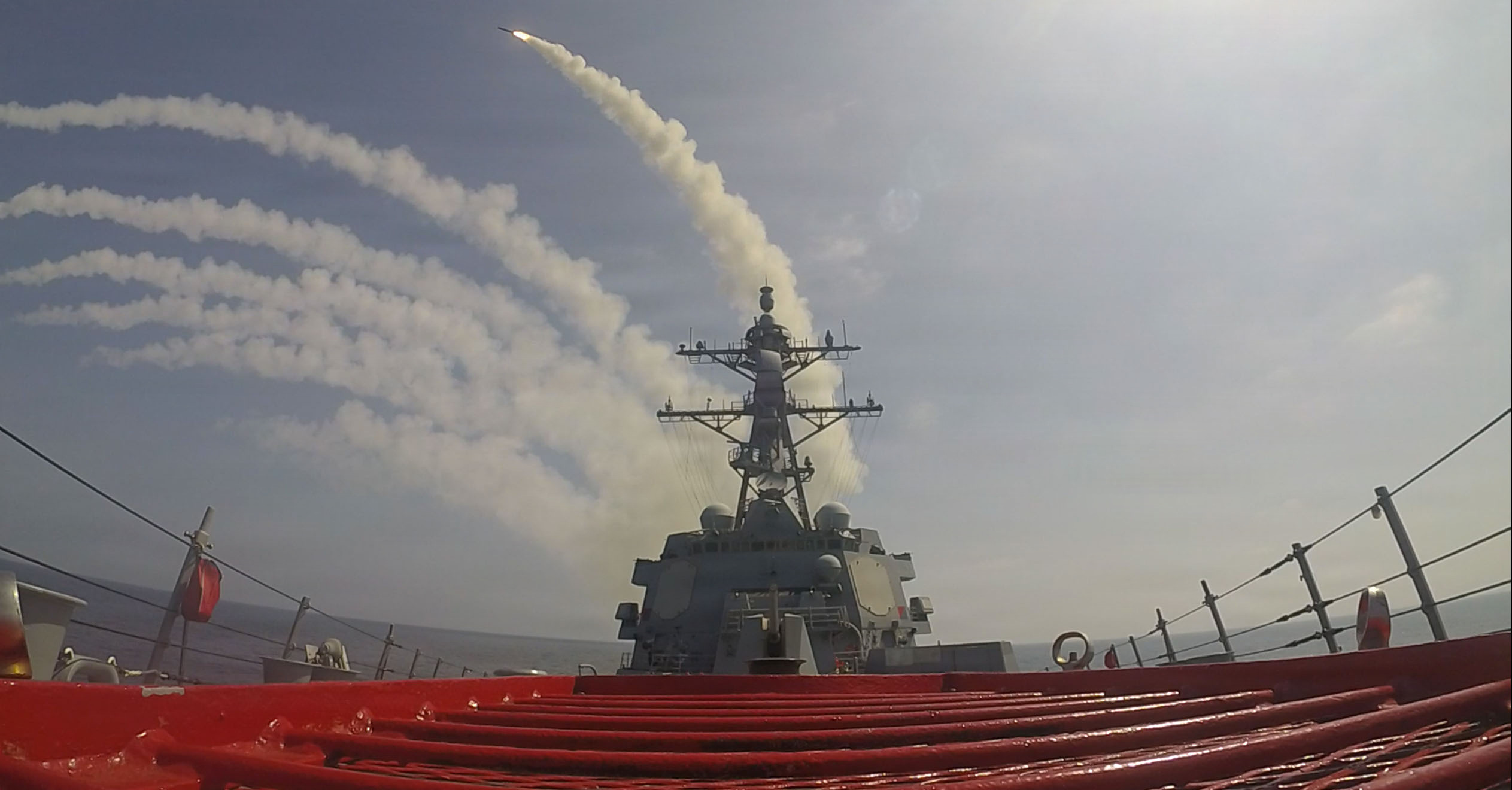
Image: Arleigh Burke-class guided-missile destroyer USS Frank E. Petersen Jr. (DDG 121) fires a Tomahawk Land Attack Missile during operations in support of Operation Epic Fury, Feb. 28, 2026. (U.S. Navy Photo)



18 thoughts on “Never Say Never: A Lesson for Canada from the Iranian War”
Ahhh Les, the reason I didn’t post anything further earlier is simple: like me, your mind isn’t going to be changed. But here we are again.
I base my views on actual experience, not hypotheticals. Recent, real world interaction with American forces. Ongoing operations like Op CARIBBE. Canadian sailors training on AEGIS systems in the United States and military members in the US for coursing including military war colleges. Hundreds of CAF members embedded across US bases. NORAD. US 2nd Fleet, with a Canadian Commodore serving as Deputy Commander no less. Constant port visits, joint exercises, shared taskings. I was in New York myself just weeks ago for a port visit, great time, great people.
You consistently downplay all of this, but this is the reality of how Canada operates. We are not orbiting the United States, we are integrated with them at every operational level that matters.
I’ll give you this much. Canada, like any competent military, develops contingency plans. That’s what professionals do. You plan for everything from the plausible to the highly unlikely. And yes, that includes scenarios involving the United States. We’ve done it before, and we almost certainly still do it today. That reality even surfaced in the media recently.
But here’s the part you’re missing. There is a massive difference between having contingency plans on a shelf and building your force structure around them.
We are not designing fleets, procurement programs, or national defence policy around the idea of US aggression. We are not out here proposing “tripwire corvettes,” fantasy deterrence schemes, or boutique capabilities aimed at our closest ally. That’s not strategy, that’s misallocation of already limited resources.
Now let’s get to the core of your argument.
Comparing a volatile Middle East conflict to some hypothetical US military move against Canada isn’t strategic insight, it’s narrative building. The United States is not sitting offshore waiting to “quarantine” Canada. It is our closest military partner, our NORAD co-commander, and the backbone of nearly every serious operation the Canadian Armed Forces has conducted in decades.
Yes, the Iran war wasn’t ideal. Wars rarely are. But are we seriously suggesting the world’s most capable military should just sit back while Iran destabilizes its region and brutalizes its own population? At least the US acted. You may not like how, but action versus inaction is still a choice, and one with consequences either way.
Where your argument completely breaks down is in the leap from “wars are unpredictable” to “Canada must quietly prepare for US coercion.” That ignores the most basic principle of defence planning: intent matters. There is no credible intent, no posture, no strategic logic supporting US military action against Canada. What does exist is deep, structural integration.
A US “quarantine” of Canadian coasts? That would cripple their own economy, fracture NORAD, and destabilize NATO’s North Atlantic. That’s not coercion, that’s strategic self-harm. The same goes for intervention in Canadian politics. If we’re there, the entire Western alliance has already collapsed, and no quiet Canadian contingency plan is going to save the day.
Meanwhile, this kind of thinking distracts from actual defence priorities. The Royal Canadian Navy doesn’t need to prepare to fight the US, it needs ships, submarines, sustainment and readiness to operate alongside them and other allies in real contested environments.
Professional militaries plan quietly. They assess risk soberly. And they prioritize based on what is credible, observable and likely. So yes, plans exist. They always will. But confusing contingency planning with actual defence policy? That’s where this argument goes off the rails.
You want a lesson from recent conflict? Here it is:
Wars are messy. Alliances matter. And confusing your closest ally with a threat is how countries get it badly, badly wrong.
Canada doesn’t need to prepare for war with the United States.
Canada needs to get serious about being a credible ally within the system that actually keeps it secure.
Les Mader is absolutely right and plans for a future that is very different from the present. Ted Barnes is wrong and lives in the distant past when the USA was just a very right wing, violent country but had not yet gone over the extremist edge. Any country that has a political system as dysfunctional as the USA, and any country that would even allow a Donald Trump to get close to being on the ballot, is a country that must be quickly put in Canada’s rear view mirror. The USA has, for 40 years, been building to achieve its current status as a violent, failed democracy. The entire modern wealthy world is dumping the USA as fast as they can. Failed “empires” going down in flames lash out at anyone within range. The good old days are still with us so Canada had better get moving. The USA is still a threat to Canada https://www.youtube.com/watch?v=LEVOgu9AOBk&t=36s .
Canada’s entire defence posture, from NORAD to NATO to day-to-day naval operations, is built on cooperation with the United States. That’s not nostalgia, that’s current reality. Canadian sailors train with the US Navy, embed in their commands, operate their systems, and deploy alongside them routinely. You don’t throw that out because of personal political grievances or YouTube rabbit holes.
And this idea that “the entire modern wealthy world is dumping the USA” is just flat out nonsense. If anything, the opposite is happening. Allied integration is increasing, not decreasing. NORAD modernization, joint Arctic surveillance, shared satellite capability, AEGIS training pipelines, carrier strike group integration, you don’t get more intertwined than that. Canada is not putting the US in the rear view mirror. We’re bolting ourselves tighter into the same operational framework because that’s what serious countries do when facing real threats.
You’re not being forward thinking. You’re being argumentative because your PMSV concept has gone nowhere.
You’ve spent months pushing a vessel that has no validated design, no costed program, no survivability case, no crewing model, no procurement pathway, and zero institutional backing. And every time someone asks for actual numbers or engineering, you pivot into philosophy, innovation slogans, or now apparently geopolitical rants about the United States.
That’s not naval planning. That’s deflection.
And here’s the part that really undercuts your entire argument.
For someone now claiming Canada needs to distance itself from the United States, you had absolutely no issue leaning on American support when it suited your own project. Your oil spill technology history highlights testing at the US Navy’s Ohmsett facility, participation with BP’s US-linked programs, and collaboration with American institutions.
So which is it?
The United States is a dangerous failed state we must avoid, or a critical partner when you need validation, facilities and credibility for your own work?
You can’t have it both ways.
The reality is simple. Canada works with the United States because it benefits Canada. Operationally, industrially and strategically. The same logic applied when your spill recovery concept needed testing and exposure. You understood that then, even if you don’t want to admit it now.
Bottom line, this isn’t about living in the past. It’s about refusing to accept that your PMSV idea hasn’t stood up to scrutiny, and instead of addressing the gaps, you’re dragging the conversation into places that have nothing to do with credible naval capability. You want to be taken seriously? Then bring numbers, designs and evidence.
Until then, this isn’t strategy. It’s just noise.
Regarding “You don’t throw that out because of personal political grievances or YouTube rabbit holes”. This is very true. However, Canada has already thrown all that undeserved “trust” out the window. The USA is today a treacherous threat led by a demonstrably unhealthy, incompetent “Commander-in-Chief” who has just driven his country over yet another cliff in the Middle East. A world-class proven loser (how many bankruptcies, impeachments and court losses so far, and still counting?). With a friend like that, what could go wrong? On top of that, American weapons systems today are poorly-performing nightmares (1.7 Trillion USD and unable to fly 50% of the time https://fortune.com/longform/lockheed-martin-f-35-fighter-jet/ ). For the navies of the world, the USA has produced the Littoral Combat Ship fiasco. Maybe Canada can buy the Trump battleship. It’s probably going cheap by now. Are there still people in Canada who want to buy American defence systems? If so, why? The entire world has seen how poorly they perform, and how terrible the value. Thankfully, the world no longer needs US weapons so there is no need to buy these hyperexpensive products. Canada is rapidly switching to increasing its own defence industrial base and buying from trusted allies. There is no longer any reason to buy from today’s untrusted countries that are threatening Canadian sovereignty (USA, Russia, China). It’s worth noting that YouTube consists of more than rabbit holes. The accurate ones are freely available if you look for them: https://www.youtube.com/watch?v=Vl_0sW_F_2s
https://www.youtube.com/watch?v=GnkCbiOl3v4
(also see Argonne National Laboratory, below, https://www.anl.gov/ )
Regarding: “Allied integration is increasing, not decreasing”. True, but only increasing with our trusted allies. Severing ties with the now-untrusted USA is a slower process, similar to watching the ebbing and flowing of tides. During the transition period, the water level level does not appear to be changing for an hour or so, but when movement becomes visible, it is already well underway and rapidly accelerates.
Regarding: “We’re bolting ourselves tighter into the same operational framework because that’s what serious countries do when facing real threats”. To be accurate, that should read “We’re bolting ourselves tighter into new and different operational frameworks because that’s what serious countries do when facing real threats like the USA”.
Regarding: “You’re being argumentative because your PMSV concept has gone nowhere”. On the contrary, I am very pleased with the rate of progress of the PMSV. Rome wasn’t built in a day and significant innovations usually take years and decades. Even with the immense resources of NASA and the global aircraft production industry, it took until the 1980s for “winglets” to begin to be used even though they were first described in 1897 and pioneered by NASA engineer Richard Whitcomb in the 1970s. Now they are an essential, permanent feature in modern aviation https://flywith.virginatlantic.com/il/en/stories/wonder-winglets-things-end-wings.html#:~:text=It%20was%20some%20time%20back,the%20end%20of%20the%20wing.
Regarding: “You’ve spent months pushing a vessel that has no validated design, no costed program, no survivability case, no crewing model, no procurement pathway, and zero institutional backing”. All true. None has been addressed because none of it is related to innovation that has just been freshly created on a mess deck napkin, where 99.9% of true innovation begins. Let’s stop wasting time on issues that rightfully lay in the product development and engineering phase. Of course, I recognize that people lacking adequate imagination cannot participate in the very early stages of innovation. Those people are best served by listening and learning.
Regarding: “And every time someone asks for actual numbers or engineering, you pivot into philosophy, innovation slogans, or now apparently geopolitical rants about the United States”. You are right to want to want to see actual numbers or engineering, but the Comments section of RCN’s Broadsides is not an appropriate venue. However, I can refer you to some numbers. My name is on this article, which you can download: https://asmedigitalcollection.asme.org/offshoremechanics/article-abstract/137/2/021301/376511/Hydrodynamic-Simulation-and-Optimization-of-an-Oil?redirectedFrom=fulltext
Here are the official test results on my prototype tested at Ohmsett: chrome-extension://efaidnbmnnnibpcajpcglclefindmkaj/https://www.spilltechnology.com/Ohmsett_tests.pdf
Here is my $400,000 prototype being tested at Ohmsett in 2012. The vessel was later delivered to CCG under the first tranche of funds from the Canadian Innovation Commercialization Program (CICP) program:
– https://funding.ryan.com/blog/government-funding/cicp/
– http://www.spilltechnology.com/videos/Ohmsett_EST_12m.mp4
– https://www.youtube.com/watch?v=L4s-icPHd8Q
On May 20, 2014, CCG Deputy Commissioner Jody Thomas wrote that my Ohmsett prototype “… is an essential piece of response equipment that we maintain in Atlantic Canada”. She was responding to BSEE in Washington who wanted to view the vessel. I have her signed letter, available for viewing upon request https://www.cigionline.org/people/jody-thomas/ .
Regarding: “So which is it? The United States is a dangerous failed state we must avoid, or a critical partner when you need validation, facilities and credibility for your own work?” . The timeline is important here. I worked with Americans in 2012, both at Ohmsett and in Mobile, AL, after I gave this interview https://www.youtube.com/watch?v=ZmkfGoeSki4 . In early July I flew to Mobile, AL, incorporated SP Tech, and built a 6m demonstration vessel for BP. I was president, my two business partners were Greg Friedlander (lawyer) and Tommy Marr Jr (real estate). Their fathers were law partners: Marr & Friedlander https://news.ua.edu/2011/03/ua-honors-five-distinguished-engineering-fellows-4/ .
SP Tech’s office was in the head office of DRC in Mobile https://www.drcusa.com/ . The demo vessel for BP was built in the Mobile factory of RPC in Mahone Bay, NS https://rpscomposites.com/ . Within days of BP witnessing the test of our SP Tech demo vessel, SP Tech was invited into BP’s High Interest Technology Testing (HITT) program:
chrome-extension://efaidnbmnnnibpcajpcglclefindmkaj/https://apps.dtic.mil/sti/tr/pdf/ADA590644.pdf
My company signed an NDA with https://www.anl.gov/argonne-national-laboratory to help develop their innovative oil spill technology https://www.youtube.com/watch?v=zCx5bzLlRmc .
I could go on and on about innovation projects with Americans but it all crashed to a halt when Trump was re-elected in 2024. Out with the old, in with the new. Canada’s new trusted allies agree. I have also been working with Canada’s new trusted allies. This is from my website (XXXX):
“In 2015: XXXX technology was asked to join a European consortium assembled to participate in the EU-funded H2020-BG-2015-2, offering Euro 36,000,000 to produce new oil spill technology for the ocean. Although EU funding for this initiative was suspended before our application could be submitted, we anticipate ongoing collaborations with this Consortium because XXXX was brought on as a key contributor of technology. Consortium partners included the Center for International Climate and Research (Norway), Thyssen Krupp Marine Systems (Germany), Université Pierre et Marie Curie (France), Hamburg Ship Model Basin GmbH (Germany), Imperial College London (UK), Center for Naval Analyses (USA) and 15 other institutions. The project lead was Professor Peter Wadhams of the University of Cambridge, UK https://www.damtp.cam.ac.uk/user/pw11/ .”
Also on the website:
” Nov. 2015: XXXXX invited by Natural Resources Canada to submit a full proposal to enhance EST/NST technology for the recovery of diluted bitumen.
Feb. 2019: State of California-Chevron invite XXXX to present at the Oil Spill Response Technology Workshop.”
David Prior made 2 typos:
1) Regarding “Here are the official test results…”. It should read: https://www.spilltechnology.com/Ohmsett_tests.pdf
2) Regarding “HITT”. It should read: https://apps.dtic.mil/sti/tr/pdf/ADA590644.pdf
You had no issue working with the Americans when it suited you, taking their facilities, their validation, their partnerships, and their credibility when you needed it. But now that things didn’t pan out the way you hoped, suddenly the entire United States is a “failed state” and every piece of equipment they produce is junk. That’s not analysis, that’s revisionist bitterness.
Your argument collapses under its own weight the moment you step outside your own narrative. You claim American systems are universally poor performers while simultaneously citing cherry-picked talking points and YouTube links as if that substitutes for operational reality. Meanwhile, allied navies including Canada’s continue to integrate, train and deploy alongside US forces every single day because in the real world, interoperability, logistics and capability matter more than internet talking points. The same goes for your PMSV concept, which still exists entirely in the realm of imagination with no validated design, no procurement path and no institutional backing. Invoking winglets and NASA doesn’t elevate it it just highlights the gap between actual engineering programs and ideas that never leave the napkin.
And this whole “Canada is abandoning the US” line is pure fiction. Canada is diversifying procurement and strengthening its own industrial base, yes but that’s about resilience, not divorce. NORAD still stands, NATO still exists and Arctic cooperation is increasing, not collapsing. You don’t walk away from your largest trading partner, closest military ally, and primary continental defence partner because of political swings — you adapt, you hedge and you contribute more. Serious countries don’t burn bridges because of personal frustration. They build capability, strengthen alliances and stay relevant.
Good afternoon Ted,
Thank you for your thoughts. You raise some interesting ideas that merit discussion. However, you have not addressed my point.
The American constitution makes POTUS a real military commander-in-chief, not a titular one like King Charles III, our Governor General, Ireland’s president, and Denmark’s Frederik X (among many examples). One has only to remember Lincoln’s repeated firing of generals during the American Civil War to understand the reality of this power. I would argue that the exigencies of the Cold War’s Mutually Assured Destruction doctrine increased the significance and reality of POTUS’ authority; when only minutes existed to respond to a perceived nuclear attack, POTUS got to decide what to do.
The continued existence of POTUS’ personal military authority has been repeatedly demonstrated during numerous real-world events – such as Lebanon 1982/83, Grenada 1983, Libya 1986, Panama 1989, Caribbean 2025 and 2026, Venezuela 2026, and Iran 2026 – and abundantly reinforced in popular culture through countless books and films.
Whatever the merits of taking action against Iran, the current American attack is not noteworthy for either its strategic coherence or thoughtful execution. It increasingly seems to be the fruit of Trump’s personal biases, hubris, and “stable genius;” he now needs to find a way out of his mess where his usual tactics of mendacity and deflection will not work.
Trump was able to launch these shambles, essentially on his own, without any American institution seemingly planning to hold him to account, and leave all the rest of us to live with the consequences. This level of freedom to launch wars harkens back to the age of absolute rulers who personally started them whenever the mood struck them. I am not sure that the American political system will be able/want to put real curbs on this presidential power.
Therefore, I firmly believe that, as the USA continues its inexorable, relative decline as a great power, Canada will have to worry about some POTUS having a similar set of personal biases, hubris, and “stable genius” against it. We are certainly far more valuable than Iran and much closer. And, “quick military excursions” are so attractive!!!!
Thus, I continue to believe that Canada must look to its own defences, build up its economic, political, and military strength, and make discrete preparations for American coercion, all while navigating an increasingly fraught relationship with the USA.
WRT your reply of 27 Mar 26 to Dan Middlemiss:
– There is no reason to believe that “we’d be sitting today with more influence, more leverage, and likely an even stronger economic relationship, not a weaker one [with the USA] if “we had been consistently pulling our weight, meeting commitments, investing in capabilities, maintaining stockpiles, building industrial capacity.” Ask the ~1,000 allied dead in America’s wars in Iraq and Afghanistan how much influence and leverage their deaths bought with Trump.
– Alliances don’t weaken simply when one partner stops carrying their share of the load. They can also metastasize when the major/dominant member no longer sees them as an alliance but rather as an empire. The conversion of the anti-Persian Delian League into the Athenian Empire is the classic example of such a process. I believe that Trump views NATO and NORAD the same way.
Ubique,
Les
Alright Les… you’ve wrapped a real concern in a fundamentally flawed understanding of how the system actually works.
You keep leaning on the idea that the US President is some kind of unchecked, quasi monarchical warlord. That sounds compelling until you remember one inconvenient fact. The US Constitution deliberately split war powers to prevent exactly that. Congress alone has the authority to declare war, fund it and sustain it. The President may command forces, yes, but cannot legally wage a prolonged war without political, financial and institutional backing. That is not theory. That is why the War Powers Resolution of 1973 exists, requiring notification, consultation and ultimately congressional approval for sustained operations. Even today, the ongoing arguments in Washington over Iran are proof of constraint, not freedom. Congress is actively trying to rein it in, and sometimes succeeds, sometimes fails. That is messy democracy, not absolutism.
Now here is where your argument really goes off the rails. You are projecting US expeditionary behaviour abroad into a hypothetical invasion of Canada. That is not just unlikely, it is strategically absurd. The United States does not treat NATO or NORAD as empires. It treats them as force multipliers. You do not dominate your closest neighbour, largest trading partner and integrated defence partner. You rely on them. NORAD alone is a binational command structure, not an American tool. If Washington viewed alliances as empires, Canada would not be sitting inside the continental air defence system with shared command authority. It would have been sidelined decades ago.
And the Delian League comparison. That is not analysis, that is a history meme. Athens turned allies into subjects because it needed tribute to sustain a naval empire. The United States does not need Canadian tribute. It needs Canadian geography, resources and cooperation. Those are not things you seize without detonating your own strategic position.
Where you are right, partially, is that Canada needs to build its own capacity. But not out of fear of American invasion. That is fantasy. We need it because credibility matters. Influence in alliances is earned by contribution, not by moral positioning or historical grievance. You mention Afghanistan and Iraq as proof contribution does not buy leverage, but that ignores the reality that access, intelligence sharing, industrial integration and defence cooperation are all built on showing up consistently over decades. That is how alliances work, whether people like it or not.
And this idea that Canada should quietly prepare for US coercion. That is not strategic thinking. That is paranoia dressed up as policy. The real risk is not American invasion. It is irrelevance. If we underinvest, underdeliver and disengage, Washington will not coerce us. It will simply route around us.
So yes, build Canadian industry. Expand munitions. Strengthen the CAF. Absolutely.
But do it to make Canada more valuable to its alliances, not less connected to them.
Because the fastest way to lose influence is not American aggression. It is Canadian withdrawal.
Good afternoon Ted,
I must admit that you may be completely correct and I completely wrong about how the USA will behave in the future vis-à-vis Canada. It is possible that it will act in the same manner as it has during 82 of the past 87 years.
However, that seems not very likely to me for the following reasons:
– All of the points that I have made previously in my Broadsides Forum post of 24 Mar 26, my subsequent comments about it, and in my replies to your post of 18 Feb 26, which I do not intend to repeat here.
– The authoritarian imperiousness, incompetence, and incoherence displayed by the USA during the current Iranian War, which was launched on Trump’s personal whim based on his intuition that it “would be another Venezuela.” This “excursion” calls completely into question the relevance of your point that the US Constitution deliberately splits war powers to prevent exactly what has occurred; Congress alone having the authority to declare war, fund it and sustain it. While true, it is more and more meaningless; Congress has shown no willingness to do anything other than cheerlead The Leader’s latest brilliant, historic, and heroic endeavour. Even if Congress did find the courage to act, the damage is already done; once the egg is broken, subsequent handwringing will not put it back together again.
– The proof that the USA is accelerating its decline, by falling into the trap that Paul Kennedy has previously identified, by emphasizing the visual symbols of power over the real sources of such strength. Witness of this is the current proposal to raise the ANNUAL American defence budget to $1.5T, while cutting funds to the programmes that support the American population’s health, well-being, etc. (see Link 1 below).
– The Trump regime has demonstrated its contempt for the rule of law, its treaty obligations, and societal norms by urging the commission of war crimes by the military forces under its command (see Link 2 below).
– The fact that the American military can be used against Canada at levels less than the invasion to which you mockingly refer.
We will have an indication of which of us is correct by what happens:
– During the Iranian War and to bring to an end.
– During the CUSMA negotiations of later this year.
– Before, during, and after the American mid-term elections of November 2026.
– Before, during, and after the Alberta separation vote.
Given my personal expectations, I hope that the CAF’s contingency planners are not as sanguine as you and are actively considering a range of undesirable possible outcomes for these events. Willful blindness is reassuring and comforting right up to the moment that reality finally strikes.
Ubique,
Les
Link 1. (https://www.cnn.com/2026/04/03/politics/white-house-budget-proposal-defense-spending-trump)
Link 2. (https://www.bbc.com/news/articles/cy91x2n29nlo)
I have many retired CAF friends and colleagues who hold the view that Canada should continue its long tradition of close defence cooperation with the United States. Their view is wholly understandable given that they have experienced nothing else but cooperation in their long years of operational service.
I suspect that we could have a lively discussion about the unspoken, but widely held, belief that when the chips are down, the US would come to Canada’s defence. Related to this is the corollary that Canada has no other option but to continue to cooperate closely with the US military because Canada cannot defend itself alone. This may be true, but many would also contend that Canada as a very wealthy nation can – and should – do far more to bolster its own defences.
Our current government certainly has indicated that Canada must do more for its own defence and also must reduce its high dependence on the US for both trade and defence, especially for US-made military equipment. What this might mean for everyday operational interaction between the Canadian and US militaries remains to be seen.
But even if we accept the argument of ‘business as usual’ in our defence collaboration with the United States, there is the issue of our heavy dependence on foreign sources – primarily from the US – for our vital weapons and combat systems.[1] The example of the River-class destroyers is germane in this regard.[2] Given the rapid depletion of US air defence munitions stocks occasioned by the Iran conflict, one might wonder where Canada might stand in the pecking order to acquire or replace badly needed air defence missiles in the event of a major naval conflict
Even before the Iran war, Japan has raised concerns about the rising costs and lengthy delays acquiring US weapons under the US Foreign Military Sales (FMS) system.[3] The latter gives the US great control over the scheduling and terms of such sales.
Some commentators have have even questioned the operational effectiveness of certain US-made weapons, such as the MQ-9B, which Canada is also acquiring.[4]
Accordingly, it is perhaps an opportune time to question some of the deeply rooted assumptions about the benefits and costs of Canada’s continued close military cooperation with the United States.
Notes:
1. John Ivison, “Iran war spotlights vulnerabilities of Canadian defence”, National Post, 23 March 2026. https://nationalpost.com/opinion/ivison-iran-war-spotlights-vulnerabilities-of-canadian-defence [paywalled]
2. David Pugliese, “More U.S. equipment ordered for new Canadian warships”, Ottawa Citizen, 4 December 2025. https://ottawacitizen.com/public-service/defence-watch/u-s-equipment-canada-warships
3. Daisuke Sato, “Japan accuses U.S. of failing to meet $6.9B arms supply deals”, defence-blog.com, 18 January 2026. https://defence-blog.com/japan-accuses-u-s-of-failing-to-meet-6-9b-arms-supply-deals/
4. ComNavOps, “Dropping Like Flies”, https://navy-matters.blogspot.com/, 23 March 2026.
https://navy-matters.blogspot.com/2026/03/dropping-like-flies.html
Dan, In my humble opinion, the goal shouldn’t be to make ourselves less tied to our alliances, it should be to make ourselves more valuable within them.
For years, Canada has underinvested in defence while still benefiting from the security umbrella and economic access that comes with being tightly integrated with the United States. You can’t separate those two things. Our defence relationship and our economic relationship with our largest trading partner are intertwined whether people like it or not.
If we had been consistently pulling our weight, meeting commitments, investing in capabilities, maintaining stockpiles, building industrial capacity, there’s a strong argument we’d be sitting today with more influence, more leverage, and likely an even stronger economic relationship, not a weaker one.
That’s why the right move now isn’t to step back, it’s to step up.
Build out domestic production. Expand beyond 155mm into missiles, naval munitions, and air defence interceptors. Strengthen supply chains. Invest in readiness. All of that makes Canada a contributor, not just a participant.
And when you combine that with platforms like the River-class destroyer and integrated structures like NORAD, you’re not demonstrating dependence, you’re demonstrating relevance.
Alliances don’t drift apart because countries cooperate too much. They weaken when one partner stops carrying their share of the load.
So the path forward isn’t less cooperation, it’s showing up as a country that actually pulls its weight.
Ted,
I agree with nearly everything you have put forward. But I think you are missing a key point: yes, Canada must do much more, but it should be done to meet our own strategic interests and needs NOT those of the US.
It’s the other party to the cooperative relationship I am really worried about. The US no longer seems to care about our ‘relevance’ nor any contributions to the collective effort Canada makes – except during Trump’s semi-psychotic Truth Social rants etc. Whatever we do or might do, we are increasingly irrelevant to the US. Moreover, based on former President Biden’s refusal to replace or overturn some of the main pieces of Trump 1.0’s policies, I don’t think even a wholesale changeover to the Democratic Party down the road would be likely to change very much at all. The Americans, according to recent polls, have now got a taste for being the Big Guys on The Block and so are likely to continue to be bloody-minded about their swagger in future.
I think the US is very wrong-headed about all this, and I would argue that it does need allies like us to assist in its own defence, especially in North America. As far as US-made military equipment goes, some of it is very good, but again, I agree with the current government’s stated intention to dramatically reduce our dependence on it. From the standpoint of the PRC and perhaps Trump’s handler in Russia, the US is being perceived as an increasingly hollowed out, Paper Tiger, but still a dangerous one given its nuclear weapons stockpiles. I would think twice about deepening our defence connection to those aboard the USS Titanic, but that is a subject for another day.
I think you’re raising a legitimate concern about Canada anchoring its defence policy in its own national interests first, and on that point there’s really no disagreement. Any serious strategy has to start with what Canada actually needs in the Arctic, in the North Atlantic, and for continental defence, not simply what fits into someone else’s priorities. Where I would push back a bit is on the idea that the United States is drifting toward irrelevance to us, or that the relationship is somehow optional going forward.
Geography alone makes that a hard sell. Canada and the United States share a continent, an aerospace warning system through NORAD, and deeply integrated supply chains in defence and industry. That isn’t sentiment or politics, it’s structural reality. Even when administrations change tone or policy, those underlying systems continue to function because both countries depend on them. If anything, recent investments in Arctic surveillance, missile warning, and infrastructure show that the relationship is being modernized rather than abandoned.
On the procurement side, reducing overdependence is sensible. Canada should absolutely be expanding domestic production, whether that’s munitions, shipbuilding, or sustainment capacity. But diversification doesn’t mean disengagement. The most effective approach is to be a stronger, more capable partner, one that brings real capability to the table, rather than trying to create distance for its own sake. In practical terms, interoperability with the US (and NATO more broadly) remains a force multiplier that Canada simply cannot replicate alone.
As for the broader characterization of the US as a “paper tiger” or strategically adrift, I’d be cautious there. The United States still fields unmatched global logistics, power projection, and technological depth. It may be politically turbulent at times, but from a defence planning perspective, it remains the central pillar of the Western alliance system. If anything, that reinforces the argument that Canada should invest more seriously in its own capabilities, not to decouple, but to ensure we are a credible and valuable partner when it matters.
So yes, build Canadian capacity, absolutely. But do it in a way that strengthens our position within alliances, not outside of them. That’s where Canada gets the most strategic return.
Regarding Ted Barne’s comment on 29 March 2026. 6:24 pm: “The same goes for your PMSV concept, which still exists entirely in the realm of imagination with no validated design, no procurement path and no institutional backing.:
Your definition of innovation violates official definitions of modern innovation:
– https://dictionary.cambridge.org/dictionary/english/innovation
– https://www.merriam-webster.com/dictionary/innovation .
I use the word “innovation” in the modern sense and you use it in the way that was common 700 years ago, and abandoned 500 years ago:
“Pejorative Past: From the 1400s through the 1600s, it was often used negatively, acting as a synonym for rebellion, revolt, or heresy.
Modern Usage: By the 1540s, it took on the meaning of introducing a novel change, variation, or a new thing into established systems.”
From the 1400s through the 1600s is also the same period during which witch hunts thrived in Europe:
“European witch hunts (c. 1400–1775) were a series of persecutions where roughly 100,000 people were prosecuted, resulting in 40,000 to 60,000 executions, mostly in the Holy Roman Empire and during the 1560s–1630s. Roughly 80% of victims were women over 40 accused of diabolical pacts, often targeting the marginalized, with forced confessions extracted through torture.”
I will continue to use “innovation” in the modern sense. I think that is the appropriate usage of the word in the Canadian Naval Review.
You’ve just taken a straightforward critique about the complete absence of a design, funding line, or operational requirement for your so-called PMSV and tried to deflect it into a lecture on medieval linguistics and witch hunts. That’s not an argument, it’s evasion. Nobody is confused about what the word innovation means in 2026. The issue is that real innovation in a naval context is something that gets engineered, validated, funded, and adopted by actual navies not something that lives entirely in comment sections and hypothetical brochures.
Invoking dictionary definitions does not magically turn speculation into capability. The Royal Canadian Navy, like every serious maritime force, does not procure ships based on abstract notions of novel change. It evaluates survivability, classification standards, ice loads, structural fatigue, damage control, and decades of operational evidence. By that standard, your PMSV concept still has no design maturity, no class society validation, no procurement pathway, and no institutional sponsor. Calling it innovation does not elevate it, it highlights the gap between rhetoric and reality.
Comparing professional skepticism about an unproven vessel concept to early modern persecution of witches just underscores how far you have drifted from the actual discussion. Engineers questioning an idea is not heresy, it is literally how ships do not sink. If anything, what you are seeing here is the modern process working exactly as intended claims are challenged assumptions are tested and only what survives that scrutiny moves forward.
So by all means use the word innovation however you like. Just understand that in naval terms innovation is not declared, it is delivered. And until your PMSV exists as more than a thought experiment that is a bar it simply has not cleared.
1) The sacred cow of conventional innovation research and development is the peer review system, whereby long-established experts pass judgement on truly innovative ideas, created necessarily by imagination. Imagination cannot be learned, studied or classified. Free thinking (imagination) is quite rare. Established experts, long married to and invested in the past, don’t have much, if any. Peer review is an ideal tool for blocking true innovation and progress. It enables an obsolete past to have a death grip on the future. In a very fast moving world like we live in today, this is crippling. Crippled is something militaries cannot afford to be. Peer review is, however, very beneficial to the profitable (aka expensive to society) military-industrial complex that produces the weapons that are, today, being destroyed en masse by the much less expensive, innovative drones. Societies under threat cannot blindly accept peer reviewed traditions. It’s a matter of life and death.
2) Today, Ukraine is leading the world on drone warfare innovation https://www.youtube.com/watch?v=tTXeQoqeveQ minute 10:50 . Minutes 12:52 to 15:58 describe one of their newest innovations. Like most innovations, it is part of an evolution in thinking. Likewise, the world’s first military vessel conceived to maximize drone deployment, the PMSV, did not arrive out of nowhere https://www.navalreview.ca/2022/12/the-case-for-a-polar-multifunctional-security-vessel/ .
The PMSV is a multifunctional vessel. The first function to be fully developed was oil spill recovery capability on the world’s oceans and in the High Arctic. This capability began development at DAL in 2004 and was largely completed by 2014. It is a capability that is recognized by the USCG to be essential:
– https://maritime-executive.com/article/adm-zukunft-we-are-not-ready-for-arctic-oil-spills
– https://www.youtube.com/watch?v=eKITrB1j5Mg minutes 1:20:40 to 1:25:55
This new oil spill technology required a 4,000 tonne, polar-capable, multihull vessel with a large moon pool and immense internal tankage within many bulkheads. These features turned out to be ideal for a drone-equipped military vessel, with UUV and UAV drone swarms being at the core of the design. All aspects of the PMSV are derived from established engineering but are combined in an innovative design. While it appears that almost all innovation is evolutionary in nature, none of it is stuck in the past, and none is capable of being peer reviewed.
You keep dressing up imagination as if it alone were a substitute for evidence, testing, procurement reality, seamanship, and operational credibility. Nobody serious is arguing against innovation. Peer review, expert scrutiny, trials, and challenge functions are not enemies of innovation, they are the filters that separate workable ideas from expensive fantasies and PowerPoint warships. Ukraine’s drone innovation did not emerge from daydreaming and self affirmation, it came from relentless battlefield feedback, brutal experimentation, rapid iteration, and real operational necessity. That is the opposite of sitting ashore insisting a pet vessel concept is beyond criticism because criticism itself is supposedly old fashioned. The PMSV remains what it has always been: an imaginative collection of features in search of a navy, a budget, a doctrine, and a reason to displace actual procurement priorities. Bolting together oil spill response ideas, moon pools, tankage, drones, and multihull language does not magically create a credible warship any more than calling skepticism a sacred cow makes your concept mature. Innovation that cannot survive scrutiny is not bold, it is brittle. And a military that mistakes unchecked enthusiasm for serious capability development is not visionary, it is foolish.
Regarding: “And a military that mistakes unchecked enthusiasm for serious capability development is not visionary, it is foolish”. This is absolutely correct and we need look no further than the F-35 and Canada’s past addiction to other USA military-industrial players. We can also look at the home-grown Polar Class 2 Amphibious Icebreaker https://www.navalreview.ca/2026/01/rcn-polar-class-2-amphibious-icebreaker/ .