
By Jeff G. Gilmour, 11 January 2026
In December 2025, President Trump announced that two new battleships were to be built in the United States – what he’s calling the “Trump Class”.[1] This announcement came despite the fact that US naval shipbuilding programs have fallen short on delivering new warships on time and on budget in recent years.
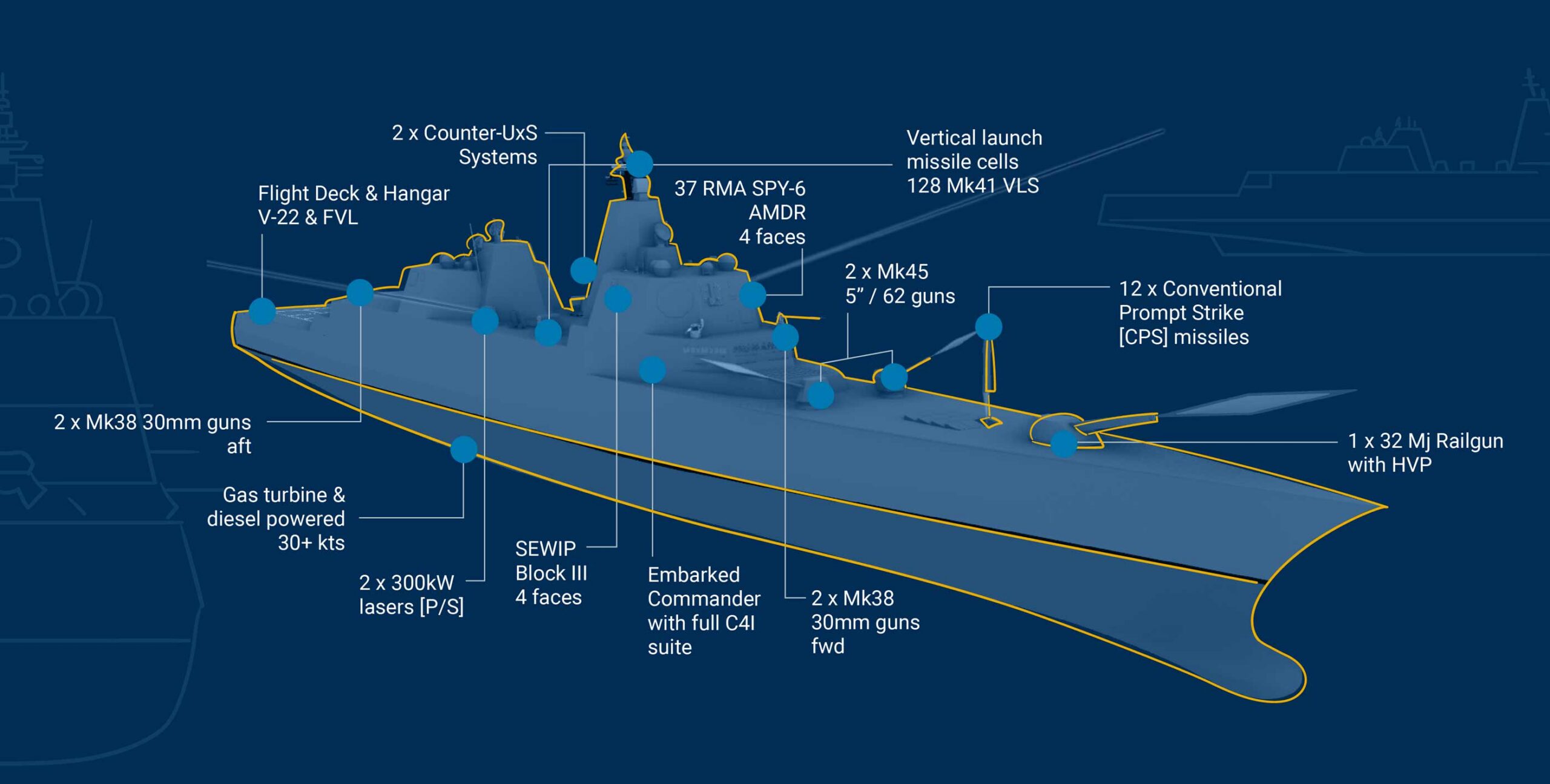
The new warship would be approximately 880 feet in length with a displacement of about 30-40,000 tons. It would be the largest surface combatant the United States has constructed since WW II. The Iowa-class battleships, such as USS Missouri, were 887 feet in length at around 58,000 tons displacement. Aside from aircraft carriers, the biggest warship in the US Navy fleet currently is the Zumwalt destroyer at 15,000 tons. It is envisioned that the new ships’ armament would include 12 cells for cruise missiles, 128 vertical launch cells for Tomahawk cruise missiles, rail guns and laser defence weapons. Currently there are no timeframes for the design and building phases for the new ships and no contractor has been identified to actually construct the battleship.
The President stated that these new battleships were intended to replace the Navy’s Arleigh Burke-class destroyers which are the backbone of the US surface fleet and cost approximately $2B. Each of the new battleships could cost in excess of $15B.
The US Navy shipbuilding program has not been a lesson in excellence, based on-time of delivery and cost overruns. The following are a few illustrations:
- The aircraft carrier USS Gerald R. Ford took 12 years to build, from the cutting of steel in 2005 to the commissioning of the ship in 2017;
- The Zumwalt-class destroyer program began in the 1990s, and 32 were planned to be constructed, however only three were actually built. The program was cut short due to massive cost overruns and shifting strategic priorities. The last of the class, USS Lyndon B. Johnson was commissioned in 2017;
- Twenty Constellation-class frigates were planned to be built. In June 2025, the US Navy Secretary John Phelan told a US House hearing: “All our programs are a mess. I think that our best ship built is six months late and 57% over budget - and that is our best one.”[2] In November 2025 he axed the Constellation-class frigate program, which was already three years behind schedule;
- The Littoral Combat Ships (LCS) had a very turbulent track record, which was fraught with controversy from the very start.[3] There are a number of questions surrounding reliability, and what the mission of the ships was supposed to be. In 2013-14 the planned requirement for these ships was reduced from 55 to 32 vessels. In a Global Outline Agreement (GOA) report reflecting on the fiscal year 2019, the US Navy was noted to have spent more than $28 billion to develop and build 32 ships.[4]A good number of the LCS will be retired early.
- The Navy’s newest aircraft carrier, USS John F. Kennedy, is two years behind its delivery date, which was supposed to be July 2025.
A former US Navy Captain, Carl Schuster, stated: “We no longer have the shipbuilding and maritime infrastructure to build the battleships quickly. New shipyards have to be built or closed shipyards activated.”[5] Schuster also remarked that the management of Navy’s shipbuilding programs has to change from Naval Sea Systems Command (NAVSEA). He suggested that the President must clean house if he wants any shipbuilding program to succeed.
When it comes specifically to the building of two “Trump-class” battleships for the US Navy, I suggest the following issues should be considered:
- Instead of building two battleships in a new class, could the USN reactivate the old Iowa-class battleships? USS Missouri and USS Wisconsin were both used in Operation Desert Storm in 1991. They were modernized to include Tomahawk missiles in the 1980s.[6]
- As a result of the Ukraine War, it is clear the surface fleet has become a target for hypersonic missiles and drones. As a result,1,000 foot long aircraft carriers and battleships could certainly be considered major targets by an enemy force at sea. For example, the PLAN has developed an intermediate range ballistic missile, the DF-26 nicknamed the “carrier killer”. China has disclosed it has also developed effective undersea drones as well as advanced hypersonic missiles fired from submarines or surface ships.
- There are ongoing deliberations by both the United States and Canada about whether to acquire ships off-the-shelf from foreign countries such as South Korea. Though Canada has three shipyards building ships pursuant to the National Shipping Strategy (NSS), similar to the situation in the United States, delivery of ships is both late and over budget. It is difficult to compete with Asian shipyards in the delivery of new warships based on shipyard capacities, workforce and labour costs.
From the Canadian perspective, the Mark Carney government has established the Defence Investment Agency with the hope of at least centralizing expertise and cutting red tape in the procurement of military equipment.[7] It will not however, address the fundamental questions concerning North American shipyards of capacity, workforce availability and increasing costs for each significant shipbuilding program.
Based on the cost overruns and delays in US shipyards building their current service fleet, it will be difficult to forecast when the two “Trump-class” battleships will ever form an integral part of the US Navy.
[1] CNN, B. London, “Trump’s new battleship plan could transform the US Navy - or sink it”, December 23, 2025.
[2] AI Overview
[3] Navy News, L. Heckmann, “Littoral Combat Ship still fighting to prove its worth”, 26 March, 2024.
[4] See footnote 1.
[5] See footnote 1.
[6] AI Overview
[7] Government of Canada, October 2, 2025.
Image: An infographic illustrating the Trump class "battleship" weapons. Credit: USN



11 thoughts on “President Trump’s Battleships”
The Iowas are old, expensive to run and man, would cost billions to upgrade the sensors, and use engines that few in the Navy have any experience with. So, no.
This argument treats the proposed ‘Trump class’ battleships as if they were meant to be a sober program of record replacement for the US Navy’s surface combatant fleet. They’re not. This is plainly a vanity project, and critiquing it as though it were a Burke replacement or an industrially disciplined acquisition misses the point. Presidents announce symbolic platforms all the time; very few survive contact with the POM cycle. The lack of timelines, contractors, or a funded design path tells you everything you need to know about its seriousness.
That said, dismissing the idea outright as fantasy also goes too far. The global trend line is toward very large surface combatants with disproportionate firepower, not away from them. China’s Type 055 is already a 13,000-ton ‘destroyer’ in name only, and Russia’s Kirov-class nuclear battlecruisers remain some of the most heavily armed surface ships ever built. In that context, a 30–40,000-ton missile-centric capital ship is not conceptually absurd, it’s simply unfashionable in Western navies that optimized for arsenal ships distributed across smaller hulls.
Where the critique is valid is execution. The US shipbuilding record over the past 25 years, Ford, Zumwalt, LCS, Constellation shows a system that struggles with clean sheet designs, unstable requirements, and serial concurrency. Building an all new capital ship class inside that ecosystem would almost certainly be late, grotesquely expensive and politically fragile. On that point, skepticism is entirely warranted.
But the article’s own logic undermines its conclusion. If the surface fleet is increasingly vulnerable to hypersonics, drones and long range ISR, then that vulnerability applies just as much, arguably more, to distributed Burke-sized hulls operating forward. Replacing the Arleigh Burke-class with smaller or ‘thriftier’ ships does not solve the targeting problem; it merely trades survivability for quantity. The question isn’t whether big ships are targets, they always have been, but whether they can justify their cost through concentration of capability, command presence and deterrent signaling.
If Washington actually wanted a realistic option rather than a headline, the better path would be neither new build fantasy nor incremental destroyers, but reactivating and modernizing two Iowa-class battleships. Not as war winning platforms, but as symbolic, limited utility capital ships: VLS-heavy, missile centric, heavily defended and politically useful. They would be cheaper, faster and crucially honest about their purpose. Pride, presence and deterrence have always been part of naval power, whether strategists like admitting it or not.
So yes, the ‘Trump class’ is a vanity project. But vanity projects have precedent, and they don’t have to be irrational. The real mistake is pretending this was ever meant to replace the US Navy’s destroyer force or that the alternatives on offer are somehow immune to the same industrial and strategic realities.
This is what you get when you “egg-on” an “ego-tes-ti-cal” maniac who thinks he has the world by his “Gahonas”! The problem is, he actually believes his “Trump Class” Bovine Scatology” replacement for the Arleigh-Burkes is a great plan in his own demented mind no matter how many $$ Billions over budget he spends on these dream battleships in his own dream world! The Zumwalt-class was not a bad idea (in retrospect). And he wants to build 12-15 of these 30-40000+ tonne Big Honkin’ Ships! I know where his planer’s will quietly put this one…. in File 13 (before they all get fired)!! He will find out this November that, in fact, he can’t do anything he wants. Best laugh Ted, I’ve had all day!! Thanks for this.
Good afternoon David,
Thank you for your clear and humorous post. I find myself agreeing with almost all of it.
The one area of major disagreement is that I am far from certain that the November 2026 mid-term elections will be allowed to matter.
Ubique,
Les
If, and only if, by some miracle, the Democrats can pull off a victory in both Houses this November, it’s a question then of mind over matter. We won’t Mind and…. He won’t Matter!!
Unless of course Trump declares the election stolen and invokes non-existent powers to “defend democracy” against a Democrat victory and the Supreme Court and Congress discover that he is absolutely and totally correct and wise and wonderful.
Ubique,
Les
Both you gents need to get Trump out of your head.
The issue I have is that the stated plan is for 128 cell VLS, given that the Ticonderoga class have 122 cells and the Sejong the Great has 128 cells (Based on the Arleigh Burke).
At $15bn per ship and intended to replace the Burkes you only have to do the math on that one to realise even the USN could never afford to do such a program, with 100 ships planned on the Burkes replacing 1 for 1 would be in the region of $1.5 trillion (not even adjusted for inflation).
If they do get built you might get 2, although in my own opinion after the next election with Trump gone the whole thing would get canned.
I would agree the entire US shipbuilding & maintinance complex is a gong show and likely that any yard having to re-open after decades closed would be years of reactivation work probably post-election meaning, in my opinion, probably close again after.
As for bringing back existing battleships, just a no pure and simple. The cost is huge, training for the crews would be difficult, the logistics would be difficult as well. They are where they are meant to be – in a museum.
Acquiring off the shelf, well we have seen how that goes haven’t we. The problem for the USA & indeed Canada is when you buy off the shelf you want to customize it which inevitably leads to increased costs and delays. I honestly don’t grasp why anyone thinks that you can buy an OTS equipment and modify it to whatever you want, you may as well just build you own. It’s stupidity plain and simple.
As for Mark Carney trying to cut red tape…… with another agency full of it? There’s a reason he is disliked in the UK after his handling of the Brexit deal.
Overall I can’t see this coming to pass within the next 2 years that Trump has left.
Reply to Ted Barnes of 16 Jan 26.
Time will tell whether more people should have worried about Trump.
Ubique,
Les
To both Ted & Les: When DJT says he is going to do something….. please believe him! He thinks the CUSMA agreement is irrelevant (unless of course Canada becomes his own personal “Critical Minerals”/AI deposit bank (51st State)). Right now his actions towards annexing Greenland and pi$$ing-off a great NATO member like Denmark as well as all other NATO members (excluding Turkey), are causing major concerns within the organization and Canada, is caught in the middle. PM Carney knows it, and he is extremely concerned that Trump will see that Canada will be next on his ‘greatest hit list of all time’! I suggest we take our critical mineral ball and go flaunting our wares elsewhere to sell our trade-free goods & services, perhaps to Europe, Asia or yes, even China! There is nothing more that the present POTUS would love more than to tear up CUSMA completely and tariff Canada into submission. Let’s face it. The quicker we lose the United States as a ‘True North Strong And Free’ trading partner and align ourselves with other like-minded states, the better off we may be as a country!
Precision guided projectile technologies that have emerged over the last quarter century have allowed the return of the battleship, but career minded professionals lack the insight to exploit newer technology to advance strategic hegemony.
Electromagnetic guns require technology, particularly advanced ultra high temperature materials, that simply do not exist, and the money would be better spent on infantry hoverboards and terminator drones which are technological feasible.
Conventional gun propellants can easily drive a sub-caliber projectile to hypersonic velocities (~1715m/s or Mach 5), a reality since the earliest saboted tank shells of the Sherman Firefly that Canada used in Europe in 1944 that evolved in to the modern tank cannons of the last half century. A ring airfoil projectile with a moving parts free hypersonic duct down the middle could achieve velocities up to 2500m/s or Mach 8, better than any electromagnetic gun, and it could do it at rates of fire LITERALLY orders of magnitude greater than existing EM guns and their one or two or three rounds in an hour or day and back to the factory for several months for a total rebuild or new build with used parts.
The problem with the 155mm AGS was the choice of gun size, way too small, being based on a field artillery caliber that the AGS did not share any munitions in common with, essential an 200lb 8″ howitzer shell squeezed down to a 6.1″ bore…stupidity. Scaling up the muzzle energy, a weapon around ten times as powerful is required to exploit the capacity to hit point targets out to medium and even intermediate range, requiring a baseline caliber in the 280mm/11.1″ range in double length form. The pocket battleships of the Kriegsmarine had such (rifled) guns in 54 caliber lengths, the K5 railway guns including the famous Anzio Annie and other mounts used this bore caliber at 76 calibers in length, the M65 atomic cannon of the U.S. Army also was a shorter ~40 caliber weapon. The objective (smoothbore) cannon should range in the 111 caliber length, a bore length of about 102 feet, and have a muzzle energy in the 100-200MJ range, allowing for an albatross like ~25kg sub-caliber glider shell fired in salvos by the dozens or hundreds out to thousands of kilometers with a warhead to assure the destruction of major military systems, or full bore projectiles up to ~250kg with various enhancements to defeat hardened targets from medium ranges.
Although battleships had thick armour belts and decks, it’s the subdivision, battle damage systems, and crew training that allowed these ships to take intense punishment from dozens of torpedos, bombs, and shells; it is possible to reinforce the survivability of a hull type like the current LPD to battleship like protection sans the non-essential thick armour plating. The well deck would be ideal for replenishment of the ~1000 insensitive-energetic projectiles (and a frigate/destroyer like missile system) that the magazine could hold to feed an optimal four fixed vertical gun outfit each with blast containment gun house towers. Future versions of the guns would employ serial propellant chambers with RAVEN-breech venting and liquid cooling of the barrels to multiply the rate of fire, these features being easy to accommodate in the confines of the housing rather than a free hanging barrel, and thermal and smoke signatures could be mitigated as well. The CBG’s could carry 1-8t drones to find and fix targets while supporting a Marine BLT/ARG/MEU.
The reactivation of the four Iowa-class battleships in the 1980s effectively demonstrated that a fleet size of four ships was an efficient and effective scale of deployment for this type of warship. In the future, such large ballistic gun cruisers could compete with aircraft carrying cruisers as the prime capital ship of the fleet and be deployed in greater numbers in the second half of the century.