By Peter M. Sanderson, 24 September 2026
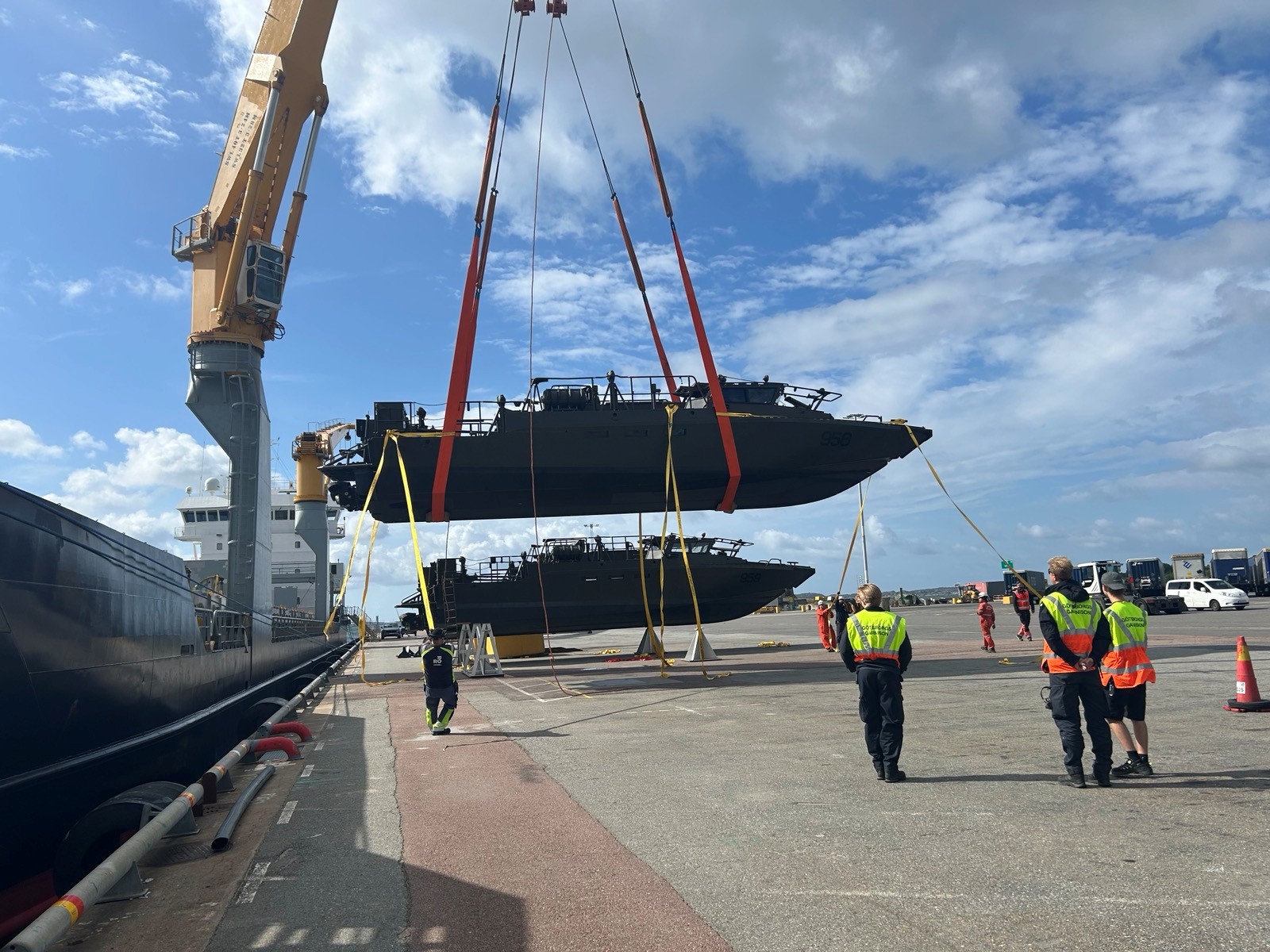
On 20 September 2026, armyrecognition.com revealed that the RCN has secured the loan of two CB-90Hs (2x 700-hp engines) from Swedish Amphibious Regt. to trial their suitability for the RCN (see reference 1). The takeaway I got from this AI-assisted article, was that Admiral Angus Topshee is collecting data to make a presentation to Treasury Board which will answer two questions: (1) is a low-profile amphibious assault craft, the CB-90H, built to be invisible to radar in the ‘wave clutter’ in its 100 km dash to Gotland Island, suitable for use on Canada’s littoral coasts? (2) is your only goal to land troops, then be like Sweden and acquire the CB-90H, a ‘basic’ boat , or do you want to use the ‘sophisticated’ CB-90HSM (2x 900-hp engines) to regenerate the Naval Reserves, and have it as a tool of retention and tool of attraction for recruits? The ultimate goal is to have Naval Divisions be both caretaker of the boats and provide their highly trained crews for future amphibious operations. (see Reference 2).
While Reserve Artillery units have their guns and the Reserve Amour units have their TAPV patrol vehicles, what does the Naval Reserve have? In an interview, Admiral Topshee thought the CB-90 would remedy that, and the boat was ideal for training junior leaders.
The Junior Warship -- the CB-90 HSM -- has a commander and three crew. The first crew member, the helm, uses electronic charts; the second crew member runs the Combat Management System (CMS), this member runs communications to the team through headsets and screens. The CMS uses imagery from the remote weapon station (RWS), including stills, video and live feed which it can share with the crew, the flotilla or higher headquarters. The fourth member is the gunner/observer who operates the Saab Trackfire RWS, while the Laser Range Finder allows the gun to always hit targets. The daylight television camera and the IR thermal camera also provide the craft with a passive day/night surveillance capability.
Commanding a fast boat takes the usual: seamanship, small boat leadership, multi-tasking, decisiveness, tactically sound, command presence, and communication skills.
If there is buy-in by Treasury Board, here are some random thoughts – apologies for this being Eastern Canada centric:
1. The Jay Treaty, 1794. Neither Canada nor the United States can have a ship with guns or cannons on the Great Lakes nor the St Lawrence River. When our frigates and AOPS do their Great Lake Tours, they get and carry their letter of exception. This definitely means the Gunnery qualification will get done in the Maritimes during the summer National Amphibious Assault Boat School.
2. The French announced they were ordering the CB-90. If they are occupying the queue we may have to make an ‘ask’ so they give us one of their spots, in order to have a boat for recruiting. The boat should visit every Division to give the young sailors hope that change is coming. Canadian boat deliveries should be annually oriented for 15th of June acceptance-introduction conundrum, i.e., you need boats to train crews and you can’t issue boats to the Division until they have trained crews.
3. Trailers. The nomenclature should read “Amphibious Assault Boat, Mk 1 c/w trailer” because of winter. Our lakes and rivers freeze up, the boats need to be lifted out of the water, placed on their trailers, winterized, shrink-wrapped then trucked to a DND Base, parked on hard standing and put on the MP Night Patrol Route due to their valuable electronics. During this 7-month stand down in the interior of the country, if there is crisis on one of the coasts, the boats are centralized and ready to roll. Plus, after the boats are built, initial crews are trained and boats are issued to the Naval Divisions. A normal annual training cycle would mean that for 10 weeks each summer all the Ontario boats from Windsor to Kingston, all Quebec and Newfoundland boats will be trucked to the school, remaining Maritime boats would just sail to the school, thereby providing the flotillas for the school courses.
4. National School. Here are some course individual* and boat training** examples:
a. Boat Ballet* (man/machine maneuvers that can then be synchronized into a public display)
b. Group Boat Ballet**
c. Surveillance and Reconnaissance* **
d. Night Patrol Resupply RV**
e. Night Deep Insertion of a 4 man LR Patrol **
f. Major Surprise Daylight Landing* **
g. Major Night Raid with a fighting withdrawal* ( important Gunner* fire control Ex – Fire/ No Fire conditions)
h. The school will require a section of Reserve Army soldiers as ‘walk ons’ at various times during each course.
5. Reserve Army Area Rank and Trade School and Military Concentration (MilCon). During summer, the two schools are running at the same time, with Jr and Snr NCO and officer leadership courses taking place, hopefully their syllabuses will allow some amphibious warfare training. Failing that, the end of summer is when Reserve Units go to the field – MilCon will be the best opportunity for major Amphibious Warfare Ops for the school.
6. Amphibious Warfare Patch. The Admiral has got the boats, how do you show you are using your resources? Your Division’s Annual Training Report should read, for example, “worked with 4 separate army units, conducted 8 Ops, involving 111 soldiers.” Of course, the sailors got their patch on graduating from the school. For the Reserve Army, a soldier must participate in a major daylight landing, a major night raid with a fighting withdrawal and a patrol drop off and RV pick up, in order to be put up for this.
7. How fast is the CB-90HSM? It goes 45 kn (83 mph) vs an off-the-shelf Cigarette Boat that goes 80-100 mph vs the fastest model of the three engine WW II German E-Boat, which went 43.5 kn.
8. The future of warfare is unclear, but many navies have fast boats. Will they fight again like they did in WWII, unknown, but we were once pretty good at it. While Battle of the Atlantic was going on, the RCN was also fighting in the North Sea and English Channel.
References:
2. https://youtu.be/epbzbRgTNdU?si=2RQ23QNsKtxk1n6z (6.04 mins) Docksta CB-90HSM into video


4 thoughts on “The RCN is testing the CB-90 fast assault craft for suitability in Amphibious Operations”
“While Reserve Artillery units have their guns and the Reserve Amour units have their TAPV patrol vehicles, what does the Naval Reserve have?” Quite possibly, responsibility for jointly crewing the FAST-V – the vessel that the RCN envisions for costal patrol as well as training, both on the coasts and on the Great Lakes.
The article assumes that there is a pressing need for amphibious capability for use in Canada (against what threat?), and that a fast raiding craft is part of the solution. I believe the the former proposition is (still) contentious, which makes the latter wholly premature. This seems more like one of the CAF’s ‘buy and try’ initiatives.
The French have long had a small marine corps. It makes sense for them to consider this kit.
Hi Barnacle Bill. Ted answered one of your questions and I will give you my best guess on who is the threat. If you saw the CDR video “Arctic Defence – Why Canada needs LST for Arctic Sovereignty…” you would see that, while not DND policy, it does represent defence community thinking when it talks about a LST being a mobile base, HIMARS (kinetic) and “establish[ing] temporary, distributed defence sites” (deterrence). Two phrases come to mind ‘nibbling’ and ‘little Green Men.’ China has been accused of nibbling at the Line of Control in the Himalayas and unoccupied islands of The Spratly Islands in the South China Sea, and in 2014, little Green Men occupied Crimea, Russia was suspected. We think we own all the islands of the Arctic Archipelago but the Inuit don’t occupy all the islands. Cheers Pete
Hi Peter. I understand the concern about maintaining a credible presence across the Arctic, but I would be cautious about drawing a direct comparison between the Canadian Arctic Archipelago, the disputed Spratly Islands and Russia’s seizure of Crimea. An island does not need to be permanently inhabited for Canada to exercise sovereignty over it. The absence of a community on every island does not, by itself, establish a requirement for an LST or an amphibious assault capability. In my assessment, the scenario of a foreign power quietly occupying Canadian Arctic islands is highly unlikely, although the risk is not zero. It deserves consideration, but procurement priorities should reflect both the likelihood of a threat and its potential consequences.
If you are suggesting that craft such as the CB90 could support Canadian Ranger detachments, with seasonal assistance from the Naval Reserve and Army Reserve, then I agree that this is an idea worth examining. It is something I have proposed in the past. My preference would be to develop that capability around northern communities, drawing on the Rangers’ local knowledge and experience and providing the personnel, training and infrastructure needed to sustain it.
I would envisage a standardized boathouse and support depot at suitable locations, with a launching and recovery rail or a tractor and trailer arrangement similar to those used by the Royal National Lifeboat Institution. Each depot could include appropriate fuel storage, a fenced vehicle yard, a helicopter landing pad, accommodations, a galley and maintenance facilities. During the navigation season, a contingent of Naval Reservists and Army Reservists could help the Rangers operate and maintain the craft, subject to local requirements and the suitability of the boats for those waters.
That would provide a practical starting point for improving local mobility, patrols and support to Arctic operations. A video discussing an LST as a mobile base, or proposing HIMARS and temporary defence sites, presents a concept for consideration. It does not establish an agreed operational requirement or demonstrate that a large amphibious ship is the best investment. We should first define the task, identify the actual gaps and assess how to sustain the capability in the North.
The two CB 90’s in Halifax seen being evaluated this summer are for possible use for the SF not the naval reserves. The naval reserves will probably be getting the new ORCA replacement.
The treaty name and the description of the restrictions need correcting. The relevant agreement is the Rush Bagot Agreement of 1817, not the Jay Treaty of 1794. Disarmament of the Great Lakes was proposed during the Jay Treaty negotiations, but Britain rejected that proposal.
Rush Bagot limited the naval forces maintained on the Great Lakes and Lake Champlain. It did not prohibit every vessel carrying guns or cannons. Each side was permitted one vessel on Lake Ontario, two on the Upper Lakes and one on Lake Champlain, each not exceeding 100 tons and carrying one 18 pound cannon. The original agreement also does not establish a blanket prohibition on armed ships throughout the St. Lawrence River.
The agreement has since been interpreted to accommodate modern requirements. In 1946, Canada and the United States agreed that stationing naval vessels on the Great Lakes for training was consistent with its spirit, provided advance information was exchanged about the vessels’ number, disposition, functions and armament. This means an armed naval vessel’s presence is not automatically a violation.
The claim that visiting Canadian frigates and AOPVs obtain and physically carry a “letter of exception” is false. Such paperwork may form part of particular deployment arrangements, but the official agreement establishes advance notification rather than a universal requirement to carry that specific document. The accurate point is that Great Lakes naval deployments operate within the Rush Bagot framework and its subsequent interpretations, rather than under an absolute ban imposed by the Jay Treaty.