By Les Mader, 30 September 2026
Comments made over the years here in the Broadsides Forum and by some individuals connected with Canadian Naval Review have led me to understand that the Royal Canadian Navy (RCN) has no intention or plan to procure amphibious vessels for use in the Arctic or anywhere else. It was further understood that the RCN feels that it has so many other concerns (personnel shortages, finite shipbuilding capability, limited funding, etc) that it could not be expected to waste time and energy looking at nice-to-haves like an amphibious capability.
Given these ardently and repeatedly expressed views, I was extremely startled to discover the interview at the attached link on YouTube that was given by Vice-Admiral Topshee some two months ago when he was still Commander of the RCN. (“Designing The Future Royal Canadian Navy with Vice-Admiral Angus Topshee,” https://www.youtube.com/watch?v=dujFNrIVMJI) During some six minutes (from 39:05-45:00), Vice-Admiral Topshee discusses the procurement of an Arctic amphibious ship in terms that seem to indicate that the RCN is actively exploring/pursuing such a vessel.
From his comments, I have understood the following:
• The RCN is currently at the conceptualization, identification and options analysis phase of the procurement process. This includes identifying whether other options exist to meet the key requirements.
• There is no formal capital equipment project yet.
• Therefore, no firm timeline has been identified.
• The envisioned vessel would be used to support the army and allow it to operate/intervene anywhere in the world, with the priority being in Canada’s Arctic.
• A primary purpose for the vessel would be to provide sustained Humanitarian Assistance/Disaster Relief throughout the year, even during the Arctic winter.
• The implications of such a vessel on the remainder of the Canadian Armed Forces (CAF) (army, air force and special operations forces) need to be determined.
• The combat amphibious approach envisioned is the ‘British one’ – landing where the enemy is not – rather than the ‘American one’ – being able to conduct opposed landings.
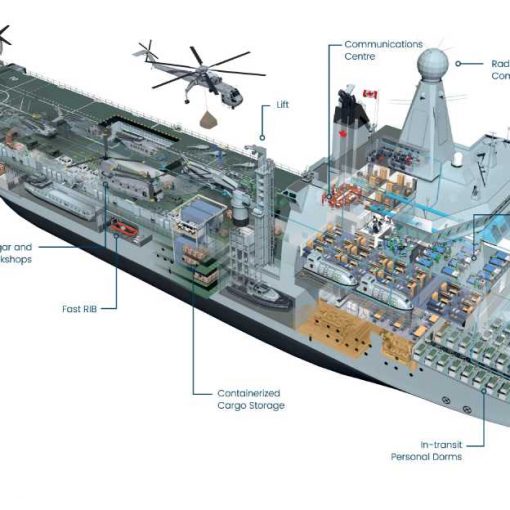
• From these requirements, the navy envisions a Polar Class 2 vessel that is similar to the Netherlands navy’s Rotterdam-class Landing Platform Dock (LPD), that has a strong air component including: helicopters and UAVs; and surface connectors (landing craft, floats, etc.) that can move supplies to shore.
• The supply requirement means that a well-deck-like capability is essential in order to be independent of the need for port infrastructure, but perhaps with side access in order to optimize the vessel’s stern for ice breaking.
• The vessel would have self-defence weaponry only.
• The ability of the Canada’s shipyards to build the vessel must still be determined. However, Vice-Admiral Topshee thinks that among the three relevant shipyards, the capacity likely exists.
From the above, I am left wondering where things are headed with the CAF’s force structure and whether we might see the government direct the CAF to procure at least one Polar Class 2 LPD, especially now that Vice-Admiral Topshee is the Vice Chief of the Defence Staff.
Time will tell.
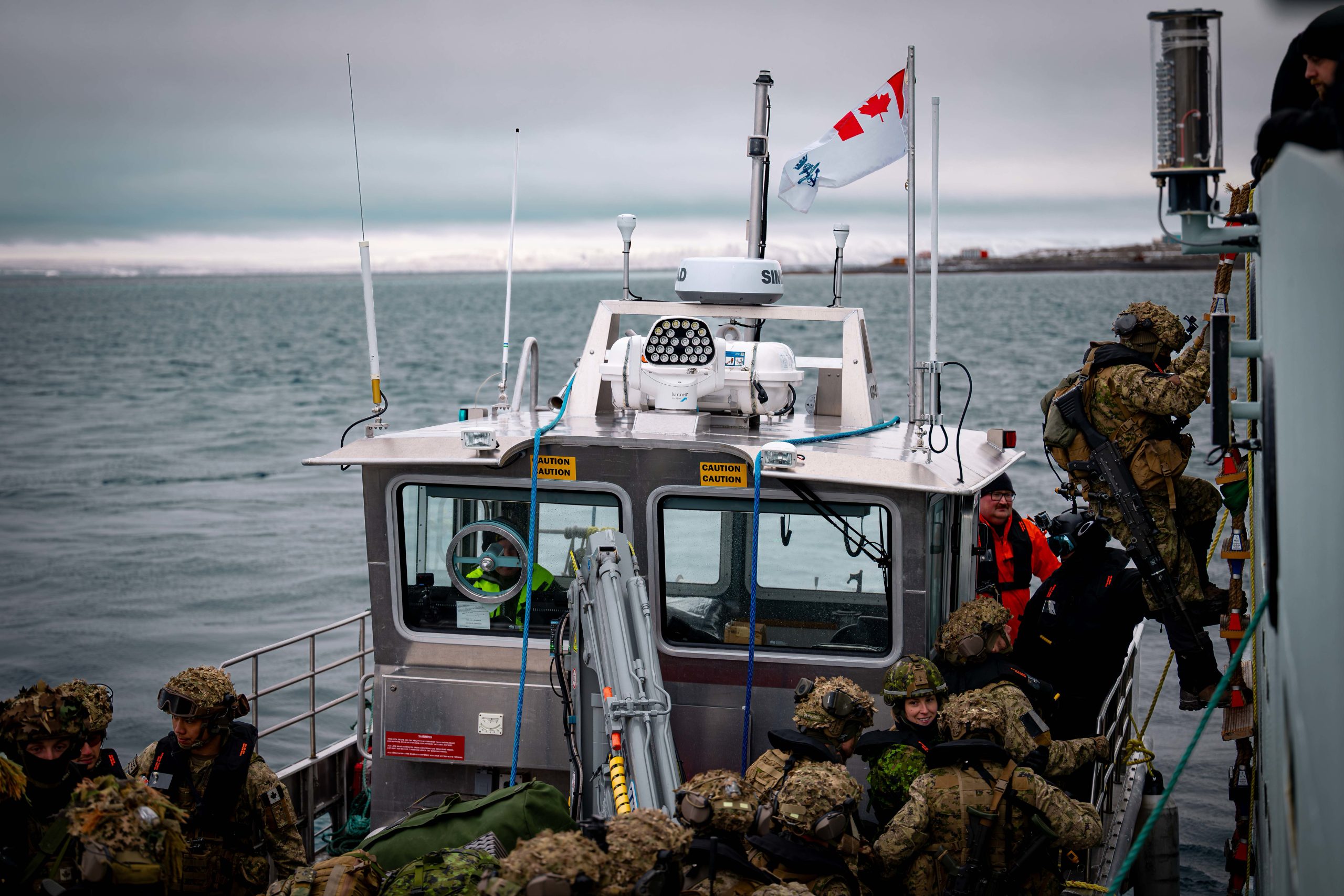
Image: Canadian Army Soldiers are transferred to HMCS ROBERT HAMPTON GRAY by a landing craft near Resolute Bay during Operation Nanook-NUNAKPUT on 8 September, 2026.


8 thoughts on “Considering Arctic Amphibious Ships”
I believe Canada should invest in an arctic amphibious presence with three vessels similar to the Rotterdam. First, more states (China) will try to use the Northwest Passage for shipping without our permission. Flying a Poseidon over them and sending angry emails will not stop them. It hasn’t stopped us in the South China Sea. Having a ship with robust multiple boarding teams and onboard aviation assets to maintain a presence is a sign we take it seriously. Second, with more shipping and cruises there’s bound to be a disaster. A ship with the required humanitarian response and/or spill mitigation materials in the Arctic already saves us a week in transport time from the lower coastal ports. While fixed wing aircraft could get close to a disaster, they’re not bringing in the hundreds of tons of supplies needed.
Third, they’re a floating base. With the right sensors, or sensor links, and optional containerized munitions they could be used as an early anti-ballistic missile platform when things get spicy with Russia or China. Having a few dozen ready to launch missiles on the helo deck or dispersed ashore, with dozens more in reserve, adds another layer for the opposing force to try and go through.
Lastly, they can be used elsewhere in the world for training and disaster relief. Or quickly reinforcing our Latvian presence by transporting more armour and then moving offshore to act as a hospital ship.
We don’t need to land heavy armour ashore via connectors but it should have the ability to move almost everything else under 30-40 tons. Construction and engineering equipment, LAV’s, loaded fuel trucks, etc. The US LCAC’s, though expensive and fuel hogs, deliver that capability but is there another hovercraft on the market that could move even 50% of that capability? Landing craft, though cheap and plentiful, can’t get to every beaching zone, thus forcing your land forces to operate from a less than ideal location or waste time and resources traveling to one. The aviation component should be four navalised AW101 helicopters with folding rotors and tail. Sadly the Chinook would take too long to pull from the hanger, attach the blades, do a test flight, then go out for the rescue. Add several general purpose drones that can carry either sensors to monitor the situation or cargo to reinforce a rescue or resupply a ground team and you’ve got a great platform.
It’s not a platform just to hold a few hundred soldiers ready to retake Juno beach.
Good afternoon Chris,
Thank you for your thoughts.
In an unconstrained world I would embrace everything that you suggest.
I believe, though, that in Canada’s current situation, an incremental approach would be very worthwhile; start out with a useful Arctic amphibious capability and then grow it as we gain experience. Such an approach is discussed at CNR 18.3 (2023), pp 31 and 32. However, I would modify what is written there to include building up to several Polar Class 2 LPA(H)s, which are described a bit in my reply below of 4 Oct 26 to Ted Barnes.
Ubique,
Les
Les raises a worthwhile question, but there is a substantial difference between examining a capability and deciding to acquire it. We have people whose work includes looking at future capabilities, assessing requirements and exploring options and that’s all they work on. That does not mean a proposal will move beyond that stage. Conceptual work should not be mistaken for an approved procurement plan.
Topshee’s interest in the concept also predates the interview cited here. The Canadian Seapower Report published in 2025 recorded him discussing a heavy icebreaking amphibious vessel while acknowledging that it lacked policy approval, funding and even a project title. That demonstrates interest in exploring a capability, rather than a commitment to deliver it.
It is also worth remembering that Vice Admiral Topshee is no longer Commander of the RCN and has moved to the Vice Chief of the Defence Staff position. He no longer directly leads the navy’s requirements and fleet priorities. While he can contribute to broader CAF discussions, his move should not be interpreted as making this particular procurement more likely. The current naval leadership would have to advance the requirement, and government would still have to approve and fund it.
The photograph of HMCS Robert Hampton Gray supporting Canadian Army personnel should similarly be viewed in context. The RCN is examining what its existing ships can do in support of troops, gaining experience and identifying practical limitations. We have done this over the years with our AORs, steamers, Kingston class and Halifax class ships. These activities contribute to joint readiness and help us understand our platforms. They do not, by themselves, signal a move toward acquiring a dedicated amphibious ship.
Canada also has other avenues for bringing cargo and troops into the Arctic that do not involve the RCN at all. As in the past, these include RCAF airlift, contracted civilian aircraft and commercial sealift, with onward movement arranged according to the destination and conditions. These options have limitations, particularly for heavy equipment and winter access, but the absence of a dedicated naval amphibious ship does not mean Canada lacks the ability to deploy and sustain forces in the North. Any proposal must establish the specific gap existing arrangements cannot adequately address and whether an RCN vessel is the best way to fill it.
There is a legitimate operational argument for moving personnel, equipment and supplies ashore without established port infrastructure. However, delivering that capability would require considerably more than a ship. Troops, aircraft, landing craft, maintainers, medical support, training and sustainment would all have to be available. Any winter requirement would also need to address how equipment and personnel actually reach shore once the vessel arrives.
My view, shared by many of my colleagues, is that the RCN has more pressing priorities for the time being. Recruitment and retention, infrastructure renewal, delivery of the River class destroyers, the possible procurement of Continental Defence Corvettes and the prospect of acquiring up to 12 submarines would place substantial demands on the institution. Expanding the submarine fleet would itself require major investment in crews, specialist training, maintenance facilities and shore support. These demands must inform any consideration of another ship type.
There is nothing wrong with studying an Arctic amphibious capability. That work can inform future decisions and identify gaps. However, studying a proposal does not oblige the RCN to pursue it, and interest from a former commander does not establish its priority. For now, I believe the navy’s effort should remain focused on its people, infrastructure and core fleet requirements and right now thankfully that’s what’s happening.
Good afternoon Ted,
Thank you for your comments.
It is fully understood that conceptual work does not guarantee project initiation and completion. However, based on my experience with land requirements decades ago, having the VCDS supporting a capital equipment project does not do it any harm. Further, I am not sure that the proponent for an amphibious capability absolutely has to be Commander RCN. Given that this is a ‘purple’ capability, Commander Canadian Army could also fulfill this role, or it could even be the CDS personally.
That said, given the sums involved, the truly vital proponent for creating a complete Canadian Arctic amphibious capability is actually likely the MND, if not the PM. Thus, nothing may ever come to pass from any of our speculations.
Your point about having other means to get troops and equipment into and around the Arctic is valid. However, having to depend on aircraft and/or civilian ships to accomplish this would leave us with serious operational weaknesses.
Using amphibious ships to address these weaknesses will certainly lead to very significant costs. These are particularly dependent on the Polar Class (and number) of the ship(s) selected and the amount of cargo – troops, helicopters, landing craft, and stores – that must be carried. A Polar Class 2 (heavy ice bank) Landing Platform Arctic (LPA(H)) loaded with a marine infantry battalion team (600-800 personnel) and sufficient helicopters and landing craft would cost far more than the LSI(A) that was mentioned in CNR 17.1 (2021), pp 33-35 or even the LPA[L] discussed in CNR 18.1 (2022), pp 31-34 and CNR 18.2 (2022), pp 23-27.
This does not mean, though, that Canada is currently facing the complete cost of building such a capability. The biggest single personnel cost – the landing force – has already been met. The new 3rd Canadian Light Infantry Regiment resembles almost completely the conceptual paratroop/landing force capability that was described in Canadian Army Journal 19.2 (2021), pp 70-75 and foreshadowed in CNR 16.1 (2020), p 33. The only difference between the two may be the amount of staff and signals support available to the new regimental headquarters.
https://publications.gc.ca/collections/collection_2021/mdn-dnd/D12-11-19-2-eng.pdf
What is missing are the actual amphibious elements needed to support the troops and formed units which already exist. These elements – notably the helicopters and landing craft – do not have to be prohibitively expensive. Canada could ‘put some water in its wine’ and pursue a viable capability that is not the full amount that one could imagine and desire.
The true issue underlying all discussions about forming an Arctic amphibious capability is really what is the correct balance among DDGHs, CDCs, SSK(A)s, AOPS, AORs, and amphibious ships. You and I disagree on what this balance should be and we do not need to relitigate our differences here.
It is my hope, though, that those who will actually decide what balance will be chosen by Canada do a thorough cost/benefit analysis of all of the components.
Ubique,
Les
Hello Les. I was really taken by surprise by your assumptions that Canada had no intentions of even considering a plan to procure an Arctic Amphibious Capability. The so-called Amphibious Mobile Base (AMB) concept offered by Admiral Topshee. Now that the Admiral has taken up his new duties as Vice-Chief of Defence (VCDS), this concept seems to be more seriously considered to the point where plans may now be more concrete for such an AMB capability.
-There are several options that could be considered. They include a Polar Class 2 based on the Dutch Rotterdam Class; the USN San Antonio Class; base it on our new Polar Class 2 Canadian Coast Guard (CCG) Diefenbaker Class; or in my own opinion a Polar Class 2 AMB that has not been built…. Yet.
-In order to be credible, this new class would be a larger vessel (27-30,000 tonnes) with sustained top speeds of 24+ kts. It would have a side & top loading capability with two well decks aft for vehicle and boat loading (the RCN is now testing the Swedish CB-90H fast assault craft for suitability in amphibious operations). The flight deck would be large enough to hold at least 6 light/medium helicopters.
-A fleet of 4 vessels would be appropriate (2 per coast) — one vessel on each coast would have a full Submarine Tender Capability (including a Submarine Rescue vehicle).
-For self-defense, it would have 2 x RAM 116 Systems (Fore/Aft), MK 38-30mm gun systems (Port/Stb’d-same as River Class Destroyers).
– Ship’s crew would be around 140 personnel with the ability to accommodate a Canadian Battalion strength.
-It would have a full level 2 Hospital with a shore deployable field hospital.
The costs for all of this would be eye-watering to say the least (more than CAD $5 Billion each). The only negative thing about all this will be the training of personnel for all of this. It took the Royal Australian Navy (RAN) almost 20 years to finally acquire this Amphibious Sealift Capability.
It must be said, however, that this capability is still only a ‘conceptualized’ idea as it stands now but with the support of our VCDS, this capability seems to be quickly moving forward. It would be a much-needed capability for both Amphibious Operations and Humanitarian Assistance & Disaster Relief (HA/DR) as well as Task Group (TG) operations.
David, I think there is a considerable gap between considering an Arctic amphibious capability and concluding that it is quickly moving towards procurement. Having people examine a concept is entirely reasonable as we have a whole department doing that, but that does not establish an approved requirement, funding, a construction schedule or a government commitment. Admiral Topshee’s support does not, by itself, demonstrate that the proposal has advanced beyond the conceptual stage you acknowledge.
His move to VCDS also should not be treated as evidence that this particular naval proposal will proceed. That position involves balancing requirements across the Canadian Armed Forces. Any amphibious capability would still have to compete with other priorities and demonstrate that it is the most practical way to meet an identified operational need.
From my perspective, and that of many colleagues, the RCN has more pressing work: recruitment, retention, infrastructure renewal, delivering the River Class Destroyers, the possible Continental Defence Corvette procurement, and potentially bringing as many as twelve new submarines into service. Adding four large amphibious ships would create another substantial demand for sailors, technicians, maintainers and shore support. Training would certainly be a challenge, but it would be far from the only one.
The specification you describe would also require some difficult engineering and operational compromises. Combining Polar Class 2 ice capability, speeds above 24 knots, well decks, extensive aviation facilities, battalion accommodation, a hospital and submarine support in one design is an ambitious undertaking. A crew of 140 would need careful examination, particularly once aviation, medical, boat handling and submarine rescue personnel were included. Using your own estimate, acquisition alone would exceed $20 billion, before accounting for the wider cost of operating and sustaining the capability.
The CB90 trials and HMCS Robert Hampton Gray’s support to troops should be understood in that context. Exploring what boats and existing ships can do is useful work, but it does not establish a requirement for four amphibious mobile bases. We have supported troops and transported equipment with our replenishment ships, steamers, Kingston Class and Halifax Class over the years. Canada also has avenues for moving personnel and cargo into the Arctic through airlift, commercial sealift and other government arrangements that do not necessarily involve the RCN.
There could eventually be a sound case for a dedicated capability, but we first need to define the mission, how often it would be required, and why existing or expanded alternatives cannot meet it. Humanitarian assistance, Arctic logistics, amphibious operations and submarine support each deserve examination; combining them does not automatically make one large ship the best answer. My view remains that this is a longer term possibility, dependent on a funded requirement and the people to sustain it, rather than something we should describe as rapidly approaching procurement.
Hello Ted. Yes, you are absolutely correct. The gaps between ‘considering’ an Arctic Amphibious Capability and concluding that the ‘fix-is-in’ and approval is just weeks away is just not there….yet. All that I’m saying is that as the new VCDS, Admiral Topshee’s conceptualized Arctic Mobile Base (AMB) has a fighting chance to be strongly considered as a new capability within an updated “Our North Strong and Free,” Canada’s Renewed Defence Policy and “Leadmark 2050”.
In my opinion, Admiral Topshee is now in a much better position as VCDS to move this concept for 4 of these Mobile Bases to be forwarded to the CDS, MND and the Prime Minister and House of Commons for strong consideration as a Joint CAF future project. Yes, this amphibious capability may put a strain on other projects that are now either being built or considered for the RCN. A Polar Class 2 Amphibious Sealift Capability/Humanitarian Assistance/Disaster Relief (HA/DR) vision will take commitment and resources but is a needed capability for the RCN. The size, speeds, well decks, extensive aviation facilities, medical staff and hospital requirements would be an ambitious undertaking, but not unsurmountable.
The crew size for each unit may have to be upgraded from 140 personnel to around 200 (to include air crew detachments, medical and Task Group Staffs). Separate female washrooms and messes/cabins would also have to be considered along with accommodations for a full Canadian Batallion strength as well.
All of this would be articulated within an updated “Our North Strong and Free” to include what its over-arching mission requirements would be, both within Canada and international requirements (including HA/DR) for this dedicated capability. Yes, CAD $20 Billion for this fleet is eye-wateringly expensive and will take time (years, perhaps) — however, the need is great.
Good morning David,
I fully agree with you on the value of, and need for, an Arctic amphibious capability. I fear, though, that a capability level such as you describe may be too much, especially initially, for the CAF.
I would be very happy if we built a basic, robust, multi-ship force soon with your vision as the long-term aspiration. The most important step for any Canadian Arctic amphibious capability is the first, concrete one.
Hopefully, the confluence of personalities and the historic moment will see us implement at least a basic force.
Ubique,
Les