By Moderator, 6 July 2026
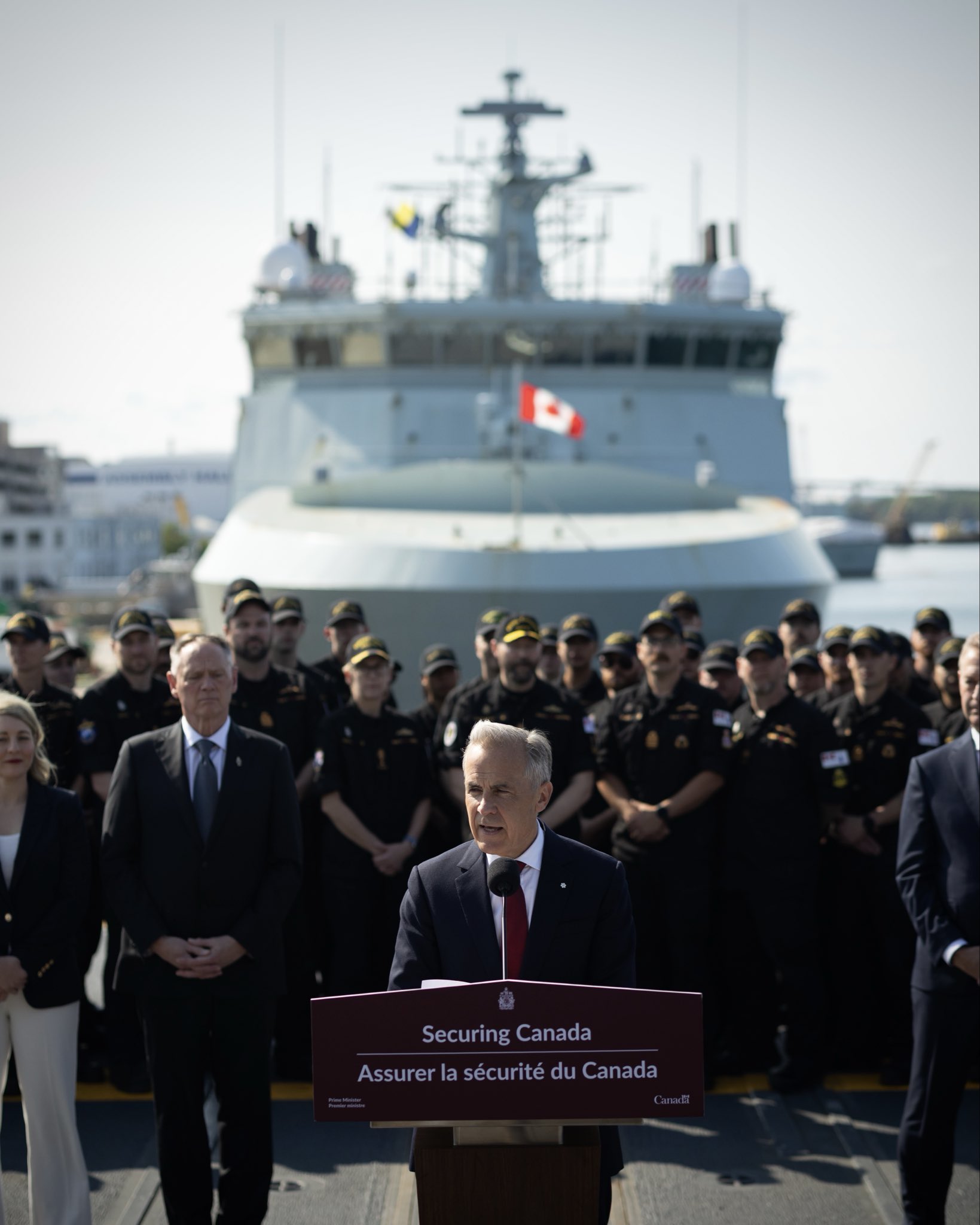
The decision has been made! Prime Minister Carney announced today that the TKMS’s 212CD has won the competition to build the RCN’s next submarines. The German-Norwegian TKMS consortium will now advance to discussions on the building of up to 12 submarines. Both Hanwha and TKMS have been aggressively courting Canada with promises of money spent in the country, but it seems that relations and interoperability with a close NATO partner have won over the possibility of closer ties to an Asian country.
Image: Prime Minister Mark Carney announces TKMS as the preferred bidder for the Canadian Patrol Submarine Project on the flight deck of an Arctic Offshore Patrol Ship in Halifax on 6 July 2026. Credit: Mark J Carney's X account.

21 thoughts on “New Submarines for Canada”
What’s this – the biggest procurement in history and nobody has anything to say on Broadsides?
It is good to have made a decision and be moving forward
Hi Michael,
Perhaps the ‘usual crowd’ is trying to find the dark cloud around the silver lining!!
This is excellent news.
Ubique,
Les
This is good news for the RCN.
I think many of us were watching this with massive curiosity, as both the two finalists, KSS-III-batch II and the Type-212CD appeared based on unclassified press to be excellent choices for the Royal Canadian Navy. In many respects it appeared to be a win-win for the RCN. I suspect there is a lot more we don’t yet know which has not yet appeared in the unclassified press.
PM Carney stating possibly 4 x Type-212CD by 2034 from TKMS was a massive surprise given TKMS on their website say first boat only in year 2033. I note though German language news source ( https://www.hartpunkt.de/kanadische-regierung-will-bis-zu-12-u-boote-bei-tkms-kaufen/ ) claims TKMS will be increasing their production of the Type-212CD stating “TKMS is currently developing Wismar (on north coast of Germany on the Baltic coast) into its second production site alongside Kiel, where a second pressure hull assembly line is also under construction. According to (TKMS CEO) Burkhard, the plan is for each shipyard to eventually produce 1.5 boats per year. However, the goal is to become even faster.”
The RCN has a big challenge ahead of it to
(a) Man the existing Victoria (Upholder) class to prevent a critical capability gap.
(b) Maintain the existing Victoria class as it ages into the 2030s
(c) man the project office to support subsequent negotiation with TKMS for the Type-212CD
(d) continue staffing that project office to oversee the massive multi-year procurement process
(e) recruit personnel to be trained to both man and maintain the new Type-212CD, including creation of new training pipelines
(f) monitor/support the major infrastructure changes needed at places like Halifax (or nearby), Esquimalt/other for berth and alongside maintenance area of these submarines
(g) support any submarine industrial offset verification directly related to submarine equipment.
Being a new submarine class (as it is a massive change from the Type-212A), I think we all hope there will be no cost over-runs. Presumably by now, the design of the Type-212CD is frozen, which should help reduce the risk.
If all 12 submarines are procured, I can’t help but think that will bring about a fundamental shift internal to the RCN, a shift in terms of Canada and NATO maritime aspects and even a shift with RCN and USN, as Canadian submarines could start patrolling areas, or waiting quietly in strategic northern ‘relative bottle neck passages’ which until now were mostly the domain of USN submarines.
I hope the very best for the RCN to rise up to this challenge of manning this new boat – and sorting not just the manpower recruitment/retention/training/maintenance, but also sorting all the other strategic aspects.
Everything you mention is true. There will be a lot of challenges ahead for sure.
I hope there aren’t many teething troubles, being a new design, but the lineage of the boat suggests hopefully it will be just minor bits as a lot of the tech is already proven.
It will be good for NATO commonality and indeed hopefully could foster more exchange programs.
It is good news and hopefully they do build 12 and we can eventually crew 12.
I think the main first hurdle is going to be infrastructure upgrades which they need to start doing pretty soon to accommodate the new boats.
Further to my previous comment , noting that the preferred bidder selection of the TKMS Type-212CD for the Canadian Patrol Submarine Project marks a welcome milestone for the RCN, I think it also immediately raises interesting operational questions regarding sustained under-ice endurance in the Arctic. Operating a fleet of up to 12 conventional submarines across three oceans means the RCN may wish to consider the reality of forward-deployed logistics if NATO allied support is not available. If the RCN intends to fully exploit the Type-212CD’s capabilities in the Arctic, reliance on distant dockyards such as Esquimalt and Halifax risks imposing practical limits on submarine deployment range and on station time. This suggests there is a case for investigating a dedicated, ice-capable mobile support base specialized for submarine support — a specialized submarine tender designed to reside (be pre-positioned) seasonally in northern Arctic waters, while sufficiently flexible for more global deployment.
Such a capability need not be prohibitively expensive if the RCN strictly controls the vessel’s displacement and operational scope. There is a cost risk in a more expanded auxiliary procurement arising from the temptation to turn a utility hull into a multi-mission Swiss Army knife. If this support ship is deliberately restricted from acting as a tactical replenishment vessel for all surface combatants — avoiding the massive engineering premiums of more complex, high-tension Replenishment-at-Sea (RAS) masts, explosion-proof fleet pumping systems, and heavy double-hull fuel architecture needed for servicing surface combatants — then the platform could remain comparatively affordable. By keeping the platform focused on submarine support, with commercial-off-the-shelf (COTS) winterization standards, the capital expenditure could more likely be kept within a manageable range.
Rather than over-scoping the hull with built-in combat systems, the vessel’s utility could be enhanced by allowing it to dual-purpose also as an ocean-going diving tender for global deployments. This could complement, rather than compete with existing diving tender programs. I believe the RCN’s current Naval Inshore Support Vessel (NISV) project may be limited to a 30-meter length and a 350-tonne displacement, meaning those replacement diving tenders are structurally restricted to shallow, localized harbour and coastal operations and not ocean going. A larger, ice-capable submarine tender with basic diving support capability would provide a blue-water platform for deep-sea clearance divers globally—an environment where the RCN’s current planned coastal vessels are simply not intended to operate.
Finally, such a platform would potentially provide the RCN with a globally deployable submarine rescue support ship. Having a flat-deck auxiliary ship capable of embarking specialized rescue submersibles or hyperbaric systems could be an important asset for both global and northern under-ice emergencies.
This seems like a genuinely good idea. If Canada can accept displacement under 1000 tonnes or delivery after 2040, there might even be an NSS shipyard available to build it. Delivery in the 2040s doesn’t sound crazy, considering that the subs themselves will not be fully delivered until then.
So, you mean a ‘submarine tender’?
Hi Lee. I had another thought. Not too long ago, The Canadian Naval magazine “ReadyAyeReady had an article had an article entitled “Canadian Navy Eyes Amphibious Landing Ship for Arctic Defence.” This vessel is based on the new ice-capable Polar Class 2 Canadian Ice Breakers now being built in Vancouver and Davie Shipyards. This Amphibious Landing Ship could also do double duty as a Submarine Tender as well. Sort of like Swiss Army Knife as an Amphibious/Humanitarian Assistance/Disaster Relief Vessel; a Command Ship; and a Canadian Submarine Tender as well. Probably 4-5 of these ships would need to be built at around 30,000 + tonnes each. Just a thought? See below:
https://readyayeready.com/canadian-navy-eyes-ice-capable-amphibious-landing-ships-for-arctic-defence/
I’ll throw in my usual comment here – we can’t even begin work on any more large, complex vessel classes for the next 15 years because we don’t have any spare capacity in the NSS yards. So any talk about amphibious vessels, sub tenders, or anything else is aimed at the navy in 2045.
A very short time ago people were saying there might not be enough work to sustain two shipyards over the long term; now there are three; the corvette program will have to add a fourth yard at the very least. Any more increases in capacity and we might as well admit that we are abandoning the central point of the National Shipbuilding Strategy and embracing a full-on boom-bust cycle.
Good afternoon Michael,
I agree entirely with your point. Given the government’s stated intention to augment the defence budget massively, we must reconsider the NSS. It was brought in by a miserly government (remember the JSS fiasco) in order to rebuild a moribund shipbuilding capability while providing the RCN and CCG with some desperately-needed ships. The program was not, however, meant to deliver ships in a timely fashion – the last DDGH would not have been delivered until the 2040s. Instead, it was more focused on providing some ships at a pace that kept two shipyards functioning steadily. This plan was bad enough that it did not come close to meeting the CCG’s needs; only two icebreakers announced to replace seven/eight.
This leisurely pace might have met the needs of bowler-hatted accountants but failed miserably to address operational requirements. Thus, we must aggressively embrace your idea of at least four NSS shipyards: Halifax, tied up with the DDGHs; Vancouver, focused on the CCG after the two (!) AORs; Levis, providing icebreakers and other polar-capable ships – such as submarine tenders, LPAs, and perhaps LSI(A)s?; a new shipyard, the CDCs; and possibly a fifth shipyard if the four already mentioned cannot keep up with the operational requirements.
This expanded capacity could lead to the bust portion of a boom-and-bust cycle in the 2040s. However, one can answer this concern with two questions. 1. Is this a worse problem than having Canada’s fleets collapse in the meantime due to a lack of production? 2. Might not the refit needs of the additional ships and likely new construction (for example for the AOPS replacements) stave off/delay a “bust?”
Clearly though, plans to employ four(+) NSS shipyards must be built on the ability to have and/or train the necessary workers. I would suggest that unaddressable production capacity shortfalls are a greater issue than the “need” to avoid boom-and-bust cycles.
Ubique,
Les
Hi David. I appreciate the reference to amphibious concepts; if such vessels are fully funded, they would certainly be a welcome addition to RCN capability in the Arctic and globally, which I for one, would fully support. However, I am concerned that a ‘Swiss Army knife’ approach —combining amphibious assault, surface replenishment and submarine/diving tender functions into one class — could lead to a prohibitively expensive vessel. I worry that rising costs for such an ambitious platform might leave us with no northern mobile base at all. My hope is that RCN leadership, given the funding available, adopts the approach that best fits the budget to better help ensure Canadian northern sovereignty – whatever the RCN leadership assesses that to be.
Hi David, Further to the idea of a mobile base seasonally pre-dispositioned in the Arctic to support Arctic deployed submarines, … I believe to be truly effective the scope may be a bit larger to attain full benefit.
To ensure the sustained operational effectiveness of a polar-class mobile base ship or polar class submarine tender stationed in the Arctic, it may be prudent to establish a distributed aviation network to provide further support. Something to assess is the merits of a hypothetical possibility of assigning a detachment of up to nine helicopters (CH-148 Cyclone, or CH-149 Cormorant or CH-146 Griffon), strategically dispersed across three chosen northern airports, the idea being to create a resilient “hub-and-spoke” logistics system. This configuration could potentially enable the reliable relay of urgent supplies, specialized submarine components, and personnel from southern Canadian bases—such as Esquimalt or Halifax—to these northern nodes via fixed-wing transport, followed by rapid helicopter transit to the mobile base ship – where the assumption is such a hypothetical submarine tender/base ship would have a suitable helicopter deck.
Operating in the High Arctic presents unique challenges, including extreme weather, long distances, and the necessity for redundant maintenance infrastructure. By distributing the helicopter detachment across a few airports, the Royal Canadian Navy and Royal Canadian Air Force could in part mitigate the risk of operational disruption due to localized weather events or mechanical issues, ensuring as best practical that the mobile base remains tethered to its supply chain. While this approach offers a possible aid to assist in maintaining northern sovereignty and submarine endurance, the viability and total lifecycle cost of such a large-scale seasonal deployment clearly requires further, detailed examination to ensure it aligns with overall defence priorities, infrastructure capacity, and budget. A smaller scope than what I hypothesized may be more than adequate.
Possible airports to be considered and assessed for the feasibility of such include CFB Resolute Bay (CYRB), Iqaluit Airport (CYFB), Rankin Inlet Airport (CYRT), Inuvik (Mike Zubko) Airport (CYEV), and Nanisivik Naval Facility (Public/Government Airfield) – where an appropriate subset likely would need be selected.
My previous post was long. I want to add, that stationing many helicopters in multiple selected northern airfields, so to be able to fly to/from the airfield to/from a polar class Canadian submarine tender, would be an expensive proposition.
That leads to me speculating that by running through those financial numbers for such an expense – and then comparing such to the cost of a “swiss army knife” mobile base ship (with submarine tender functionality) where that ship embarks a few helicopters, the financial trade-offs as to which approach is most economical might better be done. Further the amount of equipment/personnel on any given helicopter flight would likely be limited to only the most urgent of needs.
Perhaps such calculation being made – dependent on the outcome of the numbers – could help justify the extra expense for making any such a polar class arctic mobile base (with submarine tender functionality) financially justified.
I do love the German submarines I do think they are a good fit for the country but, the Korean offer economically seemed to be a lot better.
Hopefully we can get a deal done without being raked over the coals on cost and a confirmed schedule on boats delivered.
Let’s all get behind this Mark Carney decision! The real work now begins for Canada and the TKMS Type 212CD to hammer out the final details before the build begins. If contracts are not signed before 2027 and negotiations go south, don’t forget that Hanwha Ocean waits in the wings!! The KSS III Batch II is a larger & heavier sub (4000+ tonnes) and is also a great choice for Canada. It would also be a great choice for the RCN as well. Again, let’s see what happens by this time next year!! Cheers!!
The possibility of Arctic deployment is raised from time to time in regards to the Canadian Patrol Submarine Project. On the topic of equipment preparations in a submarine for Arctic operations, I found this March-2026 paper of Choi and Lajeunesse paper which interesting details on Arctic equipment modifications, mentioning aspects such as “Diving plane position”, “Sail/Fin strengthening”, “Propellors”, and “Upward looking sonar” : https://www.naadsn.ca/wp-content/uploads/2026/03/Policy-Primer_Some-Design-Considerations-for-Arctic-Capable-Submarines_Choi-and-Lajeunesse.pdf
More specifically, the Choi and Lajeunesse paper which explores some submarine equipment differences for potential Arctic operation notes:
Part 1: Equipment Constraints and Structural Adaptations (Diving Planes & Sail)
Diving plane position:
It states that
— quote —
“perhaps the most obvious and visible measure taken by navies (especially the USN) has been adjusting the forward diving planes, which are used for angling the submarine up or down underwater. Starting with the Flight III variant of the Los Angeles-class SSNs, these planes were moved from their previous position on the sail to the forward hull. These could then be retracted into the hull, providing a degree of protection when surfacing through thicker ice”.
– end quote —
To me, that begs the question, what is the Type-212CD diving plane position? GlobalSecurity’s technical breakdown of the 212CD (https://www.globalsecurity.org/military/world/europe/type-212cd.htm ) states the configuration explicitly:
— quote —
“ the configuration of the draft rudders would remain unchanged – the bow rudders would go to the conning tower, and the stern ones would be in the shape of the letter “X”… “
— end quote —
If accurate, this is not the optimal position for Arctic operations, if a submarine is considering to punch through a small layer of surface ice. However this may not be accurate, so it should be taken with caution.
Sail strengthening
The Choi and Lajeunesse paper also says some words about Sail/Fin strengthening for Arctic Operations.
— quote—
The violence of surfacing through ice also requires a robust sail. In the American experience, this manifested in both extra room on top of the sail to protect the fragile periscopes, communication antennas, radars, and electronic support measures mounted there, as well as the use of stronger steel. Exemplifying the former, the Flight III Los Angeles sails are twelve inches taller than those of their predecessor, and even the first nuclear- powered submarine, USS Nautilus, had her sail modified to provide an extra 8-12 inches of recessed room for her masts.
In terms of extra strengthening, USS Skate, one of the first SSNs, had its sail hardened with HY-80 steel, which was adapted from World War Two-era armour that the Navy’s Arctic Submarine Laboratory estimated could break through 15-18 inches of ice. HY-80 would later be used for the entirety of the hull starting with the Skipjack class. The ice strengthening of the Sturgeon-class sails performed better than expected when punching up through ice, which was recommended to be no thicker than six to twelve inches.
…
…. not all parts of a sail can be hardened: the vital upward and forward-looking sonars – so crucial for navigating in ice – require relatively thin “windows” for their signals to propagate, and these remain susceptible to damage. USS Pargo had some tears on the rubber covering of its BQS-8 sonar on the front of the sail, and the Flight III Los Angeles class employs a steel covering for extra protection. “
— end quote —
That does make me wonder if the Type-212CD sail height and strengthening will be assessed and potentially modified for an RCN Type-212CD?
Part 2: Propulsion, and Upward Looking Sonar
Continuing on from the physical design considerations in the Choi and Lajeunesse paper, they had observations on propellers and upward looking sonar.
Propellers
The Choi and Lajeunesse paper says some words about propellers for Arctic Operations.
— quote —
“In 1962, USS Skate damaged her starboard screw sailing in the icy waters of the Kara Sea, resulting in crippling vibrations that limited her speed to 13.5 knots. To inspect the damage, the captain surfaced the boat through a large polynya. Scuba divers found one of the blades had been “bent aft about one- and one-half inches, beginning five inches from the tip.”
….
The Flight III Los Angeles-class boats have been photographed with a thin ring connecting the tips of the blades of their screw. This may well be an attempt to increase its structural integrity in the face of sea ice and would be consistent with the other measures taken to increase the class’s Arctic capabilities.
Naval historian Norman Friedman believes that similar, robust cowlings around the propellers of the Russian Typhoon-class ballistic missile submarines were specifically designed to protect them from ice while working in their under-ice “bastions.” … “
— end quote —
Best that I can assess from Internet sources, there are no public disclosures or official specifications indicating that the Type-212CD class utilizes specialized mechanical cowlings, shrouded rings, or ice-strengthened propeller tips akin to the historical examples cited by Choi and Lajeunesse for the Los Angeles or Typhoon classes.
Upward Looking Sonar
The Choi and Lajeunesse paper says some words about propellers for Arctic Operations.
— quote —
“One of a boat’s chief navigational concerns is keeping track of polynyas, thin ice, and open leads. This consideration means equipping submarines with upward-looking sonar or light sensors, which allow a boat to detect thin ice, at least when sailing directly beneath it. The ever-shifting nature of leads, and to a lesser extent polynyas, means that any submarine seeking assured access to the air above will need to continually map the underside of the sea ice with these sonars, potentially revealing their location to enemies, despite the relatively short range of these sonars. In areas of thinner ice, light-based sensors can accomplish the task with greater stealth and, as such, the equipping of vessels with that technology is a potential indicator that a submarine is being prepared for Arctic operations. “
—end quote —
The best that I can ascertain from Internet sources is there is no specified upward looking sonar nor fathometer on the Type-212CD. That does not mean it won’t exist, it just means nothing has been published about it. The best speculation I could find re some potentially relevant Type-212CD active sonar, is the Kongsberg SA9510S MkII (configured explicitly for Mine Avoidance and Navigation looking forward/horizontally – which may detect ice forward) and the EM2040 Mil and EA640 for downward-looking swath bathymetry and vertical seabed depth-keeping.
Its all interesting. I suspect thou, if Canada successfully negotiates with TKMS (Canada’s current preferred submarine supplier) to have the Type-212CD delivered to the RCN, there will be a strong motivation to keep any potential RCN Type-212CD identical to German/Norwegian Type-212CD. This could mean “Diving plane position”, “Sail/Fin strengthening”, “Propellors”, and “Upward looking sonar” will match such of the German/Norwegian Type-212CD variants and not be optimised for Arctic operations.
Further to the above … Some other aspects from the internet, concerning submarine design considerations or modifications for submarine deployment in the Arctic, that may be relevant are:
(1) Masts, Periscopes, and Photonics Strengthening: The sail and its equipment can be subjected to substantial loads if the submarine comes into contact with ice. Normally, masts/periscopes would be retracted before a submarine attempts to surface through very thin ice. Regardless, I suspect it is possible that some modifications have been made to SSNs to strengthen these devices and reduce the possibility of damage from an inadvertent or minor ice strike.
(2) Acoustic Window and Transducer Protection: Upward-looking sonars and other acoustic sensors require acoustically transparent surfaces, which can potentially be vulnerable to damage from contact with ice. Some form of engineering protection for these sensors, intended to reduce the possibility of damage from ice contact, may therefore be a consideration.
Again, I suspect the Canadian Patrol Submarine selected by the RCN will be procured essentially “as is”, and that such modifications will quite possibly only be incorporated if they are already part of the submarine’s basic design.
I had some further thoughts re potential Canadian Patrol Submarine operation in the Arctic, where some other aspects that may warrant consideration for Arctic operations are the thermodynamic and hydrodynamic challenges that do not exist to the same extent (or at all) in warmer or open-water environments:
• Seawater Freezing & Thermal Management: Operating in near-freezing Arctic waters may expose the submarine’s seawater cooling intakes to blockage by slushy ice. An Arctic-adapted submarine may therefore require provisions to prevent or clear ice buildup in its cooling system. Likewise, if equipped with high-density lithium-ion batteries, maintaining battery temperature within its optimal operating range through active thermal management may become increasingly important during prolonged operations in very cold environments.
• Halocline & Density Gradients: Arctic meltwater can form low-salinity surface layers over denser seawater, creating pronounced haloclines. Although submarines routinely operate through water-mass density changes, under-ice operations reduce the vertical safety margin available for any hypothetical under ice depth excursions. Accordingly, if any under-ice operation is foreseen as a possible future possibility, the submarine’s ballast, trim and automated depth-control systems should be assessed to ensure adequate control authority and stability while transiting strong Arctic density gradients beneath ice.
• Snorkeling considerations: Recharging batteries using diesel generators (instead of using AIP) requires snorkeling, which is not possible beneath continuous ice cover. Even in marginal ice zones or polynyas (areas of open water within the ice), raising the snorkel mast could expose it to impact from drifting ice, while slushy surface ice could interfere with engine air intake and potentially impact engine operation. Consideration should therefore be given to the robustness of the snorkel mast and air-induction system, as well as the operational limitations associated with snorkeling in ice-covered waters.
My best wishes to the RCN as it assesses these and many other considerations in determining which, if any, warrant attention in selecting Canada’s future submarine capabilities.
With regard to the potential for Arctic operations by any submarine procured under the Canadian Patrol Submarine Project, one point is obvious: Arctic operations are extraordinarily difficult. Even that is probably a massive understatement.
Historically, Arctic patrols and sub-surface operations have been the domain of nuclear-powered submarines, as traditional conventional boats lacked the endurance required for prolonged northern deployments. The advent of Air-Independent Propulsion (AIP) combined with lithium-ion battery systems has not, in itself, fundamentally altered this equation. AIP equipped submarines do not have the range nor duration for true Arctic operations. However, the convergence of several mutually reinforcing technological, environmental, and logistical factors could change this dynamic, potentially rendering AIP-equipped submarines viable for selected Arctic operational patrols.
First, AIP-lithium battery systems provide substantially greater underwater endurance, together with sustained low-speed submerged operation suitable for slow, ice-avoiding Arctic transit compared to older conventional diesel-electric-only submarines equipped with lead-acid batteries
Second, advanced satellite surveillance and synthetic aperture radar mapping can pre-survey ice thickness profiles to assist mission planning by identifying areas of thinner ice, recurring polynyas, and seasonal fracture zones.
Third, global warming has, over recent decades, reduced multi-year pack ice, potentially increasing operational flexibility in some regions and seasons and potentially creating seasonally sheltered, mostly ice-free marginal zones.
Fourth, Canada’s ongoing expansion of its ice-breaking fleet (including heavy polar icebreakers and multi-purpose vessels under the National Shipbuilding Strategy) could dynamically opens choked northern waterways and improve access and logistical support to northern operating areas that could support RCN operations.
Fifth, specific technical enhancements to AIP submarines—such as upward-looking ice-detection sonars, structurally strengthened sails and periscope/snorkelling masts, rudder and propeller reinforcements, acoustic window protections, seawater thermal management, and advanced digital trim/ballast systems designed to handle sharp Arctic haloclines and density gradients—help to mitigate physical under-ice vulnerabilities.
Finally, the pre-positioning of an Arctic mobile base ship (equipped with integrated containerized, modular AIP reactant generation and storage technology), potentially supported by ice-clearing Coast Guard icebreakers, could hypothetically service and replenish an AIP submarine, thereby extending its Arctic deployment. Note the word ‘hypothetically’. I believe technical attention should be paid to whether Arctic AIP replenishment of a submarine is possible, as I see that as the major ‘make or break’ whether any AIP equipped submarine should nominally cross the Arctic (unless Arctic waters warm substantially).
Combined, these factors help create a framework in which AIP-equipped submarines may be able to conduct a wider range of Arctic operations than has traditionally been possible for conventional submarines, extending beyond only static choke-point defence.