By David Dunlop, 28 March 2026
CSC TYPE 26 LM/DND RCD DESTROYER LATEST INFO GRAPHIC/CAPABILITIES AS OF 24 MARCH 2026
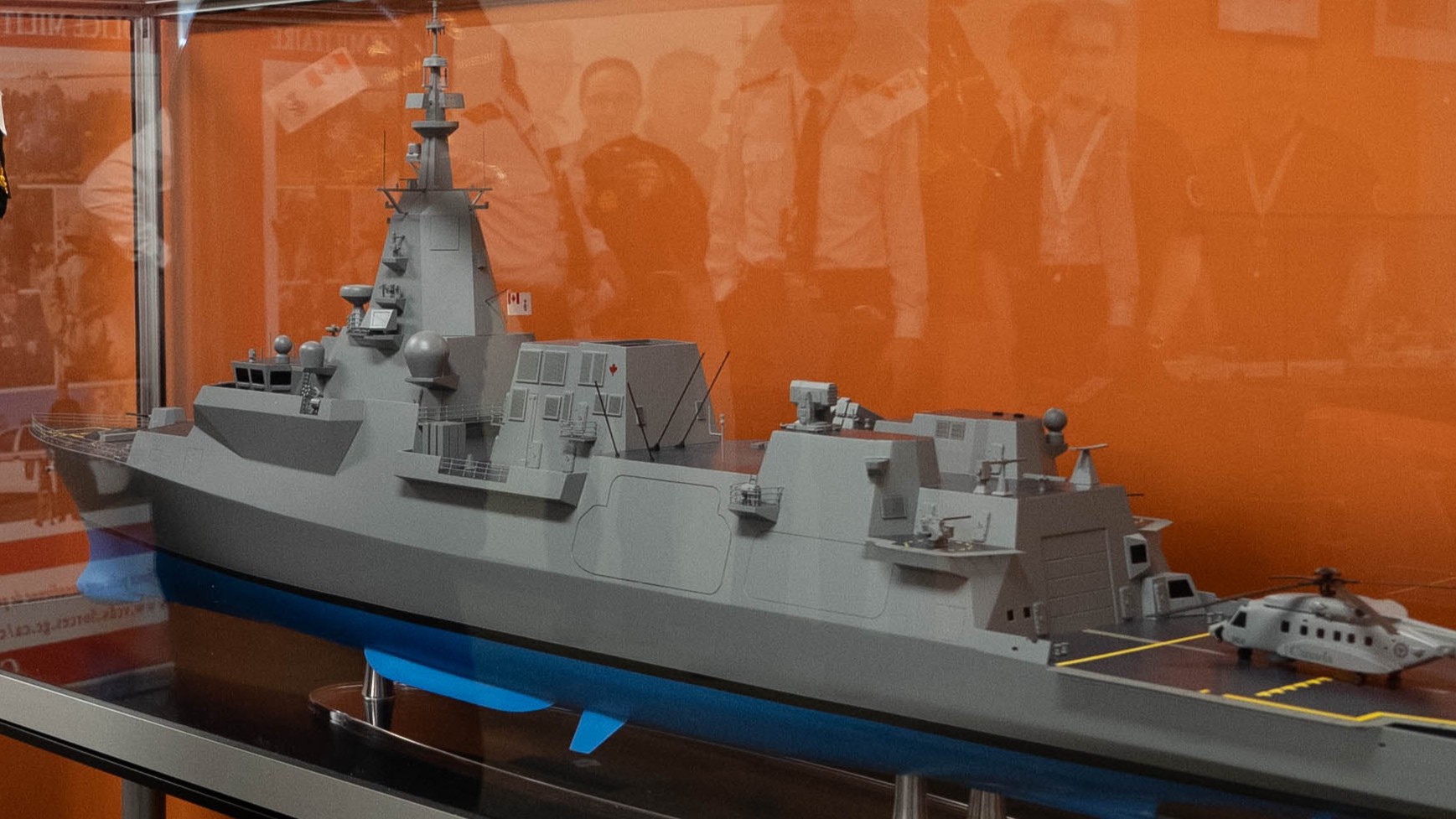
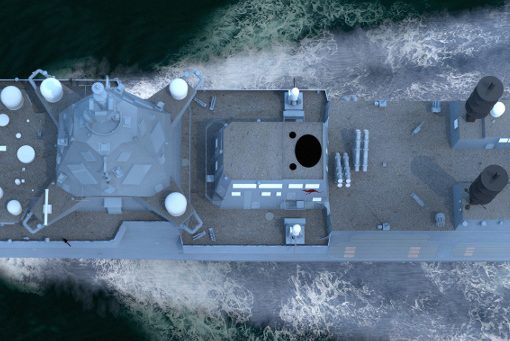
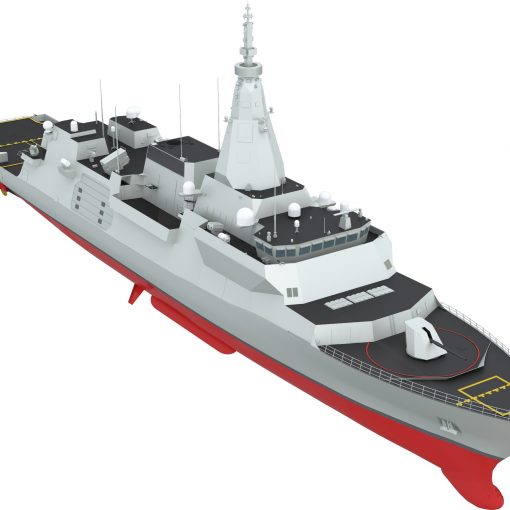
Here is the latest model as of 24 March 2026 for the Canadian Surface Combatant (CSC) Type 26 RCD Destroyer weapons & systems design provided at the Calgary, Lockheed Martin (LM)/DND booth at DEFSEC West 2026. The total Leonardo Suite including the Leonardo 127mm 5” Vulcano/Lionfish & 2 x Marlin 30mm Gun systems (including the NA-30S Mk 2 systems) have been fully removed and replaced by the US Mk 45 Mod 5 (radar system center-lined on top of the Bridge) and 2 x Bushmaster British made Mk 38 Gun systems. The NSM placement has changed (again). Now located Top-side/Starboard Aft. The RAM 116 Missile system (21) is finally confirmed located Top-side Port on a plinth with a firing arc (just forward of the Port Bushmaster Gun (looks like just 1 x RAM 116 Missile system-for now). The US-AN/SLQ-32 (V) 6 EW suite is now included. ExLS System Aft of the funnel is gone and no longer part of the design. There is an, as of now, still unidentified 12 x Missile system on the Port/Fwd Waiste Area-(not known if there is also another system on the Stb’d side). The number of MK 41 VLS Cells Fwd is still at 24 Cells vice 32 but there is still room for future growth to 32 Cells. As seen by this latest graphic, the mast is taller but has lost the X Band Illumination AESA Radar. It has been identified that the X Band Illumination Radar is now not required for the CSC Destroyer as the SPY 7 (V) 3 has the capability of targeting all threats on its own. The Port/Starboard Waist areas midships are still "cut-out" to save weight no doubt (or perhaps for 'future-proofing'). The crew size is still at 210 personnel. The ship tonnage is still at 8,080 tonnes although that may not be the full-load weight (possibly around 9,400 tonnes):
1. 1 x Lockheed Martin (LM) Solid State 3D Active Electronically Scanned Array (AESA) "S" Band Long Range Discrimination Radar (LRDR)-SPY 7 (V) 3 Phased Array Solid State Air Search Radar with integration into the CMS 330/Aegis Combat System-Confirmed by Lockheed Martin (LM/DND).
2. 2 x "X" & "S" Band Navigation Radars from BAE Systems with integration software into the CMS 330/Aegis Combat System.
3. MacDonald Dettwiler Associates (MDA)-US made US-AN/SLQ-32 (V) 6 Electronic Warfare Suite System & Nulka EW Decoy launchers.
4. MacDonald Dettwiler Associates (MDA)-Possible Future High Energy Laser (HEL) Warfare Defence System (MDA has not confirmed).
5. At least 12 “unknown” strike length ExLS-(Port-Fwd Waiste area-just below the SATCOM AE); VLS-ESSM2, SM II/IIIC-SM3/SM6 & Hypersonic Ballistic Cruise Missiles (fitted for, but not with for CSC Batch I build) Batch II build may have up to 64 ExLS Mk 41 cells as with the BAE proposed missile fit for the Australian Hunter class Type 26 Frigate and 4x4 trainable NSMs. (The Multi-Mission Bay (MMB) & Mission Bay Handling System (MBHS) would then have to be replaced to accommodate the increased missile load midships); Raytheon Tomahawk Land Attack Cruise Missiles (TLAM).
6. Combat Information Management Systems-Links 11/16/22/GCCS-M/Mode 5S Identification Friend or Foe (IFF).
7. Light Weight (LW) MK 54 Torpedo system and magazines with twin launcher tubes (Port/Stb’d).
8. Sea Spider anti-torpedo system (Magellan/TKMS)
9. 12 x as yet “unknown” ExLS VLS-Port-Fwd Waiste Area Close In Air Defence System (just below the Satcom Antenna).
10. 2 x 4 Quad packs Kongsberg NSM Surface-To-Surface Missiles-Port side Aft above Multi-Mission Bay (MMB). These NSM missiles may be increased to 4 x 4 trainable Quad packs for CSC Type 26 Batch II build.
11. Medium Caliber Gun: 1 x 5-inch US MK 45 Mod 5 127mm (LW) Land Attack and Anti-Air gun. This gun will confer the CSC ships with the ability to fire extended-range, precision-guided munitions – both in guided long-range and the ballistic extended-range versions – with conventional Anti-Air Warfare ammunition as well.
12. Secondary Guns: 2 x British made Bushmaster X-Gun 30mm weapon systems Stabilized Rapid Fire Naval Gun System.
13. Cooperative Engagement Capability (CEC)-Sensor Netting-Integrated Cyber Defence System (future-proofing for possible Ballistic Missile Defence (BMD) capability.
14. Integrated Bridge & Navigation from OSI Maritime Systems.
15. Internal/External Secure Communications Suite-HF/UHF/SHF/VHF/SATCOM from L3 Harris.
16. Electro Optical & Infrared Systems; Radio/Radar Electronic Support Measures (ESMs) to include: Frequency Identification; Laser Warning & Electric Countermeasures System (ECM-RAVEN); Radar/Radio Frequency Electronic Jammers; Electronic Decoy Systems.
17. Lockheed Martin Combat Management System (CMS)-330/ACS-Aegis Combat Systems in support of CEC and possible future BMD-Ballistic Missile Defence (BMD) Capabilities.
18. Ultra Electronics Hull Mounted Sonar (HMS)-Ultra S2150.
19. Ultra Electronics Active/Passive Towed Array Sonar (TAS); Towed Torpedo Countermeasures (TTCM)-Sea Sentor S21700.
20. Ultra Electronics Variable Depth Sonar (VDS) known as TLFAS-Towed Low Frequency Active Sonar; (This system is designed to identify and track stealthy submarines in harsh sea environments); Future XLUUV Drone capability (MMB).
21. Sonobouy Processing System (SPS) from General Dynamics with expendable Acoustic Countermeasures.
22. Combined Diesel Electric Gas Turbine Propulsion System (CODLOG) to include 1 X Rolls Royce RR/MT 30 Gas Turbine; 2 X Electronic Motors from General Electric; 4 X RR MTU Diesel Generators; Integrated Platform Management System (IPMS) from L3 Harris.
23. CSC Reconfigurable Multi-Mission Bay (MMB) along with a Rolls Royce’ Mission Bay Handling System (MBHS)-reconfigurable mission and boat bays including a 9m rescue boat, two 9-12m multi-role boats, and modular mission support (standard 20ft sea containers, other vehicles).
24. “Future-Proofing”-Directed Energy Weapon (DEW) Systems-U.K. Dragon Fire DEW (Port/Stb’d waist areas) or USN AN/SEQ-3 Laser Weapon System/Tactical High Power Operational Responder (THOR) DEW systems. These DEW systems however, do require more power than usual weapons systems and may necessitate higher power rated CSC Destroyer Diesel Generators (DGs). Autonomous Extra Large Uncrewed Underwater Vehicles (XLUUVs) for Special Ops missions (To be housed & launched in the Multi-Mission Bay (MMB). Ballistic Missile Defence (BMD) Capability. SM3/SM6 and Hypersonic Long Range Ballistic Cruise Missiles.
25. 1 x S-92 CH 148 Cyclone Sikorsky ASW Helicopter with the ability to carry 2 X Cyclones if required in the hanger/MMB; Skeldar V200 UAV-Unmanned Aerial Vehicle helicopter drone systems (possibly x 2) from Saab-known as CU-176 "Gargoyle" helicopter drones either in the hanger or in 20 ft containers in the Multi-Mission Bay (MMB).
26. Speed-approximately 27-30 kts. Statement Of Requirement (SOR); required capability for US Carrier Battle Group (CBG) Ops.
27. Crew Compliment-210 max (with separate female officer/sailor quarters).
Overall, this model confirms a lot of what’s been expected over the past year-simplification, more Standard NATO Systems, and fewer experimental additions. Still some mysteries but we’re likely getting closer to the final configuration as the program moves towards CDR.
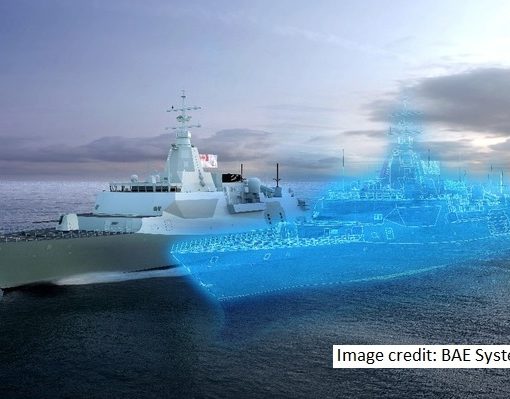
Cover image: A photo of the latest large-scale model of the River-class Destroyer. Credit: Royal Canadian Navy

9 thoughts on “CANADIAN NAVY REVEALS LATEST MODIFICATIONS TO THE RIVER CLASS DESTROYER (RCD)”
There is also an article on the Navy Lookout web site:
https://www.navylookout.com/canadian-navy-reveals-latest-modifications-to-river-class-destroyer/
The unidentified launcher you refer to are probably the Nulka launchers. In a personal observation, with this new configuration I wonder if they could replace the ESSM for Sea Ceptor for point defence? It would probably be a nightmare to integrate it to AEGIS but it probably would not add to much weight to adapt the RN configuration with the Cold Launch system fitted for 24 cells forward of the MK41 launchers and 24 cells aft of the funnel for a total of 48 missiles. It would free up the 24 MK41 cells for the SM2 and TLAM missiles. Yes the Sea Ceptor has a shorter range but if you carry more SM2s! Maybe!
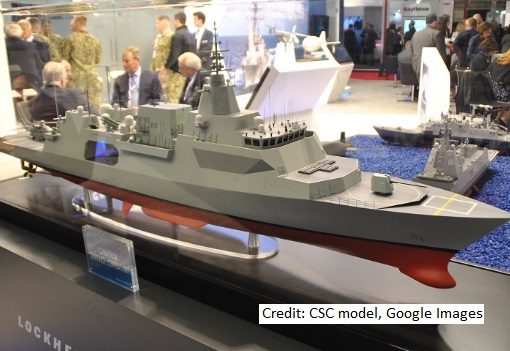
Yes Mikael, thanks for that. I should have added that pic from the RN magazine article. I like that model pic better. Again, thanks for your help on this. Cheers!
The 12 “unknown” is a Long Endurance Electronic Decoy (LEED). It’s a soft kill system.
Thanks for that Ted. Now that we know what the ‘unknown’ is, I will add that to the new RCD Model characteristics. It will start production for the USN IN 2027, I believe, and should also be available to the RCD soon after? A good addition to the SLC-32 EW defence system for the RCD. I take it that it will only be incorporated on the port side midship’s waist only?
Hello David,
The LEED launchers are present on both sides in the recent model showcase, with at least 18 cells assuming the decoys cannot be multi-packed.
Hello David,
Thank you for the overall post updating the information about the River class destroyer. However, there is one thing I would like to mention. In future articles, I think it would be best to clearly delineate what capabilities are confirmed or directly viewed through the physical model/accompanying data sheets and what is conjecture on your part. It can be confusing for some people to distinguish between is possible/probable and what is confirmed/fact.
With that being said, it seems like the RCD is finalizing itself towards standardized AEGIS integrated items for the first batch at least to speed up design finalization and overall production. While some armchair admirals will continue to bemoan ‘only’ 24 Mark 41 VLS, the RCD in this arrangement is a very versatile and capable vessel for the roles which the RCN is looking to fill. The adoption of LEED in such large numbers should make the RCD very difficult to actually hit given how high capability these advanced decoys will likely be.
Thanks for that post David. In regards to onboard ECM, as much as I would like to see Raven included, I note an old October 2024 article that claims the Raven ECM was descoped: https://www.jedonline.com/2024/10/22/canada-looks-to-us-navy-for-non-developmental-ew-for-csc/
With regards to offboard ECM, I note Australia in addition to having Nulka for their Type-26 frigates, has also elected to go for Rheinmetall MASS offboard chaff/IR (and other munitions possible). The logic being (I assume) that the munitions for MASS are significantly less expensive than Nulka ‘one-way’ drones, and for extended deployment deployments having MASS available could significantly improve one’s munition availability. Further MASS has a plethora of possible munitions and it is not confined only to chaff/IR (although in itself is very good). I believe the RCN already has MASS on its Halifax-class frigates, so likely there is already a CMS-330 interface present for MASS. My hope is that if not for batch-1, then for batch-2, that the RCN implements MASS. If by the time batch-2 is produced, it is possible some Halifax-class may be undergoing decommissioning, in which case the MASS from those decommissioned ships could possibly be repurposed to the River-class.
And one final comment – according to a U.S. Congress document (link https://www.govinfo.gov/content/pkg/CREC-2026-01-06/html/CREC-2026-01-06-pt1-PgS39-2.htm ), the Canadian River-class is also slated to receive four Shipboard Panoramic Electro-Optic Infrared (SPEIR) systems. If so, this is a significant passive detection system. I note the L3 Harris brochure on this system: https://www.l3harris.com/sites/default/files/2025-07/L3Harris-SPEIR-SPATIAL-sell-sheet-hr.pdf … I assume if correct, that is destined for batch-1. Its not clear to me, though, which equipment in the SPEIR for the River-class will provide the role of the NFOV and WFOV equipment. Possibly the Mk-20 EOSS could be the NFOV? (But that is speculation by me.)
Hi David, another item to note (which is also mentioned here at the bottom of the article: https://www.jedonline.com/2024/10/22/canada-looks-to-us-navy-for-non-developmental-ew-for-csc/ ) is that “re-use of the AN/SRD-506 communications intercept/signals intelligence system currently being rolled out to the RCN’s current Halifax-class frigates under Project StrongBow” is also planned for the River Class destroyer.
Further to my above comment re: Electro Optical … I speculate that .
(1) Mk20 EOSS may contribute to the fire control of BAE 5”/62-caliber Mk45 gun
(2) Mk48-mod-2 EOSS may contribute to the fire control of the Mk38 Mod-4 30mm (also called DS30M Mk2 (Royal Navy term) or Seahawk DS A2 (MSI Defense Systems term))
… and further speculate that both may be part of the ship wide SPEIR system (as NFOV equipment).