By Dave Perry, 17 February 2026
[This is an excerpt of an article in Vol. 21, No. 3 of Canadian Naval Review. For the full free access article, click on the link below.]
Since becoming Prime Minister, Mark Carney has made defence a priority in a way Canada has not seen in decades and his first budget, presented in November 2025, reflects that focus. While reactions to the budget overall have been mixed about whether it was as transformational as the government had suggested it would be, on the defence front Budget 2025 is genuinely transformational.
At the NATO summit in the Hague in June 2025, allies committed to meet a new investment pledge. The agreed-upon spending metric of allocating 2% of Gross Domestic Product (GDP) to defence was revised to a new commitment to spend 3.5% on ‘core defence’ while making an overall commitment of 5% of GDP, including other investments in resilience, infrastructure and other measures, all by 2035. Budget 2025 unambiguously commits to delivering on this path of increased defence investment stating “Canada will invest 3.5 percent of GDP by 2035 in core military needs” and noting that Canada is on a path to meeting the total commitment by the same year. As well, the 2025 federal budget reinforces the pledge the Prime Minister made to get Canadian defence spending to the old 2% mark this fiscal year. For years after agreeing to the old alliance investment pledge made at the 2014 summit in Wales, the Canadian government failed to follow through. Notably, after making the pledge at the Wales Summit, the government never reflected the commitment in budgetary documents, either with written commitments or actual dollars. The unequivocal commitment to meet the mark in Budget 2025 sends an important signal.
The budget most notably reflects the full impact of the funding decision Prime Minister Carney first announced 9 June 2025 when his government gave the Department of National Defence (DND) and the Canadian Armed Forces (CAF) the $9 billion in extra funding the government estimates is needed to spend 2% of GDP on defence in Fiscal Year 2025/2026. The budget reflects that the $9 billion is just the first part of a massive injection of funding over five years. Including the $9 billion, the Prime Minister announced and put into the Estimates this past June, Budget 2025 outlines a total injection of $81.8 billion on a cash (or actual dollars) basis for a range of defence investments. The funds are spread out over several areas spanning the breadth of the defence portfolio: $20.4 billion for personnel; $19.0 billion for repairing and sustaining capabilities and defence infrastructure; $10.9 billion for upgrades to digital infrastructure; $17.9 billion for new equipment and ammunition; $6.6 billion to implement the Defence Industrial Strategy; $6.2 billion over five years to expand Canada’s defence partnerships; and $805 million for the Canadian Coast Guard, Canadian Security Intelligence Service (CSIS) and Public Services and Procurement Canada for complementary initiatives.
To put this increase in perspective, the five-year funding injection for defence outlined in Budget 2025 represents about 80% of the $103 billion commitment made in the last Justin Trudeau defence policy – Our North, Strong and Free – but that document’s spending horizon spanned20 years, not five. Over the first five years of Our North, Strong and Free, a spending increase of just $10.5 billion was outlined – only one-eighth as much money for the military as Budget 2025 provides. If future governments committed only to maintain spending at the new level reflected over the next five years (and Budget 2025 clearly commits to increase it, substantially), this would add over $300 billion extra to defence coffers over the next two decades.
…
Read the full article at https://www.navalreview.ca/wp-content/uploads/public/vol21num3/cnr_vol21_3_Perry.pdf
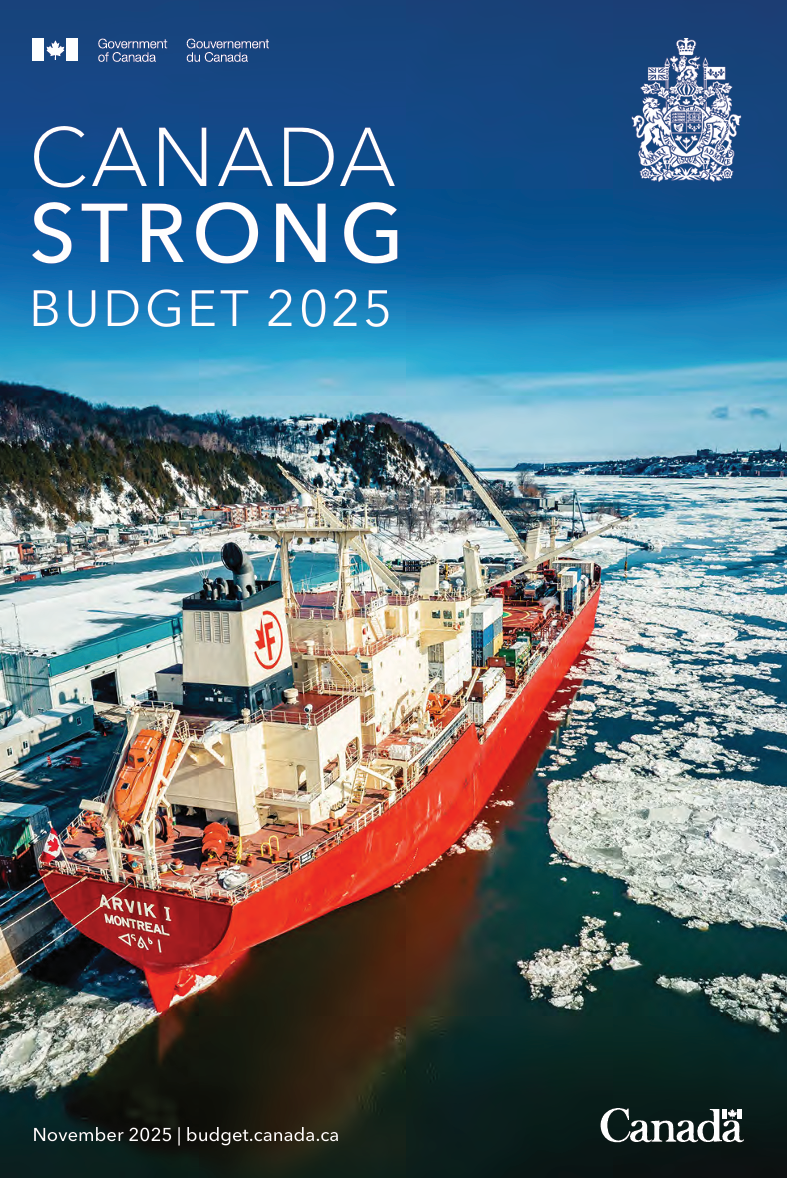
Image: The front cover of the Carney government's first budget in Fall 2025. Credit: Government of Canada.