By Ted Barnes, 10 June 2026
The latest issue of CNR presents retired Major Les Mader's proposal for a DDGH(A), an Arctic destroyer intended to combine the combat power of the future River-class destroyers with the ice capabilities required for sustained Arctic operations. On the surface, it is an appealing concept. Canada faces growing strategic competition in the North, longer navigation seasons, and increasing demands to demonstrate sovereignty. However, the article ultimately reads less like a naval capability study and more like a land warfare solution applied to a maritime problem. While military experience should always be valued, there is a significant difference between understanding strategy and understanding the realities of designing, building and operating warships.
The central weakness of the proposal is that it attempts to solve every perceived naval challenge with a single platform. The DDGH(A) would carry destroyer level combat systems, substantial missile inventories, helicopters, unmanned systems, anti-submarine warfare capabilities, Arctic endurance and meaningful icebreaking capability, all while maintaining the performance expected of a modern combatant. To a sailor, the immediate question is simple...what gets sacrificed? Every additional capability adds weight, complexity, cost, maintenance requirements and design compromises. Naval architecture is a constant exercise in balancing competing demands. The article largely assumes these trade offs can be overcome without significant consequences.
Perhaps the most revealing aspect of the article is its treatment of ice capability. Ice strengthening is presented almost as an additional feature that can be added to a destroyer design. Anyone who has spent time at sea understands that ice capability affects virtually every aspect of a ship. Hull form, displacement, fuel consumption, speed, endurance, stability, maintenance requirements and cost are all affected. There is a reason why the RCN built the Harry DeWolf-class for Arctic patrols and the River-class for high intensity naval combat. Those requirements were deliberately separated because combining them into a single platform creates exactly the sort of compromises the DDGH(A) attempts to ignore.
The article also approaches naval operations as though warships must function independently, capable of addressing every threat they may encounter in isolation. That is not how modern navies fight. Naval warfare is built around task groups, layered defence, shared sensors, aviation support, logistics networks, satellites, submarines and allied integration. No warship is expected to independently conduct sovereignty patrols, anti-submarine warfare, area air defence, long range strike and Arctic sustainment simultaneously. That may make sense when viewed from a land warfare perspective, but fleets are designed around complementary capabilities, not a jack-of-all-trades platform.
Even more surprising is the complete absence of any discussion of the Continental Defence Corvette program. While proposing a new Arctic destroyer, the author never acknowledges that the RCN is already pursuing a combatant that appears intended to fill many of the same operational gaps. Current concepts point toward an ice class warship with modern sensors, long endurance, unmanned systems capability and combat power at least comparable to the Halifax-class. Some proposed designs feature 24 vertical launch cells, exceeding the Halifax-class16 cell launcher. If the CDC delivers even a portion of its anticipated capability, much of the operational space envisioned for the DDGH(A) may already be addressed without creating another class of warship.
The proposal also bears a striking resemblance to the recurring PMSV concepts proposed in this forum for the last few years. Like those proposals, the DDGH(A) attempts to solve multiple strategic challenges with a single vessel. Arctic sovereignty, ASW, fleet air defence, long-range strike, unmanned systems operations, presence patrols and expeditionary support are all combined into one ambitious platform. Such concepts always appear attractive on paper. Yet history repeatedly shows that ships designed to do everything often become extraordinarily expensive, technically challenging and operationally compromised. The DDGH(A) risks becoming another example of a concept that appears elegant in theory but encounters enormous obstacles long before steel is ever cut.
If this proposal is simply a thought exercise unconstrained by budgets, industrial realities, crew requirements, or procurement timelines, then looking at the problem through a naval lens leads to a very different conclusion. Rather than attempting to create a hybrid Arctic destroyer, I would simply build several additional Polar Class heavy icebreakers, properly militarize them with modern air defence, anti-submarine and surface warfare systems, and use them as true Arctic combat support platforms. In many respects, this mirrors concepts examined during the Harper era before costs ultimately killed the idea and the RCN ended up having AOPVs instead. Even then, we must be honest about where Arctic warfare is heading. The decisive platforms in any future Arctic conflict are unlikely to be surface combatants. The vast distances, harsh environment, limited infrastructure and expanding sensor networks favour aircraft, uncrewed systems and submarines above all else. Surface ships will remain important for presence, sovereignty, logistics, and command and control, but if a shooting war ever comes to the Arctic, it will largely be fought beneath the ice and above it, not on it.
None of this is to suggest the article lacks value. The Arctic is becoming increasingly important. Canada must think seriously about future naval requirements in the North. However, the proposal ultimately highlights the difference between looking at a map and taking a ship to sea. Sailors, being practical creatures, immediately begin asking questions about weight margins, fuel consumption, hull design, logistics support, maintenance requirements, crew demands and cost. The article rarely addresses those realities because it starts from the assumption that all desired capabilities can be concentrated into a single platform. The sea is unforgiving, and naval architecture is even less forgiving. The DDGH(A) is an interesting thought experiment, but it feels far more like a concept developed from a map table than from a bridge wing, and that may be its greatest weakness.
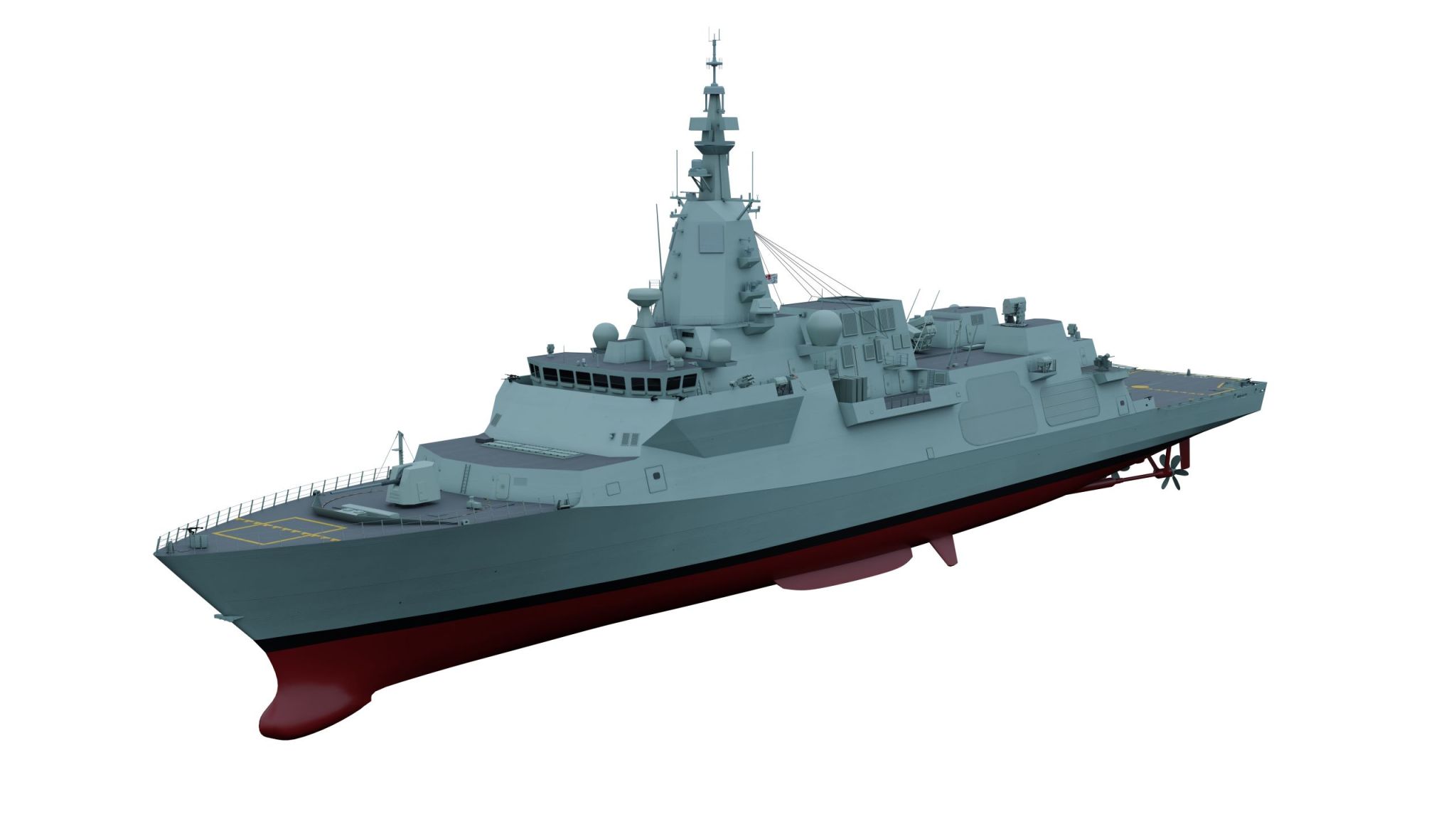
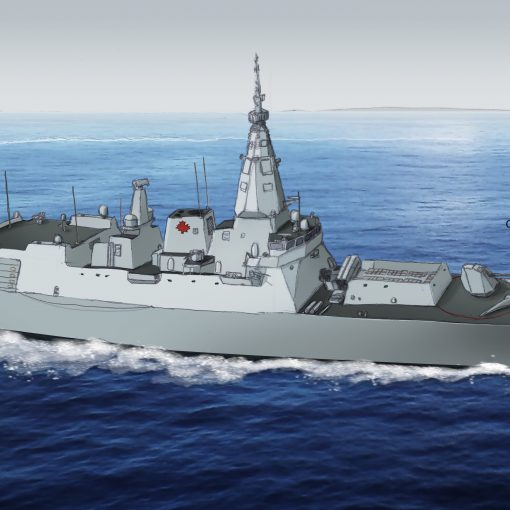
Image: The latest rendering of the River-class destroyer, posted by ADM (MAT) on LinkedIn in April 2026 following progress on the ship's design review. Credit: Assistant Deputy Minister (Materiel)

8 thoughts on “The DDGH(A) and the Perils of Designing Warships from a Map Table”
Good afternoon Ted,
Your post deserves a significant response. However, I cannot do that until some clear information is available with respect to the continental defence corvette (CDC) and I am able to see the final, printed copy of my article so that I know exactly what you read.
WRT the CDC it was no more relevant than the CASEV (corvette) of the earlier 1990s until DND briefed industry in April 2026 about what is being sought. This date is well after my DDGH(A) article had been accepted for publication. The available CDC information is scattered in various places. Are you able to provide the concise list of what the CDC may well be which allowed you to say that “If the CDC delivers even a portion of its anticipated capability, much of the operational space envisioned for the DDGH(A) may already be addressed without creating another class of warship.”?
Ubique,
Les
Good afternoon Les,
Thank you for your note.
I assumed you had electronic access to your article prior to publication, which is why I referenced it as I did. I certainly understand wanting to review the final printed version before discussing specific points in detail although it appears the editors rarely change too much in content.
My comments regarding the CDC were based on information that has gradually emerged over the last several years through interviews with industry representatives, comments from the CRCN, public presentations, CANSEC displays, industry day briefings, and various defence publications. I also have first hand experience in those circles. While much of the information remains scattered, a reasonably consistent picture has started to emerge.
I’ll discuss what can be gathered publicly. The CDC appears to be evolving well beyond the simple corvette concepts discussed in previous decades. Recurring themes include global deployability, Arctic capability, modular mission systems, embarked uncrewed systems, significant automation, integration into task groups, and a combat capability that may include anti-ship missiles and vertical launch systems that look to match what the River Class will have with most of the capability of a Halifax Class. Industry proposals displayed recently seem to reinforce that direction.
Of course, much remains speculative until DND releases a formal requirement. I will also admit that an enterprising person can glean all sorts of interesting insights from industry presentations, naval conferences, defence publications, and even discussions taking place in naval and defence chat groups. When viewed collectively, they help fill in many of the blanks that still exist in the official public narrative.
Based on those indicators, my observation was simply that if the CDC ultimately delivers even a portion of the capabilities being discussed publicly, it may occupy some of the operational space envisioned for the DDGH(A) concept without requiring the RCN to introduce another major class of warship.
I look forward to reading your comments when you have a look at the your final on paper version.
Cheers
Ted
Good afternoon Ted,
The opening up the Arctic due to climate change and the turmoil that has followed the Cold War’s end push Canada to pursue a ‘dual track’ defence strategy. The first track is a ‘distant defence’ one which sees Canada sending forces overseas as part of collective security arrangements to confront perceived adversaries far from home. The second track requires the CAF to possess very capable, specialized Arctic sovereignty forces.
The RCN meets the ‘distant defence’ requirement by sending open-ocean, expeditionary forces where needed as part of allied/coalition operations. The RCN’s ships could find themselves participating in a wide range of missions. This requires them to be very capable and well able to defend themselves, as no one can predict how events will unfold and any weaknesses may actually increase the danger of the ships being attacked. The RCN’s DDGHs, SSKs, and AORs will provide the ships needed for capable, open-ocean, expeditionary task groups.
The Arctic sovereignty defence mission will see RCN ships operating in small forces, with limited outside support, over a vast, hostile terrain with minimal or no local infrastructure, at the limits of tenuous logistics chains, and dependent on the quality, capabilities, and luck of their forces and the survival of their key platforms for success. These ships must be able to operate nearly alone; the Arctic is so vast and the available ships so few that we cannot assume that they will always be sailing in close proximity. In addition to these challenges, the ships will face the constant risk of sea-ice affecting their operations throughout the year. Therefore, Canada must be able to deploy self-sufficient, very capable naval forces which can undertake a range of on-site kinetic and non-kinetic responses, as an Arctic crisis unfolds and an intruder’s actions evolve.
The only ships actually being built/sought for this mission at this moment are the AOPS and SSK(A)s. They are/will be good at their intended missions but do not provide the basis for a multi-purpose task group. The missing element is a very capable surface combatant that can go from providing a visible Canadian presence during a crisis to conducting anti-air/anti-ship/anti-submarine combat at the drop of a hat if/when a crisis spins out of control. The CDC does not meet this requirement, as it is only a shadowy concept until its operational requirements have been approved and a production contract for them actually let.
Thus, my CNR commentary sought to provide an initial shape for the missing and vital surface combatant element. This aspirational concept provides a rough benchmark against which possible solutions can be measured. It aimed for the maximum capability likely possible in order not to constrain future crisis managers by making assumptions that would automatically limit the shape of the forces that they may have available too early.
The commentary never “… assumes these trade offs can be overcome without significant consequences.” Instead, it highlights three of the most obvious challenges: trade-off of volume and required capabilities; open-ocean speed and manoeuvrability in an ice-capable hull; and cost and complexity and then makes some tentative suggestions about how they might be met. As well, the commentary considers the issue of ice performance by indicating that the DDGH(A) would have a completely new, ice-capable hull that, for discussion purposes, had the DDGH’s length as the one starting dimension. This approach allows an existing vessel to be used as a reference to identify what capabilities could be incorporated into a hypothetical warship able to conduct all-ocean operations.
Having made these points, I suggested that “… DDGH(A)s could provide Canada with very capable, all-ocean warships able to serve wherever they are required … [and urged the RCN] to carry out an initial feasibility study to determine the higher-level technical specifications for a DDGH(A) that can be built in Canada and the macro-level cost of such a vessel.”
Already, I believe that the DDGH(A) described at Table 1 of my commentary can be used to evaluate tentatively (among other options):
– Your idea of heavily-armed icebreakers. Niche capability of constrained utility.
– VAdm Topshee’s idea of a CDC “… [having] the fight of the Halifax class,” with (apparently) a Polar Class 6 hull and a range of 7,000 nautical miles. A cheaper, limited DDGH(A).
(Canada’s race to build warships: Here’s what they’ll do and the yards vying to cut their steel | PNI Atlantic News)
Ubique,
Les
P.S. Not sure how your references to map tables relate to the discussion. Are they a naval idiom? L.
I think you’re being a little unfair in dismissing the Continental Defence Corvette as a “shadowy concept.”
There is already a dedicated project office standing up the capability, developing the operational requirements, and moving the Request for Information (RFI) forward. Senior RCN leadership has discussed the program publicly, and there has been enough reporting in the media that it is clearly an active procurement effort. The final requirements have not yet been approved, but that’s exactly where every major procurement starts. Calling it “shadowy” simply doesn’t reflect reality.
As part of my own job, I’ve been involved in discussions surrounding future crewing requirements for the CDC. That tells me the Navy is already working through practical issues such as personnel generation, training, and sustainment. If you’re not involved in those discussions, you probably wouldn’t be aware of them, and that’s perfectly understandable. But it does illustrate that the program is considerably further along than your commentary suggests.
I also think you’ve created a false comparison. Your proposed DDGH(A) is not a Continental Defence Corvette. It is, in effect, a heavily armed Arctic corvette that approaches destroyer levels of capability, complexity, and cost. It tries to combine expeditionary air warfare, anti-submarine warfare, anti-surface warfare, Arctic sovereignty, ice operations, and independent sustained operations into a single platform. Naval history is littered with examples of ships that attempted to do everything and ended up costing far more while compromising on nearly every mission.
The RCN is pursuing a layered fleet for a reason. The Harry DeWolf class provides Arctic presence and sovereignty patrols. The future submarines provide the undersea combat capability. The River-class destroyers deliver the high-end warfighting capability. The CDC is intended to bridge the gap below the destroyer. That is a balanced force structure, not a collection of ships all trying to perform the same mission.
Before concluding that the CDC “doesn’t meet the requirement,” perhaps it would be prudent to let the Navy finish defining what the requirement actually is. Then we can compare real capabilities against real requirements, rather than comparing one conceptual ship against another.
Hi Ted,
Thank you for your reply and the new information. The CDC project sounds encouraging.
My comment about a “shadowy” capability stems from a skepticism that has developed over some 50 years of defence promises that started out slowly and then petered away to little or nothing, even when made by the government of the day! If all the public promises and comments had borne fruit:
– we would have a fleet of SSNs and not require the 212CDs.
– the CDC would be being pursued to replace the in-service CASEVs.
– the army would be paying for the decision to buy a useless Armoured Combat Vehicle instead of the Leopard 2 tanks that thankfully we bought.
– there would a project office currently working on the procurement of at least two Polar Class 2 Landing Platforms Arctic.
– there would be a Marine Commando Regiment sitting isolated at CFB Comox.
With respect to your comments about my DDGH(A) suggestion, if the CDC is not ice-capable we will still face the problem that the DDGH(A) concept tries to address. If it is Polar Class 6, it will provide a “DDGH(A)-lite.”
Time will tell.
Ubique,
Les
Les,
For some, 50 years of disappointment have coloured their assessment of projects that are actually moving forward today.
There is a fundamental difference between criticizing a capability that was cancelled and dismissing one that is actively being developed. The CDC isn’t some “shadowy” concept. There is a dedicated project office developing the requirement, industry has been engaged, and enough information has appeared publicly to demonstrate this is a genuine procurement effort. The RCN isn’t in the habit of publishing every internal briefing or capability study, nor should it.
The same applies to personnel. As someone who works within the training organization, I can tell you that discussions about crewing, training pipelines, and future force generation have been underway for some time. They don’t happen in public, so it’s understandable that people outside the organization don’t see them. That doesn’t mean they aren’t happening.
Les, I also noticed your comments about nuclear submarines and Polar Class 2 amphibious ships. To be perfectly honest, Canada probably made the right decision not to pursue either capability. Both would consume staggering amounts of money in infrastructure, training, maintenance, and long-term sustainment. We have a finite defence budget. Every dollar spent chasing prestige capabilities is a dollar not spent on capabilities the RCN actually needs. Honestly I would place my armed icebreakers concept in that category as well.
Instead, the Navy is building toward a balanced fleet: River-class destroyers, Joint Support Ships, Arctic and Offshore Patrol Ships, modern conventional submarines, and what appears to be a heavily armed, globally deployable, ice-capable corvette through the CDC project. That is a far more realistic and sustainable force structure than trying to field SSNs and Polar Class 2 amphibious ships.
Finally, I think your DDGH(A) proposal is trying to solve a problem the RCN has not identified. Everything we’ve heard points toward a heavily armed corvette, Arctic capable, designed to complement the River-class destroyers, not a destroyer-sized Arctic combatant.
Designing ships around what we personally think the Navy should have, rather than what the Navy has identified as an operational requirement, is exactly the sort of map table thinking that started this discussion.
Time will tell, as you say. But the evidence today suggests the CDC is a real program progressing through the normal procurement process, not another mythical capability waiting to disappear.
Hi Ted,
I hope that the CDC project that you describe comes to fruition in a timely manner.
If the resulting corvettes are Polar Class 6 or better they will provide at least some of the capability that the DDGH(A) concept seeks.
Ubique,
Les
Hi Ted,
Your comments have led me to wonder:
– whether the AOPS were part of the navy’s identified requirements or whether they were imposed on it by the Harper government.
– how many SSK(A)s the navy wanted, say 3 years ago before the quantity of up to 12 appeared.
Do you happen to know?
Ubique
Les