By Sharon Hobson and Duncan (Dusty) Miller, 14 June 2026
[This is an excerpt of an article in Vol. 22, No. 1 of Canadian Naval Review. For the full free access article, click on the link below.]
Given recent events in the Middle East, it is more important than ever to remember the events of the recent past in the region. The year 2026 marks the 35th anniversary of the Gulf War. The war was triggered by the Iraqi invasion of Kuwait at the beginning of August 1990. In response, the United Nations Security Council passed a series of resolutions condemning the invasion and calling for Iraq to withdraw – it did not. This resulted in the formation of a coalition of states, led by the United States, to force Iraq to withdraw. Included in this coalition was Canada. This article traces the origins of the war, and the Royal Canadian Navy’s (RCN) participation in it – co-written by one of the RCN participants. A slightly revised version of this article will appear as the introduction to the new edition of the book Canada in the Gulf War to be published this fall.
Iraq’s decision to invade Kuwait in August 1990 should not have been a surprise. At the end of the 1980-88 war between Iraq and Iran, Iraq found itself heavily in debt to Kuwait and other gulf states. Iraqi leader Saddam Hussein asked them to forgive the debt but they refused. Hussein had additional issues with Kuwait, among them a territorial dispute, an accusation that Kuwait was engaging in diagonal drilling under the border and stealing oil from Iraq’s Rumaila oilfield, and the lure of Kuwait’s substantial oil reserves and seaports. Feeling confident of success with an armed force considered the fifth largest in the world, he made the decision to invade.
This decision was partly based on his assessment that the United States and others would not oppose him. He had already positioned an invasion force on Iraq’s southern border and the international community had not shown any great concern about this. In fact, most countries viewed the Iraqi threat as just another phase in ongoing Middle East struggles warranting little more than symbolic gestures of response. To that effect, at the end of July, the US Navy (USN) engaged in joint exercises in the gulf with warships of the United Arab Emirates, and the USS Independence carrier battle group was directed to the region, with the expectation that a limited show of force by the West would be sufficient to deter any aggressive moves by Iraq.
It didn’t. On the night of 1-2 August 1990, Iraq invaded Kuwait and by noon on the 2nd it had essentially taken control of the country and 10% of the world’s proven oil reserves.
The war-hardened Iraqi military was a formidable force, one million strong, with 5,000 battle tanks, 10,000 other armoured vehicles, 4,000 artillery pieces, 700 combat aircraft, and anti-ship missiles. In addition, Iraq had stockpiles of chemical weapons, as well as development programs for biological and nuclear weapons, all of which could be delivered by modified Soviet Scud missiles.
The United Nations Security Council (UNSC) immediately went into emergency session and on 2 August unanimously passed Resolution 660 which condemned the invasion and called for both an immediate Iraqi withdrawal and negotiations between Kuwait and Iraq to resolve their dispute. (UNSC member Yemen abstained.) The Arab states reassured an anxious United States that once things calmed down, the two countries would be able to settle their differences, most likely by Kuwait conceding some border oilfields as well as two strategically placed islands, Warbah and Bubiyan, at the head of the Persian Gulf.
Iraq did not respond to the UN demand to withdraw from Kuwait. Instead it increased its invasion force from 100,000 men to more than 200,000, and had its military take up positions near the Saudi border, which raised the question of whether it was defending its territorial gains or preparing for further aggression. Given the possible threat to Saudi Arabia which in 1991 had 20% of the world’s proven oil reserves, the United States and United Kingdom began putting together a coalition of countries prepared to counter the Iraqi forces.
With Iraq not responding to the UN demand that it withdraw from Kuwait, on 6 August the Security Council passed Resolution 661 which imposed economic sanctions on Iraq with military enforcement and allowed for the use of force to evict it from Kuwait if it had not withdrawn its troops by 15 January 1991. Of the 15 Security Council members, only Cuba and Yemen abstained.
After Resolution 661 was passed, Canada was one of the first countries to step forward with an offer of military forces but there was much discussion behind the scenes on what form that offer would take. After consultation with his senior officials, Prime Minister Brian Mulroney made the formal announcement on 10 August that Canada’s contribution to an international force to monitor the economic sanctions would be a naval task group. A month later, a squadron of CF-18 fighter aircraft was added to provide air cover. By clearly indicating that the military contribution was in support of UN Resolution 665 which authorized the use of force, the Canadian ships remained outside the American command structure and kept Canada involved in any operational decisions.2
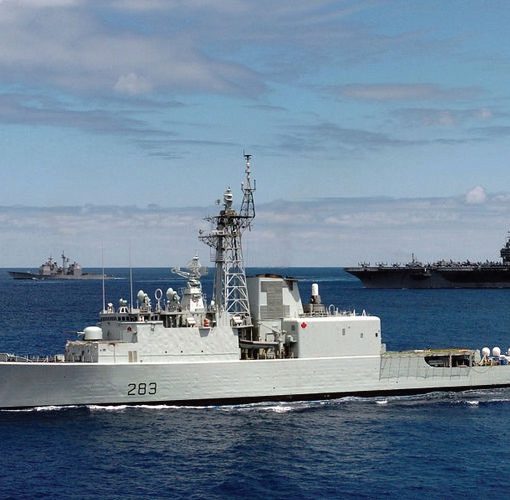
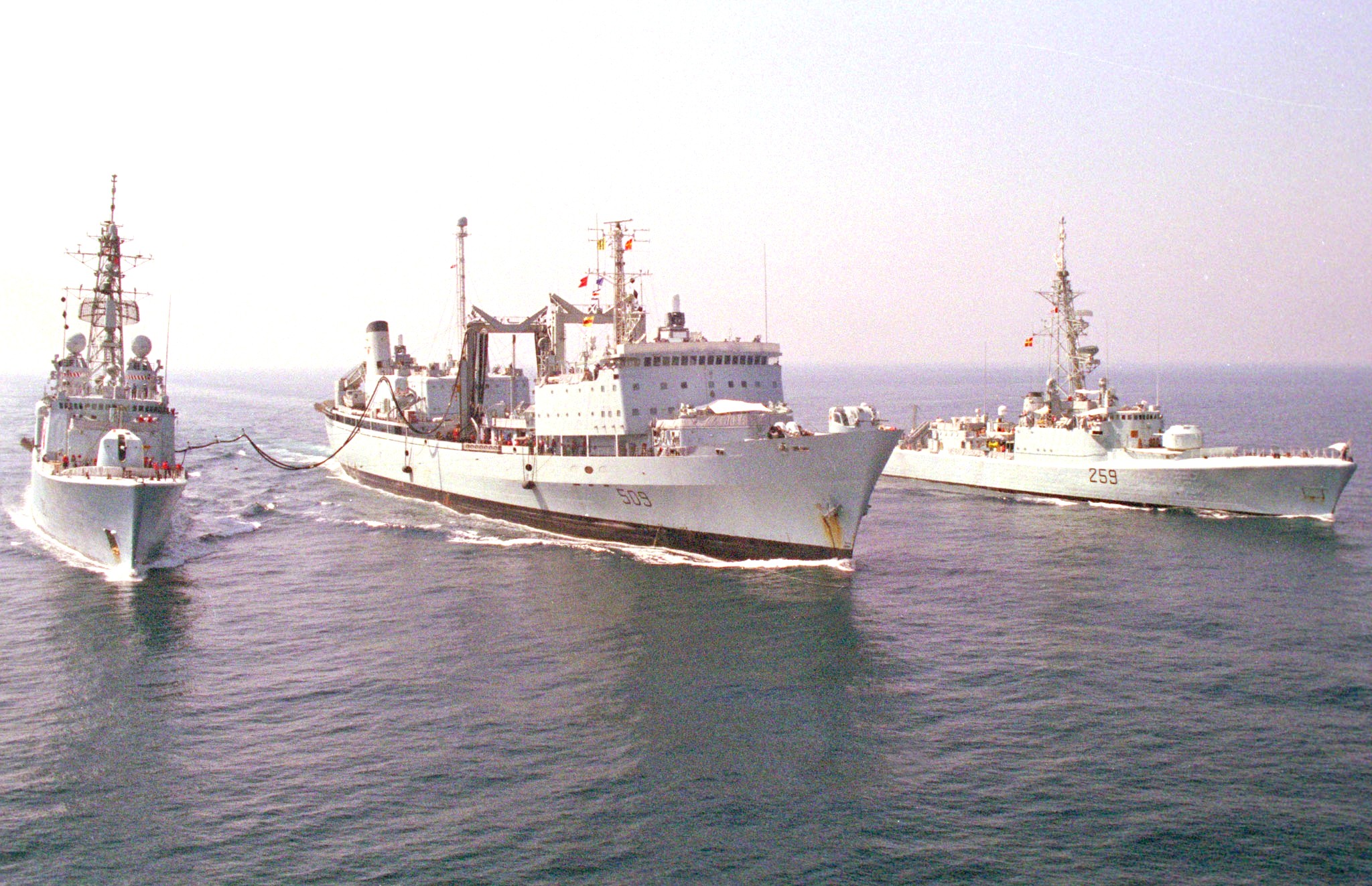
The three ships chosen to help enforce the UN embargo against Iraq – the Tribal-class destroyer HMCS Athabaskan, the Improved Restigouche-class frigate HMCS Terra Nova, and the Auxiliary Oiler Replenishment ship HMCS Protecteur – were all based in Halifax and had undergone preparations for exercises and operational deployment. They were not, however, ready for combat operations in the Persian Gulf, an area where they had never operated. For that mission, they would need to be outfitted with modern weapons and sensor systems, and they needed them all fitted in less than two weeks – work that would normally have taken at least six months.
…
To read the full article, go to https://www.navalreview.ca/wp-content/uploads/public/vol22num1/cnr_vol22_1_HobsonMiller.pdf
Image: Canadian warships conduct replenishment at sea en route to the Persian Gulf. From left HMCS Athabaskan, Protecteur and Terra Nova, September 1990. Credit: Department of National Defence