By Michael Cabral, 16 May 2026
In Some Principles of Maritime Strategy, Sir Julian S. Corbett wrote, “military action must … be regarded only as a manifestation of policy … it must never supersede it.”[i] With this view in mind, this piece seeks to reconcile policy inconsistencies that would undermine the Royal Canadian Navy’s (RCN) ongoing strategic review. In particular, my aim is to reconcile incongruences between the continental policy visions expressed in Our North, Strong and Free (ONSF) and the Government of Canada’s recent economic diversification vision, with the objective of clarifying ‘the function of the fleet’ – the navy’s purpose within Canada’s national strategy.[ii]
Foremost theorists and practitioners of naval strategy, from Mahan and Corbett to Nimitz, Brodie, and Gorshkov, remind us that a fleet’s purpose extends far beyond fighting and winning wars.[iii] Navies are instruments of national strategy, and their effective use determines the degree to which a state will profit from the sea. As the sea remains the most economical mode of communication between states, its function as the world’s highway of commerce inextricably links naval and economic strategies. This relationship imparts to naval warfare its most determinative feature: influencing what happens along sea lines of communication (SLOC) in peacetime and controlling communications during war.[iv]
For much of modern Canadian history, ties to the United States have enabled Canada to underdiscuss the link between the navy and trade. That is, consistent with a significant land border with the world’s richest country, most of Canada’s trade differs from the rest of the world in that it is predominantly conducted by land rather than by sea.[v] However, as disruptions in the United States continue, the government has made it clear that economic reliance on the United States is a weakness that must be corrected.[vi] For this purpose, Canada sits as an island, connected to new partners only by way of the sea. Thus, the sea, and by extension, the navy, will have key roles in shaping Canada’s future.
Figure 1: Canadian Trade by Mode of Transportation (1988 – 2025)
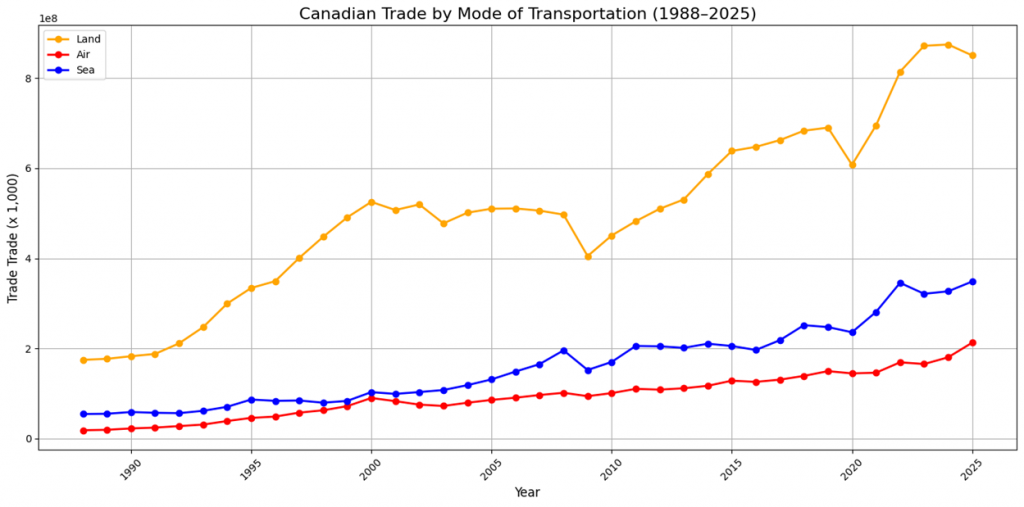
Source: Author’s Own Work Using Data from Statistics Canada, 2026, Canadian International Merchandise Trade by Mode of Transport, Customs-based, monthly (x 1,000), https://www150.statcan.gc.ca/t1/tbl1/en/cv.action?pid=1210017701
Consistent with the policy vision of diversification, the function of the RCN ought to be to ensure Canada’s access to, and expand influence within, Europe and the Indo-Pacific. However, the RCN’s attention is drawn northward by the policy vision expressed in ONSF, which states that the Canadian Armed Forces’ most important task is asserting Canadian sovereignty in the Arctic.[vii] In line with this thinking, the Arctic has maintained primacy in debate concerning the RCN’s future, with ongoing discussion on Arctic capabilities for future RCN assets.[viii] Ignoring the debate over whether this vision was justified in the first place, I argue that the policy environment that would have allowed an Arctic focus for the RCN no longer exists. With US economic policy moving away from North American integration, Canada faces the significant task of pulling away from the US market’s gravitational pull. To do so effectively will require a strong, long-term signal of commitment, something that an enhanced RCN presence in target regions can demonstrate.
Significantly, this is not to say the Arctic is unimportant; it’s to challenge the weighting assigned to the region. Different Arctic threats require different responses. Those threats concerning the bulk of the RCN are those through the Arctic, namely, Russia and China’s use of the region to influence allied actions in their primary areas of interest – Europe and the South China Sea, respectively. Therefore, RCN operations concerning the Arctic – domain awareness, air and missile defence, chokepoint control – should be viewed as contributions to preventing the region from being used as an avenue of approach for missiles or sea-denial operations. In this way, Canada would contribute to international and continental deterrence efforts while also ensuring maritime access and expanding opportunities for engagement with partners who also have an interest in oceanic sea-control.
If economic diversification is key to Canada’s economic security, the function of the RCN should align with these security needs. Focusing the RCN on the Arctic would harm this alignment by increasing platform costs, reducing combat capability and decreasing the overall size of Canada’s fleet. Furthermore, in the economic sense, an Arctic focus would also come at the cost of the benefits that would otherwise have been accrued had the RCN had a greater presence in Europe and the Indo-Pacific. Overall, as global threats escalate, Canada’s new economic relationships are intertwined with its defence capabilities, and we ignore the benefits the navy can provide in this environment to our own detriment.
[i] Julian S. Corbett, 1911, Some Principles of Maritime Strategy: A Theory of War on the High Seas; Naval Warfare and the Command of Fleets, Adansonia Publishing, 13
[ii] Both Mahan and Corbett identified the navy’s purpose as ‘the function of the fleet’. See Kevin D. McCranie, 2021, Mahan, Corbett, and the Foundation of Naval Strategic Thought, Naval Institute Press, 85.
[iii] McCranie, Foundation of Naval Strategic Thought, 11; Sea A. G. Andrews, 2026, Will Navies Prevail in “General Drone?” An Australian View, Naval War College Review, 2; S.G. Gorshkov, 1976, The Sea Power of the State, Naval Institute Press, 1-56.
[iv] McCranie, Foundations of Naval Strategic Thought, 100-101.
[v] UN Trade and Development, 2025, Shipping Data: UNCTAD releases new sea statistics, https://unctad.org/news/shipping-data-unctad-releases-new-seaborne-trade-statistics; Statistics Canada, 2026, Canadian International Merchandise Trade by Mode of Transport, Customs-based, monthly (x 1,000), https://www150.statcan.gc.ca/t1/tbl1/en/cv.action?pid=1210017701
[vi] Benjamin Lopez Steven, 2026, Carney Says Canada’s U.S. Ties Have Become ‘Weaknesses’ That Must Be Corrected, CBC, https://www.cbc.ca/news/politics/carney-trump-trade-u-s-negotiations-weaknesses-9.7169671
[vii] Government of Canada, 2024, Our North, Strong and Free, https://www.canada.ca/en/department-national-defence/corporate/reports-publications/north-strong-free-2024.html, ix.
[viii] See CMSN, 2025, Canadian Seapower Event Report, https://www.cmsn.ca/_files/ugd/0bcbee_c350567f9b23450da72c88112fe56970.pdf and Adam Lajeunesse, 2026, An Arctic Operating Concept, CMSN, https://www.cmsn.ca/_files/ugd/0bcbee_a8930279bfa44875a0d987e4786a73fd.pdf,
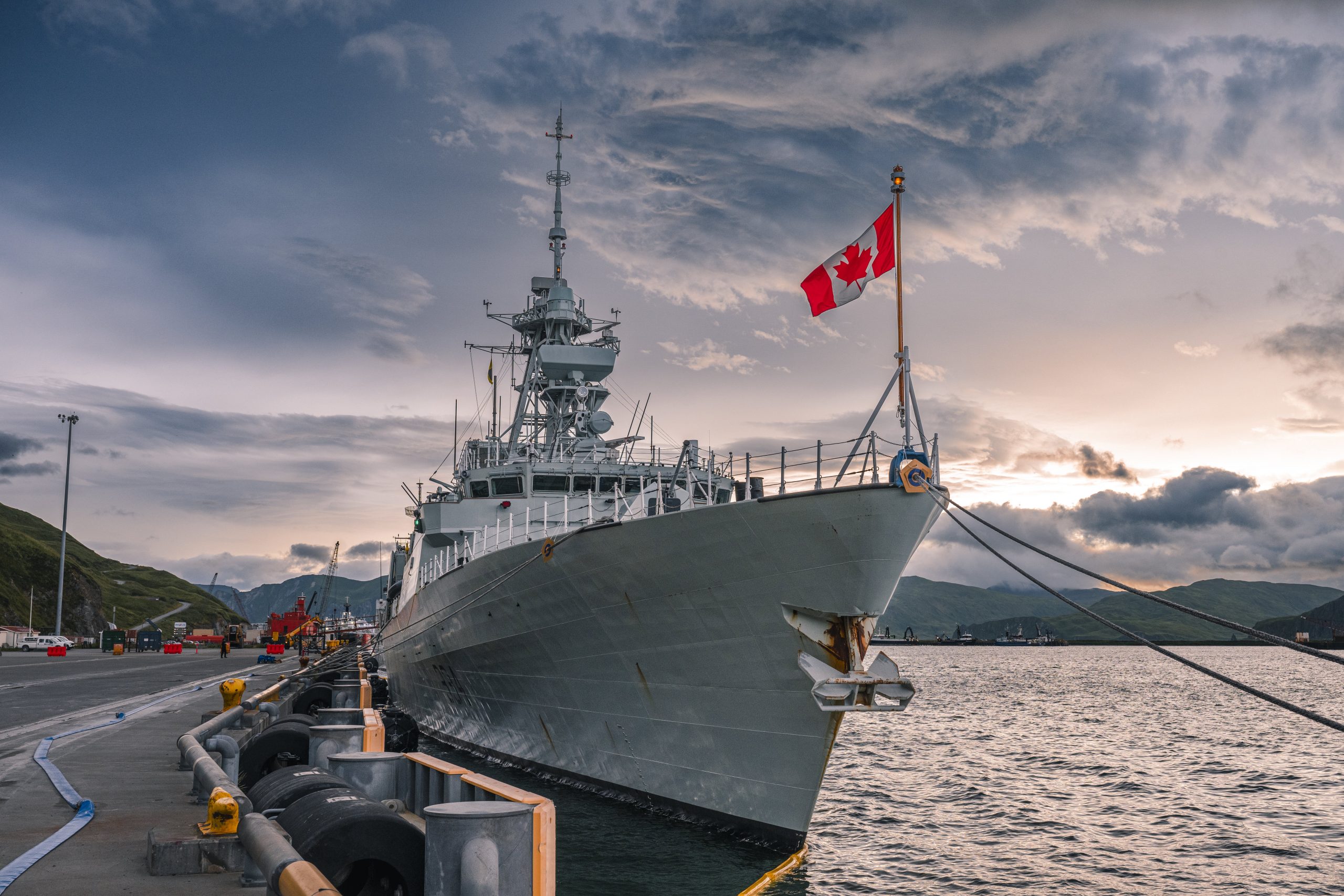
Image: His Majesty's Canadian Ship Regina alongside in the port of Dutch Harbor, Alaska during Operation LATITUDE on 25 August, 2025. Credit: Master Corporal William Gosse, Canadian Armed Forces.