By Moderator, 14 May 2026
A few weeks ago, US President Donald Trump referred to the Royal Navy’s aircraft carriers as ‘toys’ and dismissed British naval capabilities as ‘old and broken.’ That he was asking for the RN’s assistance in the Strait of Hormuz at the time is an interesting method of diplomacy.
We may not like what Trump said, but there’s no denying that the RN is a sad shadow of its former glorious self. Although it has not formally been decommissioned, the weapons and sensors of HMS Iron Duke were stripped and the ship has not left port since October 2025. [See https://www.telegraph.co.uk/news/2026/05/11/warship-hms-iron-duke-costly-refit-scrapheap/]
Having had a refit less than 3 years ago, withdrawal of Iron Duke from active service raises some questions about the ability of the RN fleet to carry on with its tasks. The decommissioning of HMS Richmond this year has been already confirmed. That will mean the RN will have 5 active frigates, and there are concerns about how long these ships can keep going.
Several of these ships will be assigned to anti-submarine warfare and submarine monitoring commitments in the Atlantic and high North as part of the RN’s contribution to NATO’s sub-surface deterrence. This means that the RN might now struggle to assign a frigate to the Carrier Strike Group which, at minimum, should be comprised of 2 frigates and 2 destroyers. Other smaller ships will now be responsible for monitoring the Russian ships and submarines regularly transiting through the English channel.
The RN has 13 frigates under construction or on order. But they may not be entering service for several years -- Type 26 first-of-class, HMS Glasgow and Type 31 first-of-class HMS Venturer apparently will not enter service until the late 2020s.
According to a recent commentary in Navy Outlook, “The collective failure to order a single new frigate between 1996 and 2017 is having disastrous consequences.” The Royal Canadian Navy can perhaps relate to this!
See “Another warship quietly withdrawn – Royal Navy now down to just 5 frigates,”
Another warship quietly withdrawn – Royal Navy now down to just 5 frigates - Navy Lookout
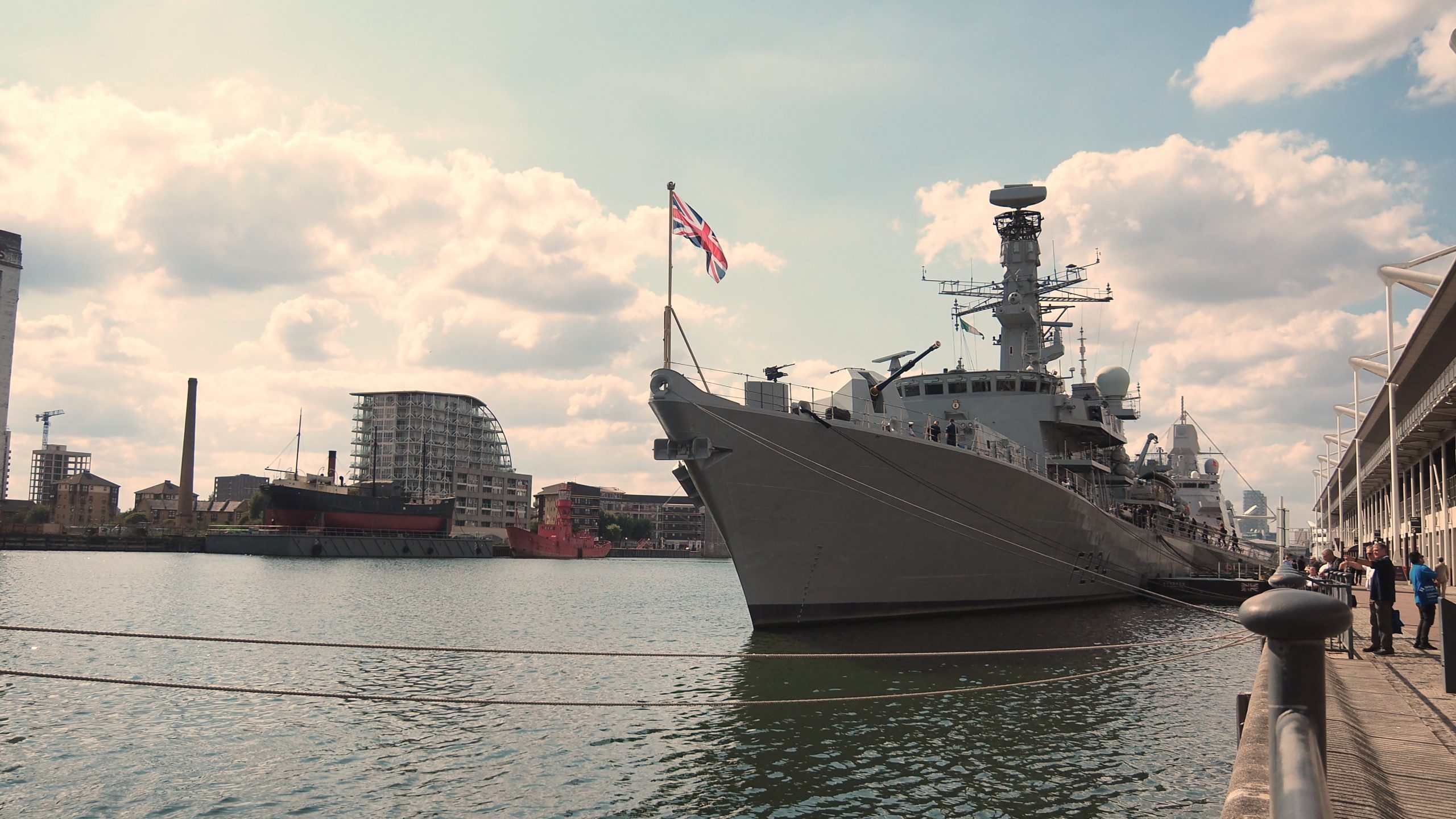
Image: The Type 23 frigate HMS Iron Duke seen at DSEI 2023 defence exhibition in London. Credit: Timothy Choi


4 thoughts on “Royal Navy Not Looking So Good”
It’s but a preview of where the RCN will be in 8 yrs with the Halifax-class.
Perhaps Wayne. Or perhaps not so much. On the whole, the RCN seems to have taken better care of its fleet compared to the RN.
I think that the Halifax-class was designed for a longer life than the Type 23s. So that will help in some respect, but if you look at some of the work done and scheduling by the UK/RN vs CAN/RCN, I don’t think that’s true. Probably the earliest a Halifax-class will be replaced is around 42 yrs. So 44+/- vs 33 +/- It’s going to get rough in my opinion.
Good Evening Wayne
The Royal Navy type 23 frigate was designed for a life span of 18 years, the Halifaxs were designed for 30 year life spans.
Right now the Royal Navy is in dire shape and the government is asking why a ship designed for 18 years isn’t lasting 30+ years. Yes I know you couldn’t make it up but here we are.
Sadly the RN has been hollowed out by successive governments going as far back as 1997. Indeed the biggest cuts were under the previous Labour administration.
The T23 program was due to be the interim until either T24 or T25 came in (Both cancelled) then the GCS (now T26) came in to play, but due to delays and cost over-runs the scheduel has been dropped back significantly.
We also saw the T26 numbers cut from 13 to 8 with the other 5 required being of a new class the T31 which itself is delayed.
But make no mistake even though there are going to be 13 Frigates, the fact is its still a cut (remember there was 16 T23s?).
We also saw, thanks to the previous Labour administration, the Destroyer reduction from 12 ships down to 8 then 6 which were to replace the outgoing type 42s of which there were 12 of them.
And even more embarrasing is the T45 at 12 units were coming in at £500m per ship but due to someone not reading the contract and thinking it’s an easy cut, each unit cost £1bn so the UK paid for 12 ships got 6.
I know, diabolical.