David Dunlop, 25 October 2020. Apparently the British have decided to use a Direct Energy Weapon (DEW) laser system on the Type 26 frigate starting in 2023 (see below). Will […]
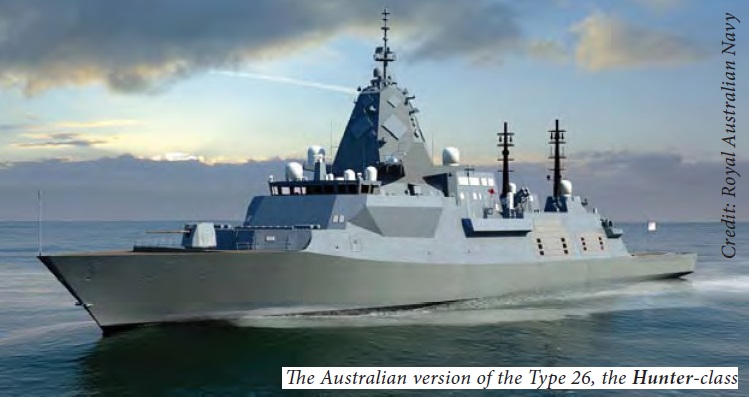
Procrustes, 26 June 2020. A 26 June 2020 report from Australia indicates potential problems for the Australian Hunter-class variant of the Type 26 frigate.[1] The report suggests that the ship […]
Procrustes, 30 May 2020. Here is a brief background of the Alion complaint. Alion was one of the 12 pre-qualified Canadian Surface Combatant (CSC) bidders, and one of the three […]
13 July 2018. David Dunlop. Don’t know if the Type 26 Frigate will win the bidding process after the ‘curing’ process on July 21, but if the LM/BAE Type 26 […]
3 July 2018. On 29 June 2018 the Australian government announced [https://www.minister.defence.gov.au/minister/christopher-pyne/media-releases/joint-media-release-prime-minister-minister-defence-2] that it had selected a variant of BAE’s Type 26 frigate for the Royal Australian Navy. The 9-ship […]
Canada is currently going through the difficult process of deciding which of the bids for the Canadian Surface Combatant to accept. Canada is looking at three design proposals – Spain/Navantia […]
The British government announced that the first of the Royal Navy’s Type 26 frigates will be laid down within the month after an order was placed and contract signed with […]
Comment by Ian Parker: This is good news for Canada and her navy. And, Despite arguments by some that the BAE Type 26 is a theoretical ship and thus should […]
Cookie Consent
At Canadian Naval Review (CNR), we are committed to respecting your privacy. When visiting our website for the first time you can either “Accept all” cookies (including ‘non-essential cookies’) or “Customize” your cookie preferences, which allows you to make individual choices and get details on the cookies we use.
Contains information related to marketing campaigns of the user. These are shared with Google AdWords / Google Ads when the Google Ads and Google Analytics accounts are linked together.
90 days
__utma
ID used to identify users and sessions
2 years after last activity
__utmt
Used to monitor number of Google Analytics server requests
10 minutes
__utmb
Used to distinguish new sessions and visits. This cookie is set when the GA.js javascript library is loaded and there is no existing __utmb cookie. The cookie is updated every time data is sent to the Google Analytics server.
30 minutes after last activity
__utmc
Used only with old Urchin versions of Google Analytics and not with GA.js. Was used to distinguish between new sessions and visits at the end of a session.
End of session (browser)
__utmz
Contains information about the traffic source or campaign that directed user to the website. The cookie is set when the GA.js javascript is loaded and updated when data is sent to the Google Anaytics server
6 months after last activity
__utmv
Contains custom information set by the web developer via the _setCustomVar method in Google Analytics. This cookie is updated every time new data is sent to the Google Analytics server.
2 years after last activity
__utmx
Used to determine whether a user is included in an A / B or Multivariate test.
18 months
_ga
ID used to identify users
2 years
_gali
Used by Google Analytics to determine which links on a page are being clicked
30 seconds
_ga_
ID used to identify users
2 years
_gid
ID used to identify users for 24 hours after last activity
24 hours
_gat
Used to monitor number of Google Analytics server requests when using Google Tag Manager