
By Jeff Gilmour, 15 September 2026
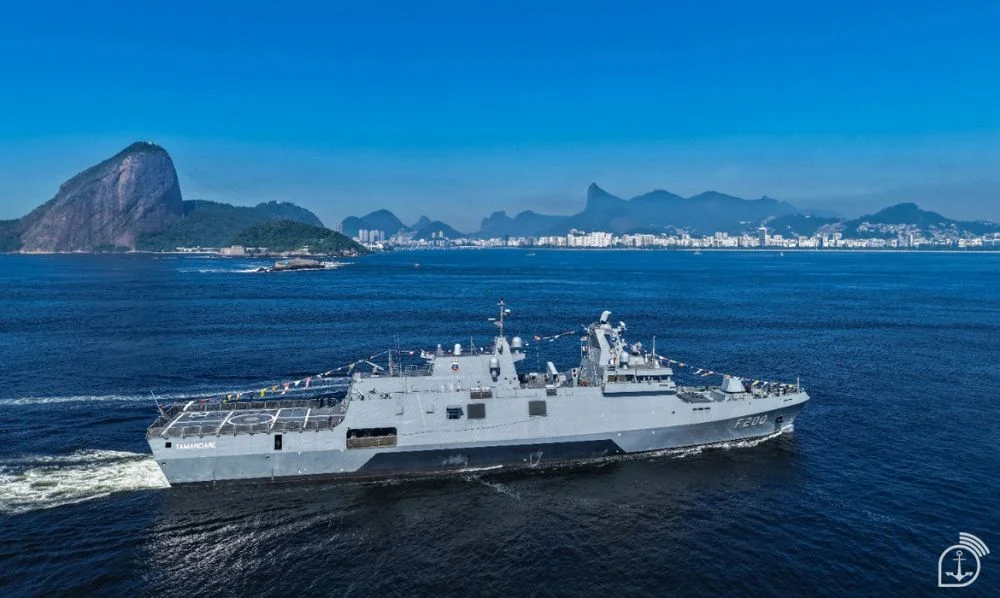
In the 1970s, apparently Brazil launched and abandoned at least three warship programs.[1] In April this year, however, it commissioned a new frigate, Tamandare, the first of four ships to be built in Brazil. The construction of a further batch of four has also been provisionally agreed to.
Thyssen Krupp Marine systems (TKMS), the same German company selected to build Canada’s 12 submarines, has agreed to work with Embraer, a Brazilian multinational aerospace corporation, to build the ships in Itajai, in the southern state of Santa Clarina. As in Canada, the project is designed to encourage domestic supply chains and create a skilled local work force. Similar to Canada, it begins with an effort by Brazil to increase its defence capability, as its defence share of GDP is now only 1.1%.
The country spent $24B on its armed forces last year. As well as its plan to build new frigates, it also has plans to obtain nuclear-powered submarines. In March the country unveiled the first fighter jet assembled in Brazil, a Gripen built in partnership with Sweden’s Saab.
With the United States adopting a more threatening posture in South America, as we have seen in its actions in Venezuela, more and more South American countries are increasing their defence spending with countries outside the United States. Therefore, the Brazilian government is eager to build more military and naval hardware at home to boost and enhance its industrial base.
[1] The Economist, “Building its own boats at last”; August 15, 2026, p.27.
Image: A photo of the Brazilian frigate Tamandaré. Credit: Brazilian Navy


One thought on “Brazil’s Increased Military Spending”
There is a worthwhile story here about Brazil rebuilding its armed forces and expanding its domestic defence industry, but the final paragraph tries to turn decades of Brazilian procurement policy into a reaction to current American behaviour in South America. The chronology simply does not support that conclusion.
Brazil did not suddenly decide to buy Gripen because of events in Venezuela. Brazil selected Gripen in December 2013 and signed the contract with Saab in October 2014. The agreement deliberately included technology transfer and Brazilian industrial participation from the beginning. The aircraft unveiled in March 2026 is therefore the product of a program more than a decade old, not evidence of some recent Brazilian decision to distance itself from the United States.
The same applies to the Tamandaré class. The Brazilian Navy began the selection process in 2017 and signed the contract for the first four frigates in March 2020. Brazil stated at the time that the purpose was renewal of an aging fleet, protection of its extensive maritime interests, domestic construction, technology transfer and development of its own defence industrial base. The decision to potentially build four more ships in 2026 is an expansion of an existing program, not the creation of a new one in response to Washington.
The nuclear submarine example stretches the argument even further. Brazil has pursued nuclear submarine technology since 1979, while the current PROSUB partnership with France dates from 2008. Suggesting that this program somehow reflects present concern about American actions in South America requires ignoring nearly half a century of Brazilian naval planning.
Even the claim that Brazil is increasingly turning to countries outside the United States needs some qualification. Gripen may be a Swedish design assembled with substantial Brazilian participation, but its F414 engine is produced by General Electric. In January 2026 the Brazilian Air Force signed a technical assistance agreement with GE Aerospace covering support, training, technical data and maintenance for those engines. Brazil is diversifying suppliers and demanding greater sovereign industrial capability, but that is quite different from deliberately excluding the United States.
Brazil certainly wants a stronger defence industry, more domestic production and greater strategic independence. Those are perfectly reasonable objectives for a country of more than eight million square kilometres, an enormous coastline and significant Atlantic resources. But they are longstanding Brazilian objectives. The Gripen, Tamandaré and nuclear submarine programs demonstrate continuity in Brazilian defence policy far more convincingly than they demonstrate a reaction to current American policy.
That is the real weakness in this article. It begins with several legitimate examples of Brazilian military modernization and then attaches a geopolitical explanation that the dates themselves contradict. Brazil is increasing defence investment because it has aging equipment, major maritime and territorial responsibilities and a longstanding desire to develop its own defence industrial base. One can certainly debate recent American policy toward Venezuela, but using procurement decisions made in 2008, 2013, 2014 and 2020 as evidence that South America is now rearming because of events in 2026 is putting the conclusion before the evidence.