By David Prior, 16 January 2026
Today things appear to be moving along faster in Greenland (see https://www.youtube.com/watch?v=yoi2yOK2xLQ minute 3:05). Now that immediate military 'exercises' in Greenland have begun, this may be a good time to talk about the next phase. To truly secure all Greenland's airports, harbours and significant infrastructure against American invasion forces will take a very large, permanent defensive force in Greenland. This means building on the current special forces 'exercises' in Greenland this week by making large scale training and exercises permanent to select countries (no USA or Hungary). At one point the United States had many bases along the Greenland coast. This should never be allowed in the future. Threatening to invade Greenland has voided past agreements. Those locations should be permanent training and exercise bases for a New NATO. The current US base should be severely limited in size and capability. The USA is fast in retreat on the world stage so that should be achievable.
The only economical way to do this, and to bring maximum economic benefits to Greenland (which is critical), is to stop reacting to emergencies and start investing in permanent facilities. They don't have to be fancy, just well-insulated and solid (large quonset huts are ideal, see https://www.youtube.com/watch?v=uO4eRciFu3Y ). In today's world of weapons, convoys by sea or by air will never get through if hostilities begin. It will just be an unpredictable shooting gallery. Storing all the required logistics and weapons in Greenland probably won't cost any more than storing them in Europe. It also means that a very large floating base utilizing a decommissioned Capesize bulk carrier to react to an emergency won't be necessary. A further benefit of a large permanent European force in Greenland training in Arctic warfare means that the threat of invasion will be always contained.
Perhaps someone should write a piece for Canadian Naval Review on why reliance on convoys by sea or by air in 21st century hostilities against a diminished or emerging superpower won't succeed. This addresses what will happen to RCN large amphibious expeditionary vessels when they try to eject American, Chinese or Russian troops from the Arctic. The current mindset of a fast response to an immediate threat only works reliably against militarily weak opponents. The United States has learned this fact; yes to Grenada, Panama and Venezuela, no to more Middle Eastern or Asian adventures against economically impoverished countries (Iraq, Vietnam).
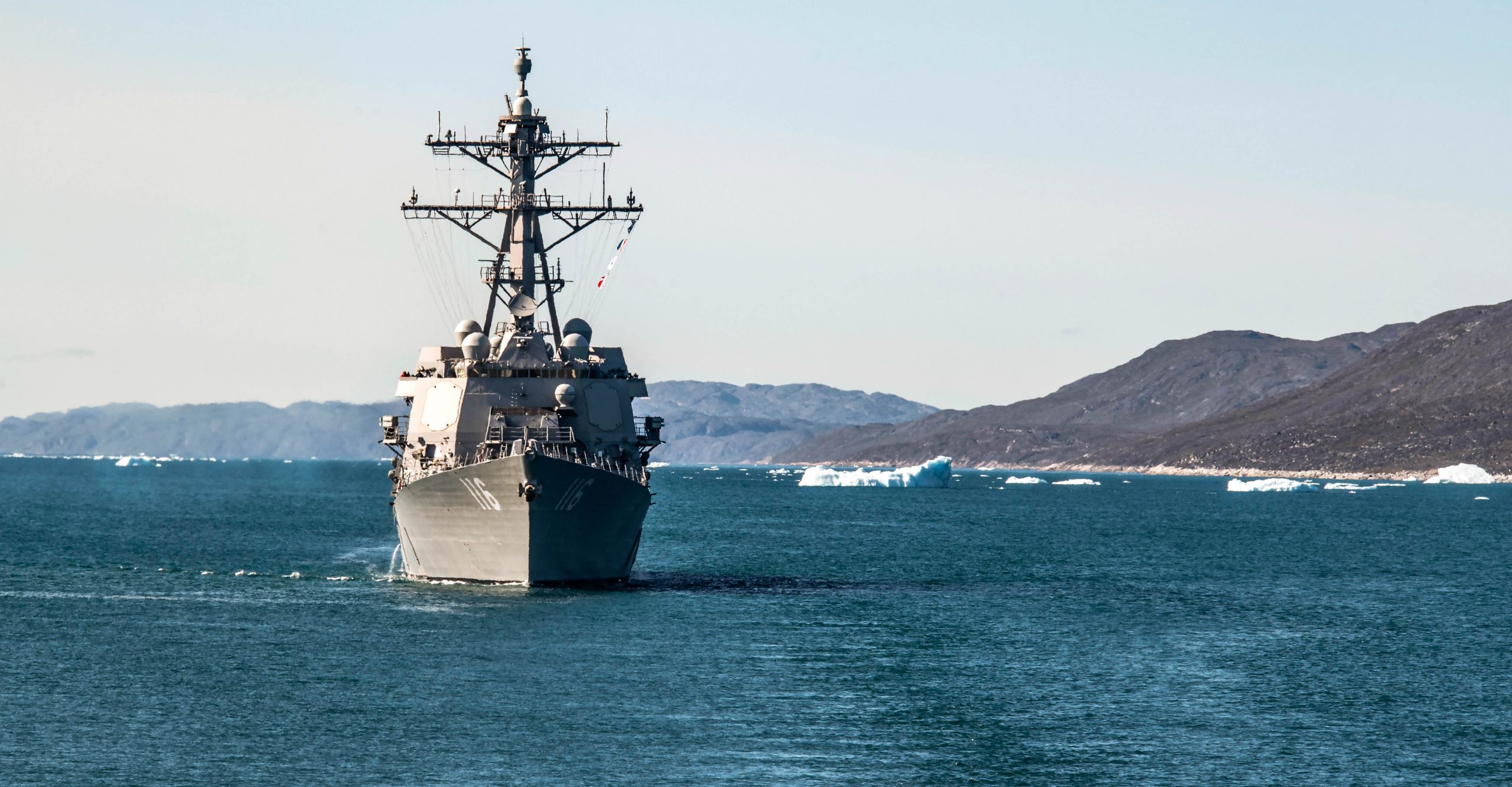
Image: USS THOMAS HUDNER transits through the Nuup Kangerlua Fjords in Greenland on August 13, 2020 during Operation NANOOK 20. Credit: MCpl Manuela Berger, Canadian Armed Forces Photo



11 thoughts on “What to do in Greenland”
I’d suggest that attempting to defend Greenland militarily against the Americans is a waste of limited resources. No military force will stop the United States from taking Greenland if it is determined to do so; just as no military force is likely to stop China from taking Taiwan. The defence of Greenland rests on two factors: (1) The Americans don’t actually gain anything by taking over that they don’t already have; and (2) an attack on Greenland would be a de facto declaration of war against all other NATO countries. This ought to lead (at least) to the cancellation/confiscation of all American properties or interests in those countries. If the United States is so irrational as to attack anyway, it will hasten its own demise and speed the arrival of the next global hegemon; likely either China or India.
So far everything is words with no concreate action, now it’s with tariffs which will lead to infuriating each party. Greenland is not going to be invaded. What this episode actually does is expose how much time has been wasted mistaking rhetoric for strategy, and how overdue a more serious posture in Greenland and the wider Arctic really is. The idea of “defending Greenland militarily against the United States” is at best foolhardy. Washington already has what it needs there, and any kinetic move would detonate NATO, destroy US global interests, and hand a strategic windfall to China or India, which is precisely why this remains political noise rather than operational reality. If anything, the net effect should be a greater, routine and credible allied military presence in Greenland and across the Arctic, something that should have been done years ago, just as Canada should be increasing its own Arctic presence. That is not escalation and it is not anti-American; it is about sovereignty, awareness, resilience and balanced allied cooperation in a region that is becoming busier and more contested by climate, traffic and extra-regional actors, not about indulging worst case invasion fantasies.
David Prior raises legitimate questions about Arctic security and Greenland’s growing strategic importance, but his proposed remedies quickly drift from analysis into fantasy.. His central premise that the United States should be treated as a likely invasion threat and effectively excluded from Greenland’s defence architecture, ignores both Greenland’s constitutional reality and the foundations of collective defence. Within the framework of NATO, deterrence in the Arctic is inseparable from alliance cohesion, not something that can be selectively rewritten based on rhetoric or personal distrust. Treating defence agreements as ‘void’ by implication is not strategy; it is a misunderstanding of how alliances, treaties and sovereignty actually function.
It is also worth stating plainly that Greenland should have had stronger defences, surveillance and patrol capacity long before recent US political rhetoric drew attention to it. Arctic security challenges did not suddenly appear because of Washington soundbites; they have existed for decades, driven primarily by Russian re-militarization of the Arctic and, increasingly, Chinese strategic interest. If anything, renewed attention may finally force more serious investment in Greenland’s security posture, not against an imaginary American invasion, but against the very real long-term risks posed by peer competitors. Suggesting otherwise reverses cause and effect.
More troubling is the operational logic underpinning Prior’s proposals. The claim that modern warfare has rendered sea and air logistics obsolete and that Greenland should therefore be permanently stocked with forces and supplies, runs counter to every contemporary military reality. Fixed stockpiles and static bases are not resilient; they are vulnerable. Prior’s vision of large, permanent European forces scattered across Greenland, supplied in advance and insulated from resupply, reads less like sober defence planning and more like a particularly wild Tom Clancy novel, where logistics conveniently vanish and adversaries politely ignore fixed targets. To be blunt, the notion that the United States is poised to invade Greenland is rhetorical fantasy. The United States is already there by agreement, and if it ever chose to seize Greenland by force, no amount of improvised ‘New NATO’ basing would stop it.
“It is also worth stating plainly that Greenland should have had stronger defences, surveillance and patrol capacity long before recent US political rhetoric drew attention to it.”
Ted Barnes’ comment draws attention to an important point: for many decades, western-aligned states other than the United States have maintained levels of military strength that essentially assume that none of us will ever have to fight a war on our own soil or critical to our own national interest; at the same time, other powers have been arming at rates that imply they intend an attack. I don’t give much credence to the claim that Canada and others have been relying on the US coming to our aid; the truth is more that we have not thought seriously about war because we perceived no threat. In that context, the recent actions of the United States can be interpreted as rational and ultimately not unfriendly. If an attack is coming, it will likely fall first, and suddenly, on a western ally that is not the US and that is not prepared to defend itself. How could an American leader, seeing the threat, induce its ally to prepare in time? Only one way: the ally must be made to feel afraid.
Threats that the United States will not come to their aid, or threats that the United States itself will attack can be understood as an acknowledgement that it is neither strong enough nor fast enough to drive back a Chinese or Russian attack; the whole alliance is needed, and must be ready before the onset of war.
US actions under Trump do not appear well meant, and I do not think they are well meant, but a well-meaning America could act in this way. It is worth noting that these things are happening at a time when Russia has not yet attacked a NATO country and China has not yet attacked Taiwan. US threats of military betrayal are no more than threats, so far.
It has been recommended to Taiwan that it turn itself into a ‘porcupine’ capable of inflicting massive losses on an invading China. Taiwan too will be cut off from resupply so it needs to stockpile sufficient supplies, and deploy them widely, to make China bleed sufficiently to give up. The greater the stockpile, the greater the deterrence and the greater the chance that China will not even attempt to invade and suffer the many consequences it knows await it. Taiwan and the West can afford the logistical stockpile required (no hyper-expensive fighter jets and naval vessels needed for the long-term resistance). The supplies should be widely dispersed, like they do in Ukraine today. Ukraine is winning despite starting with so much less in big-ticket items.
I would not automatically believe that the United States can militarily defeat NATO in Greenland (The United States is gone but the spirit and capability of NATO lives on). Vietnamese farmers drove out the US military. Iraqi taxi drivers did the same. In both cases, the terrain was far more suitable for a modern army. Greenland is anything but. Invaders will have the low ground and winter will not be their friend. There are almost no roads for their mighty vehicles. The invaders too may find their air and sea supply lines choked off. We know what drones and ballistic missiles can do to airports. Who knows what lingering underwater drones will be capable of at navigational choke points?
Granted, American military might did overwhelm Grenada and Panama, but the Florida State Police could have done the same. When was the last time the US military accomplished anything significant against a very large contingent of dug-in, massively armed, state-of-the-art opposition? Greenland, like Taiwan, is mostly mountainous and remote. These are ideal conditions for a ‘porcupine’ to operate in. But to succeed, the porcupine has to think far ahead, long before the threat is obvious. The West, and Ukraine, failed Ukraine by not thinking far enough ahead, but they got away with it because Ukraine is not an island so is not reliant solely on ship and aircraft convoys. There will not be another Battle of the Atlantic to save Greenland. That was almost a century ago. Time and technology have moved on.
The ‘porcupine’ concept is being badly over sold. It may make some sense for Taiwan, which is heavily armed, densely populated, industrially capable and backed by decades of U.S. and allied planning. It does not translate to Greenland. Greenland cannot stockpile, disperse, maintain and fight large quantities of modern weapons over time. It has almost no roads, no depth, no industry and no meaningful internal logistics. Have you been to Greenland? I have and have been to Thule. Ukraine is not surviving because it skipped expensive ships and aircraft; it is surviving because it is being resupplied every day over land by NATO. Greenland would be cut off almost immediately. Stockpiles without sustainment, command and control, and external support are not deterrence, they are just targets waiting to be found.
The historical comparisons are equally misleading. Vietnam and Iraq were political failures, not military defeats caused by terrain or lightly equipped defenders overwhelming a modern force. Greenland is the opposite of favourable insurgent terrain: it is exposed, sparsely populated, and logistically fragile. Winter, isolation and the lack of roads hurt the defender as much as if not more than the attacker. Drones, missiles and seabed systems are not a one way advantage, and pretending otherwise is fantasy. Deterrence in Greenland will not come from improvised ‘porcupine’ logic; it comes from early investment, permanent presence, high-end capabilities and tight allied integration.
There is also a basic reality being ignored. Greenland’s population is tiny and widely dispersed, there is no mass society to arm and no manpower depth to sustain a long fight. And the United States is already in Greenland, permanently and legally. If Washington ever intended to take over, it would not advertise the fact through articles and public debate; it would simply happen, quickly and quietly, as a fait accompli. Which is precisely why these invasion scenarios are implausible. The United States is not going to invade Greenland, just as it is not going to invade Canada. The political and alliance costs would dwarf any gain, especially when the US already has access to what it actually needs. Inflating porcupines and insurgency myths does not improve security, it replaces serious defence planning with comforting rhetoric.
Good afternoon Ted,
It would be very helpful to know the sources of information that lead you to believe categorically that a Trump-led USA will act rationally in the future with respect to Greenland and Canada.
Ubique,
Les
Mr Barnes states that “Greenland’s population is tiny and widely dispersed, there is no mass society to arm and no manpower depth to sustain a long fight.” That is all very true, which is why there can be 30,000 NATO, non-USA troops continuously present for the long term, engaging in Arctic warfare training and exercises, c/w with their massive armouries, all of which provide continuous, long-term economic strength to Greenland. Canada provides that service today in Alberta, and has for decades. It’s a proven technique for projecting military force.
Replying to Les
Les,
You don’t even have to get deep into theory, just apply common sense about how Trump actually operates. He’s transactional, loud, and uses pressure publicly as leverage. He talks big to shift negotiating positions, rattle allies into spending more, and create political momentum. That’s his pattern in trade, NATO funding, tariffs and it fits here too. Noise is part of the method. It’s bargaining style, not a mobilization order.
If the United States truly intended to take Greenland militarily, there wouldn’t be months of public chatter. You’d see quiet force movement, logistics staging, airlift flows, ISR coverage, and naval posture changes. None of that is happening. No carrier groups off Nuuk, no heavy forces pre-positioning, no Arctic sustainment chain being built. Because this isn’t an invasion scenario, it’s strategic pressure producing allied reaction.
And look at the outcome so far. Greenland is now central in NATO security discussions. Denmark is increasing Arctic defence spending and strengthening its posture, including buying additional F-35s, which ties it even closer into U.S./NATO airpower integration. Canada, which has historically moved at glacial speed in the Arctic, is now talking infrastructure, surveillance, and sustained presence. From Washington’s perspective, allies are paying more attention to northern defence and burden sharing. That’s a strategic win achieved without force.
Same logic applies to Canada. The United States depends on Canada for NORAD, air defence, maritime approaches, Arctic warning, and the broader North American security architecture. Destabilizing Canada would damage US homeland defence more than it would help. Tariffs, rhetoric and political theatre? Sure. But breaking continental defence logic would undercut core American interests, and that’s where institutions, the Pentagon, Congress and geography impose limits.
So assuming baseline rational behaviour isn’t faith in Trump’s temperament, it’s recognizing that even disruptive leaders operate within structural realities. The shouting is visible. The guardrails are quieter, but they’re still there.
To David Prior
David, what’s happening right now proves the opposite of your 30,000 troop garrison theory.
Denmark doesn’t have an army corps parked in Greenland – it has a handful of patrol ships moving through Nuuk and the coast. Canada isn’t sending a division, we’re sending a Coast Guard/Arctic patrol presence tied to the opening of a consulate. That’s what real Arctic security looks like: measured naval presence, sovereignty signalling, diplomacy, and allied coordination. Ships that can move. Forces that don’t require building a small city just to exist.
You’re describing a Cold War Germany model and trying to paste it onto a place that has:
almost no road network
tiny ports
limited housing
minimal local workforce
extreme weather half the year
Thirty thousand troops? Greenland can’t sustain 30,000 tourists, never mind a mechanized NATO formation with “massive armouries.” Every litre of fuel, every ration pack, every spare part, every medical evacuation becomes a strategic air/sea lift problem. That’s not force projection, that’s a logistics hostage situation waiting to happen.
And politically? That’s not “economic strength.” That’s foreign militarization of a self-governing Arctic society. Denmark, Greenland and NATO have been extremely careful to keep Arctic security low-friction and sovereignty-respecting for a reason. Your proposal hands Russia and China the propaganda line of the decade: “NATO is occupying the Arctic.” Congratulations, deterrence just turned into narrative defeat.
Meanwhile, the actual model in play, Danish patrol ships in Nuuk, allied naval visits, Canadian presence for diplomatic support is the correct one. Mobile. Scalable. Cooperative. Visible without being provocative. That’s Arctic strategy in 2026, not Fulda Gap 1985.
Greenland isn’t defended by parking an army on it. It’s defended by alliances, sea control, airpower, ISR, and persistent but light footprint presence across the whole North Atlantic system.
You’re trying to win the Arctic with a base. The Arctic is won with access, mobility and legitimacy.
Ted Barnes states that “Denmark doesn’t have an army corps parked in Greenland”. Very true, but my comments address the future, not the present. Real Arctic security has teeth, which are essential to deter aggression. These teeth need to be immediately available to deter hostile actions (which can be unleashed suddenly in today’s world, and often are). An invading force will not be an army storming the beaches which don’t exist, or an ocean surface armada, it will likely be a sudden, coordinated capture of all the ports and airports by special forces. That’s all it will take to control Greenland. Measured naval presence, sovereignty signalling, diplomacy, and allied coordination do not have any teeth to prevent it.
30,000 troops engaged full-time in annual Arctic training missions are not tourists looking for a hotel. Armies bring their own extensive support systems in order to practice “real-life”, extended deployment scenarios. Annual training exercises are regular occurences in most militaries so why not Greenland for permanent Arctic training and exercises?
Almost no road networks, tiny ports, limited housing, minimal local workforce and extreme weather half the year is the reality of the Greenland environment so the sooner 30,000 troops from trusted NATO allies begin training there, the sooner they will be ready to fight effectively. No doubt there is a lot to learn and adapt to, a process which takes years. Canada is already thinking about it https://www.canada.ca/en/department-national-defence/programs/defence-ideas/element/contests/challenge/ideas-fictional-intelligence-contest-polar-paradigms-2045-defending-canada-sovereignty.html . It’s likely that the NATO troops in training will, upon arrival, be immediately deployed throughout Greenland, practicing the protection of those many tiny ports and airports. Being dug in and well-equipped for the long haul before trouble arrives is often good strategy, better than trying to turn naval and diplomatic “presence” into boots on the ground after the occupation has occurred and the only ground left that is available is the low ground. In dangerous situations, being practiced and prepared beforehand is often valuable.
Mobile, scalable, cooperative, visible without being provocative is indeed Arctic strategy in 2026. It is legitimate too. Russian, China, and now the United States, are delighted because there are no teeth in sight and they know that, by the time the teeth arrive, it will be all over. Too little, way too late. As for “legitimacy”, has lack of it ever stopped any of them for long?