
By Jeff Gilmour, 20 July 2026
On 9 January 2023 the Canadian government committed to acquiring 88 Lockheed Martin F-35 fighter aircraft to replace the RCAF’s ageing CF-18 fleet for $19B. The first tranche consisted of 16 aircraft with the remaining 72 to be ordered later. Subsequently, the government revised the order to “financially commit” to an additional 14, for a total of 30 aircraft. On 14 March 2025 the Carney government directed a review of the program to determine whether the remaining 58 aircraft should still be purchased or whether alternatives, such as the SAAB Gripen should be considered, based on the current procurement process and changing relations with the United States.
At the present time, Canada has contractually committed to only 16 F-35 aircraft. The delay concerning the original F-35 plan for acquiring the original 88 F-35s seems unusual, for the following reasons:
1. Canada joined the Multinational Joint Strike Fighter Program (MJSFP) as a partner in 1997. Canada’s contribution amounted to approximately $810M dollars (US). The benefit to Canada of being a partner in the program was that it had access to the program itself, opportunities for Canadian companies to compete for work and participation in various aspects of the program management and future development.
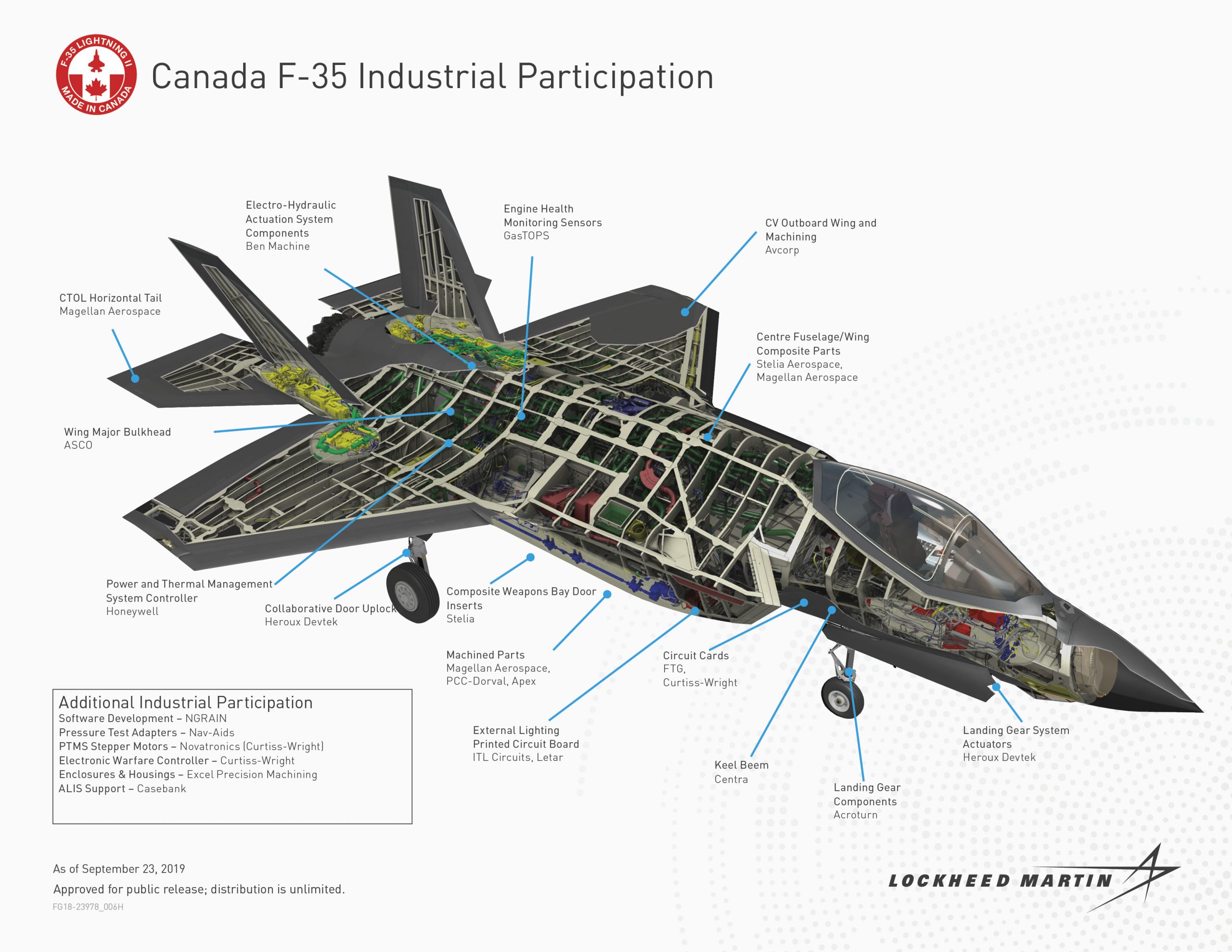
2. Canadian companies, according to the Canadian government, have received more than $3.3 billion dollars (US) in F-35 related contracts as a result of participating in the MJSFP.
3. The F-35 fighter aircraft is considered a fifth generation weapon, whereas the SAAB Gripen aircraft is not.
4. Fourteen NATO countries have purchased the F-35 aircraft to date. They include Norway, Denmark, the UK, Netherlands, Italy, Belgium, Poland, Finland, Germany, Czech Republic, Greece, Romania, Canada and the US. In total, 20 countries have purchased this fighter aircraft worldwide. Turkey may be the next country acquiring this aircraft.[1]
5. It is interesting to note the Scandinavian countries, Norway, Denmark and Finland did not purchase the Swedish built SAAB Gripen aircraft.
Based on this information, why has the Canadian government taken over a year to decide to complete purchasing the remainder of the F-35s for the RCAF? Most of the other NATO countries have already had the F-35s operational in their respective squadrons for several years now. It is a fair assumption that it will take a decade before Canadian squadrons will be fully equipped and operational with such aircraft if the decision to purchase the remainder of the contract is made now by the government. Many NATO countries are already looking at designing and building a 6th generation fighter aircraft.
[1] 2026 Ankara NATO Summit, July 7-8, 2026.
Image: An infographic of Canadian industrial participation in the F-35 program from 2019. Credit: Lockheed Martin



26 thoughts on “The F-35 Aircraft Delay – Why?”
Hi Jeff,
I assume that you are actually asking a rhetorical question since the answer is obvious.
Ubique,
Les
Jeff, you have largely answered your own question. There is no serious operational mystery surrounding which aircraft best meets Canada’s fighter requirement. The F-35 defeated the Gripen in the government’s own competitive process, which evaluated capability, cost and economic benefits. Ottawa then finalized an arrangement in January 2023 to acquire 88 aircraft. The official project remains in implementation for 88 F-35As, with the first aircraft delivered to Luke Air Force Base in 2026, the first arriving in Canada in 2028, Initial Operational Capability around 2029 to 2030 and Full Operational Capability between 2032 and 2034. Therefore, suggesting that a decision today automatically means another decade before Canada has an operational capability is somewhat overstated, although continued indecision could certainly push those dates further to the right.
Why, then, has the review dragged on? Politics and industrial policy. The government has stated that the review is examining operational requirements, Canadian industrial benefits, strategic partnerships, possible alternatives and their delivery schedules. In other words, Ottawa is no longer simply asking which fighter best meets the RCAF requirement. It is using the remaining aircraft as leverage to obtain more Canadian jobs, domestic sustainment work and greater defence industrial independence amid deteriorating relations with the United States. That may be a legitimate government objective, but it should not be confused with uncertainty over the military requirement.
Some clarification is also needed regarding the numbers. Canada did not announce an isolated purchase of 16 aircraft followed by a completely separate and undecided purchase of 72. It finalized an acquisition plan for 88 F-35As, to be purchased in production tranches. The initial tranche of 16 is the portion the government publicly identifies as being underway, while subsequent financial commitments reserve production capacity and procure long lead components. Saying Canada is contractually committed to only 16 may be defensible in a narrow legal sense, but it creates the misleading impression that the other 72 were never part of a finalized acquisition plan.
There is another overstatement in the article. Most NATO countries on the list have not operated F-35 squadrons for “several years.” Germany, Czechia, Greece, Romania and Canada are among the future operators, while several others have only recently begun receiving aircraft. The F-35 program currently says 20 countries have selected the aircraft, but only 12 nations worldwide are presently operating it. The broader point, however, remains correct: the overwhelming trend among Canada’s closest allies is toward the F-35, not the Gripen.
Canada’s announcement on July 21, 2026, that it is becoming an observer in the Global Combat Air Programme also helps explain the government’s wider strategy. GCAP provides Canada with insight into a prospective sixth-generation fighter and possible future industrial participation, but observer status involves no aircraft purchase or financial commitment. The program is targeting service entry around 2035. It may help position Canadian industry for what eventually follows the F-35, but it cannot replace the immediate requirement to retire the CF-18 fleet. Canada can complete the purchase of 88 F-35s while participating in GCAP for the next generation.
The government should now finish the review and stop pretending that a mixed F-35 and Gripen fleet would be some inexpensive, risk free compromise. It would require separate pilot conversion programs, technician training, simulators, maintenance arrangements, spare parts inventories, software support, weapons integration and infrastructure for a relatively small fighter force. Canada would pay to operate two incomplete fleets instead of one capable and interoperable fleet.
The F-35 won the competition. Canadian companies are already embedded in its global production chain, the RCAF is preparing its people and infrastructure for it, and Canada’s NORAD and NATO partners are increasingly building their air combat forces around it. The rational course is to complete the 88 aircraft acquisition, negotiate the strongest possible Canadian maintenance and industrial package, and use GCAP participation to prepare for the next generation.
The delay is not occurring because the correct aircraft remains unclear. It is occurring because the government is attempting to make one fighter procurement carry the weight of its wider industrial strategy and its increasingly complicated relationship with the United States.
Good afternoon Ted,
A sound presentation of the party line.
There is an alternate view that the RCAF has only wanted the F-35 and thus weighted the competition “appropriately.” One could imagine the air force generals hungering for an extremely expensive stealth fighter able to play with the big boys in Iran and similar places. However, is that what is needed for the air defence of Canada?
Buying more F-35s will not buy us any brownie points with the Trump regime; we will get no credit for “doing the right thing,” as Greer would likely say, and giving the USAF control of our fighter fleet’s availability (which seems likely to be poor).
Ubique,
Les
Good day Les,
Calling an evidence based argument “the party line” is not a rebuttal. It is simply a convenient way of dismissing the professional military advice of the RCAF without having to engage with it.
The suggestion that senior officers manipulated the competition because they were “hungering” to play with the big boys in Iran is particularly foolish. The RCAF did not invent the requirements. Canada needs a fighter capable of operating within NORAD, penetrating contested airspace when required, sharing data with allied forces, detecting modern threats and remaining credible for decades. The CF-35 won because it best met those requirements, not because a cabal of generals wanted an expensive new toy.
Nor is the defence of Canada limited to circling over the Arctic waiting for an unidentified aircraft to appear. Canadian air defence is inseparable from continental defence, NORAD, NATO and coalition operations. A fighter that cannot integrate fully with the United States and our principal allies would leave Canada less capable and less sovereign, not more.
The “brownie points with Trump” argument is equally irrelevant. Fighter aircraft are not purchased to flatter the temporary occupant of the White House. They are purchased to defend Canada for the next forty years. Governments change. Geography does not. The United States will remain our closest military partner, our NORAD partner and the country with which our fighter force must operate every day.
As for the claim that the USAF would somehow control Canadian aircraft availability, that is rhetoric masquerading as fact. Canada will own, crew, maintain and operate its aircraft. Like every modern combat aircraft, the CF-35 depends upon an international supply and sustainment network. Any realistic alternative would also depend upon foreign engines, weapons, software, components and supply chains. Pretending that Canada can purchase a modern fighter and somehow detach itself from allied industrial support is fantasy.
There is certainly room to debate cost, sustainment and fleet size. There is no serious case, however, for replacing military requirements with conspiracy theories about generals, Trump and imaginary American control over Canadian aircraft.
Thank you Ted for your wisdom. Your rebuttle to Les is right-on-target!
Here, here! Couldn’t have said it better myself.
Good afternoon Ted, David, and Barnacle,
You are of course totally and absolutely correct. Foolish me.
No senior officer has ever wanted to rig a competition or been seduced by fancy technology. They would never emphasize the NATO and stealth requirements to set up an RCAF competition that only the F-35 could win in order to be able to participate in every possible operation that might ever conceivably arise.
By the way, if the RCAF did not establish the operational requirements, who did?
Additionally, of course, the F-35 is so much better than the Gripen, being four times more expensive to fly (See link below) and some 20% less available (according to a CBC report). Obviously, any claim that the F-35 is an extremely expensive, delicate tool is a scandalous conspiracy theory that is built on an unstable stool of publicly available data.
(https://militarymachine.com/f-35-vs-gripen-e-fighter-export-battle)
Additionally, since the super professional USAF will have total ownership of our F-35s’ parts (see link) and the software, we can be sure that our needs will be always be fully met without any American political interference. No American president would ever use our self-imposed vulnerability against us. Nor would the USAF ever put its needs before ours.
Finally, willingly handing this control to the Americans will allow us to be participants in the American-desired de-industrialization of Canada.
(https://www.ipolitics.ca/2026/02/25/trumps-trade-czar-says-canada-must-accept-tariffs-help-reshore-american-jobs/)
I am sure that we will all be so thrilled when our shiny new planes sit idle in their airfields while we try to deal with the next, unrelated American demand.
Ubique,
Les
Hi Jeff, In answer to your “why” question, the reasons for the delays have been covered elsewhere; my interest is more in what those delays should mean for Canada’s procurement decisions. I hope the RCAF obtains the fighter, or fighter mix, they consider best. My having typed that, I believe that while the fixed-price nature of the Canadian F-35 initial procurement lots protects Canada from direct manufacturing cost overruns, the program’s prolonged technical delays—compounded by ongoing integration bottlenecks and supply-chain strains that have occasionally left airframes awaiting key mission-system components — inevitably drive up indirect sustainment and upgrade costs. For Canada, these cumulative schedule pressures, combined with the reality of high F-35 flight-hour operating costs and comparatively lower operational availability, have naturally invited a strategic re-evaluation of Canada’s future air force structure.
I think there is a view that a mixed-fleet strategy could effectively reconcile these trade-offs by pairing a core force of F-35s for integrated NORAD air defence alongside a complementary acquisition of Saab Gripens. Given the assessment by many that the Gripen offers higher operational availability, a lower maintenance footprint, and the ability to operate from austere, dispersed northern Canadian or European deployment sites, this blended approach could provide Canada with greater overall aircraft numbers and mission flexibility. Furthermore, structuring such a procurement around industrial offsets and technology transfer might deliver superior domestic economic returns to Canada compared to the more centralized and restrictive sustainment model of the F-35 program.
Complicating this as well are the political dynamics. The current U.S. administration’s tariffs are, arguably, working against Canadian industrial interests. Ultimately, independent of anything I may type, I hope that the RCAF are able to procure the fighter(s) they believe best for Canada.
Lee,
The CF-35 program has genuine problems. Technical delays, sustainment costs, spare parts shortages and disappointing American availability figures are legitimate concerns. Canada should scrutinize the program closely and demand better performance from both the contractor and the Joint Program Office. Like other countries such as Israel, parts availability and operational readiness is significantly different from American figures. I expect along with the maintenance facility that is to be built in Mirabel our numbers will be higher.
What does not follow is that Canada should create a mixed fighter fleet. A mixed fleet is routinely presented as though Canada could simply buy some cheaper aircraft, park them beside the CF-35s and enjoy the best of both worlds. In reality, it would mean operating two separate fighter systems: two training pipelines, two simulator networks, two technician communities, two spare parts inventories, two maintenance systems, two software environments and two sustainment contracts. Also three sets if you consider the CF-18. In the past we did it but the resources available then is vastly different from what is available today. Canada is already struggling to recruit and retain enough pilots and technicians for one modern fighter fleet. Dividing that limited workforce between two unrelated aircraft would not solve the problem. It would institutionalize it.
The claim that Gripen would provide dramatically greater availability and easy operations from austere northern locations is also regularly exaggerated. A fighter does not operate from a highway simply because a promotional video shows it landing on one. It still requires fuel, weapons, secure communications, trained technicians, test equipment, spare parts, command and control links and protected support infrastructure.
Nor should American fleet wide availability figures be treated as an automatic prediction of Canadian performance. The American fleet includes training, test and combat aircraft of different ages and configurations, operating within a sustainment system burdened by years of spare parts and depot problems. Those figures are concerning, but they do not prove that Canada would generate more combat power by purchasing a second fighter and duplicating its entire support system.
The industrial argument is equally selective. Saab made an attractive offer, but industrial benefits were considered during the competition. So were cost and capability. The CF-35 still ranked first unless you believe like Les, there is a massive conspiracy by the RCAF. Canadian companies have also received billions of dollars in CF-35 production work and remain positioned to compete for long term sustainment contracts.
American tariffs are damaging and Canada should respond firmly. However, designing a fighter force expected to serve into the 2060s as retaliation against one American administration would be strategically foolish. Governments change. Canada’s geography and NORAD responsibilities do not. Gripen would not provide complete independence from the United States in any case, since it relies on an American engine and other American controlled systems and weapons.
Review the CF-35 program. Demand firm costs, sufficient spare parts and credible availability targets. Hold the manufacturers accountable. But mixed fleet advocates must demonstrate that their proposal produces more combat ready aircraft after counting every duplicated technician, training course, simulator, warehouse, weapon certification and support contract. Until they can do that, the mixed fleet is not a balanced compromise.
The RCAF should not only receive the fighter it considers best but also consider the best one to return our pilots alive when they will face the other gen 5 aircraft of our adversaries. When Canada actually evaluated capability, cost and industrial benefits through a competitive process, it already told us which aircraft that was.
Good morning Ted,
To be clear – “a massive conspiracy by the RCAF” is not required. Simple institutional bias and blindness will have the same effect. The airplane that the RCAF has specifically wanted since about 2010 won the competition that the government imposed on the air force. There are several ways to explain that result. One is that the F-35 won fairly.
Ubique,
Les
Good morning Les,
Institutional bias is certainly possible, but repeatedly asserting it does not make it evidence. The RCAF preferred the CF-35 because, after years of evaluation, it concluded that the aircraft best met Canada’s requirements for NORAD, NATO operations and combat against modern air defence systems. That preference did not magically invalidate the competition. It simply meant the professionals responsible for employing the aircraft already understood which capability they required.
The suggestion that the requirements were shaped to guarantee the CF-35 would win also works backwards from the desired conclusion. Stealth, sensor fusion, secure data sharing and interoperability with our principal allies were not invented to rig a procurement process. They reflect the environment Canadian pilots may actually face over the aircraft’s service life. Naturally, an aircraft designed around those capabilities performed well when measured against them.
There are indeed several ways to explain the result. The simplest remains the one you seem most determined to avoid: the CF-35 won fairly because it was the strongest submission and the best aircraft for the missions Canada expects its fighter force to perform.
Frankly, the way you continue railing against the result is beginning to resemble Donald Trump’s endless claims about a stolen election. The accusation is repeated over and over, the absence of evidence is treated as proof of how cleverly the process was supposedly manipulated, and any legitimate result is dismissed because it did not produce the preferred outcome. Institutional expertise should not be recast as institutional blindness merely because the experts reached a conclusion you dislike.
Response to Les Mader 22 July 2026, 5:43 pm
Good afternoon Les,
The sarcasm does not improve the evidence. In fact, the first link you provided manages to undermine its own headline before the reader is halfway through it.
It claims that the Gripen “keeps beating” the CF-35 in export competitions, then admits that the CF-35 was not offered to Brazil, was not competing in Colombia, and was not involved when Thailand selected the Gripen C/D in 2008. Apparently, the Gripen is now so capable that it can defeat aircraft that were not even entered in the competition. The same article then concedes that the CF-35 is substantially more capable, has unmatched sensor fusion, is far more survivable against modern air defences, offers superior interoperability, and is the appropriate aircraft for countries expecting to face peer adversaries. That sounds rather relevant to a country responsible for defending North America against Russia and potentially China.
Yes, the RCAF helped establish the operational requirements. Who else should define what Canada’s future fighter must actually do? Accountants? Newspaper columnists? Saab’s marketing department? The requirements were then placed inside a government competition led by Public Services and Procurement Canada, overseen by an independent fairness monitor, and evaluated on capability at 60 percent, cost at 20 percent, and economic benefits at 20 percent.
The claim that stealth and interoperability were inserted so that “only the CF-35 could win” also collapses under basic examination. The Gripen passed the mandatory requirements and reached the final stage. Had stealth been a mandatory pass or fail condition written solely to exclude it, the Gripen would have been eliminated. Instead, both aircraft were evaluated and the CF-35 was the top ranked bidder.
The technical results subsequently reported from the 2021 evaluation were not remotely close. The CF-35 reportedly scored 57.1 points out of 60, or roughly 95 percent, while the Gripen E scored about 19.8 points, or 33 percent. The CF-35 outperformed it across mission performance, upgradability, sustainment, technical criteria, and capability delivery. Those figures were later cited openly before the House of Commons defence committee.
As for the supposedly decisive “four times cheaper” operating cost, your source compares a broad American F-35 cost per flying hour with a figure supplied by Saab and some unexplained “independent estimates.” It does not demonstrate that the figures use the same accounting rules, operating assumptions, personnel costs, weapons support, infrastructure, training, upgrades, or fleet utilization. I will concede it is an expensive aircraft to operate and is the price to pay to have our small pool of pilots come back home alive.
That does not mean the CF-35 has no sustainment problems. It plainly does. The latest American government assessment reported declining fleet wide mission capable and full mission capable rates. Those are legitimate concerns requiring adequate spares, trained technicians, depot capacity, and serious sustainment funding. They are not, however, proof that Canada’s competition was rigged. Nor does your link provide a mature, independently audited Gripen E fleet availability figure that can be fairly compared with hundreds of operational CF-35s flying worldwide.
Your description of spare parts is similarly exaggerated. Uninstalled parts in the CF-35 global spares pool are legally owned by the United States government, but that is not the same as saying that the USAF owns Canada’s aircraft or can casually confiscate their installed components. Participants purchase access to the common pool, and parts are allocated according to contractual requirements, fleet size, planned flying hours, and program business rules. The system creates dependencies that Canada must manage, but it is a multinational sustainment arrangement administered for American services, international partners, and foreign customers, not the private parts cupboard of some USAF general.
The software claim is also incomplete. Canada has personnel assigned to the Australia Canada United Kingdom Reprogramming Laboratory, where Canadian, Australian, and British specialists produce the mission data files that allow their CF-35s to identify and counter threats. Canada does not possess every line of CF-35 source code, but neither is it simply waiting helplessly for the USAF to decide what Canadian aircraft may recognize or engage.
Could an openly hostile American government disrupt support? Of course that risk cannot be dismissed. But the Gripen E is powered by an American General Electric F414 engine and would still rely on foreign engines, weapons, components, technical support, and export permissions. Replacing the CF-35 with the Gripen does not produce strategic independence by magic. It merely trades the world’s largest fighter support network for a much smaller supply chain while accepting a considerably less capable aircraft.
Finally, the iPolitics article about tariffs and reshoring contains no evidence that purchasing the CF-35 will “de-industrialize” Canada. That conclusion is entirely your own invention. More than 30 Canadian companies currently hold CF-35 contracts worth over US$3.3 billion. Canadian firms manufacture components for the worldwide fleet, with approximately $3.6 million in Canadian content included in every aircraft produced. The program is expected to support roughly 3,300 Canadian jobs annually, with further global maintenance opportunities available. One may debate whether Canada should negotiate for more work, but describing billions in Canadian production as “de-industrialization” is simply contrary to the evidence.
At the end of the day, cost and industrial participation matter, but the primary purpose of a fighter aircraft is not to be inexpensive or politically fashionable. It is to detect, engage, survive, and bring its pilot home against the threats Canada may face over the next forty years. Buying a cheaper aircraft that is less capable against fifth generation fighters and modern air defences is not a saving if it cannot accomplish the mission.
The longer you insist that every competition result you dislike must have been manipulated, the more this begins to resemble Donald Trump railing about a stolen election. Suspicion is not evidence. Sarcasm is not analysis. Repeating that the contest was rigged does not overcome the uncomfortable fact that the aircraft you favour entered the competition, was evaluated, and was comprehensively defeated.
I did not say that the contest was rigged. I said that that is another viewpoint. I also said that the RCAF is getting the plane it has wanted for 16 years.
Your blindness to the implications of spares belonging to the USAF until actually installed astounds me.
Ubique,
Les
Response to Les Mader 23 July 2026, 5:43 pm
Les,
You did not merely mention that the competition might have been rigged as some detached academic possibility. You have repeatedly floated institutional bias, weighted requirements and an outcome engineered to deliver the aircraft the RCAF supposedly wanted all along. Now that the implications of your own argument are being challenged, you retreat behind, “I only said it was another viewpoint.”
The RCAF wanted the CF-35 because it best met the operational requirements Canada established for NORAD, NATO and future combat operations. Sixteen years of consistency does not prove corruption or blindness. It may simply prove that the professionals responsible for sending Canadian pilots into combat understood the requirement better than the armchair procurement experts second guessing them.
As for the spares, your fixation on legal title is becoming absurd. A multinational pooled support arrangement is not the same thing as the USAF controlling whether Canadian aircraft fly. You have taken an administrative supply chain mechanism and inflated it into a theory of American operational control without demonstrating that the United States can arbitrarily ground Canada’s fleet.
What astounds me is not my supposed blindness, but your determination to interpret every feature of the program in the most sinister way possible while presenting speculation as insight.
Good afternoon Ted,
In the 1990s the senior army leadership adopted wholeheartedly the then-current American “fad de jour” which “guaranteed” victory to Information Age armies over Industrial and Agricultural Age ones through information dominance. It then sought to reshape the existing and future Canadian armies to fit this vision. Notably, it decided to eliminate hard combat power, such as main battle tanks (MBT) and artillery, in favour of the “all-wheeled army” with a wheeled Armoured Combat Vehicle to fill the role of the MBT. At the same time. it forbade all and sundry from describing the resultant force as a niche army. Instead, it essentially stated that the Canadian Army would not be used where such capabilities were needed, while also saying – when pressed – that another country would provide them if necessary.
The army leadership held resolutely to this view despite: professional feedback, the demonstrated lessons of history, and wargame-based operational research studies. The corrosive effect of this approach is shown by the fact that a LCol (who was seen as being up to speed with the army’s thinking) reportedly stated in a conference that the army would NEVER again carry out a company-sized attack on a defensive position. I believe that the naval equivalent of such a view would be a Commander stating that the RCN will never again carry out actual anti-submarine operations, and thus does not need to prepare for them. Only the fighting in Kandahar in 2006 showing up the fallacy of these views and (I personally believe) a change of personalities led to a more realistic approach, with the commensurate investments in the needed equipment (Leopard 2) and – vitally – the related training and doctrine.
This whole experience has caused me never to accept blindly what senior leaders push as a new vision, along with their preferred supporting doctrine, structure, and equipment. Thus, any massive project – such as the F-35 – which starts out as a sole source contract raises my doubts. Canada’s purchase of it would have been far less controversial if the RCAF had conducted a normal competition from the beginning. I am sure that you will point out that the F-35 was the only western 5th generation fighter available. That is likely true; I am not sure how the F-22 compares to it. However, deciding from the first instance that only the F-35 would meet Canada’s needs does not remove public doubts about the possibility of institutional bias/groupthink. Competing it against the best other options in the late 2000s would have made the entire process so much more defensible now.
Turning to the actual airplane. It seems to be a capable 5th generation aircraft which is very expensive to own and operate and which is extremely demanding from a support viewpoint (as I understand from your discussions with Lee Matheson). Thus, it will always risk questions being raised about its costs and could face the possibility, depending on its actual Canadian experience, of being the air force’s equivalent of the Victoria-class submarines. I remember how they were described as very good vessels and a great deal for Canada when they were bought. Neither of those ideas has been mentioned in quite some time whenever the submarines are discussed in public domains.
Finally, with respect to my “fixation” with the air force needing full access to the spares that it requires to maintain however many F-35s we purchase, I would simply say that the support arrangements that were acceptable in 2023 now seem less wise. I am certain that you will dismiss this concern, as you have previous discussions about the Americans being less dependable allies from whom we should seek to distance ourselves. All I can say in reply, in addition to my early points, is:
– Are we certain that the Gordie Howe International Bridge will actually open to traffic tomorrow (27 Jul 26)?
– Who will be the POTUS in Jan 29 and what will be their policies vis-à-vis Canada?
– Who will succeed that POTUS and what will be their policies?
Ubique,
Les
Hi Ted, You make some good points – other aspects … well, more checking, I think, needed.
The F-35 does have issues. Maintenance and availability is poor. I recommend you do searches, comparing F-35 availability to Gripen. I don’t dispute F-35 is a superb aircraft and I hope RCAF procures as many as they believe prudent to do so, but do so in the knowledge, that the Gripen availability and maintenance is much easier, and hence if given the same number of fighters procurred, more Gripen will be available. Don’t believe me this, research such yourself.
Now, with respect, regarding your point “A fighter does not operate from a highway simply because a promotional video shows it landing on one. It still requires fuel, weapons, secure communications, trained technicians, test equipment, spare parts, command and control links and protected support infrastructure.” is completely 100% true, but frankly, it is not exaggerated. It needs to be placed in context. Your point overlooks a design aspect of the Gripen, where the Gripen to some extent, is specifically designed to mitigate intensive maintenance environment requirements for more traditional complex fighters. This is totally different from the F-16, F-18, F-35 philosophy which is possibly why some find the Gripen approach hard to accept.
So yes, a fighter definitely does not land on an unannounced random stretch of asphalt and expect to be 100% operational. Instead Sweden, for Gripen operations, highway deployments are pre-surveyed and engineered components of Sweden’s dispersed fighter basing doctrine, supported by pre-planned logistics rather than spontaneous roadside stops such as I believe you interpret. Under Swedish established mobile turnaround procedures (rörlig klargöring), pre-positioned ground crew platoons utilize integrated transport trucks and trailers to rapidly supply fuel, munitions, and diagnostic gear directly to the site, enabling a minimal team to service and launch a Gripen in minutes. This is in stark comparison to 30 minutes to hours for other fighters. Again, don’t believe me on this, research such.
As I think you know, currently F-35’s are being delivered to the USAF with no radar. Clearly that will be addressed, but what does this mean to Canada reference parts, a country on the far distant end of the delivery chain? Especially in today’s political landscape?
Your point about mixed fleet is very true, but it should not be overstated. Note UK, Italy, Germany (all with Eurofighter Typhoon) and Poland (with F-16 CD and Mig-29 that they plan to retain) all intend to have mixed fleets. Note in the past Canada once operated CF-5, CF-100 (which was soon phased out), CF-101, and CF-104 at the same time. That is not to say operating a mixed fleet is good, rather though it does not such is not common, especially today considering UK, Germany, Italy.
Also, reference “Governments change”. Yes they do change. But that is no guarantee that the next government won’t be the same. As was elequently noted, ‘nostalgia is not a strategy’ – hopin for times when there was a different government and when there may be a new government like some old favourable government.
Back to my reply – The question staring all of this was ‘why’??
I think I answered, “the why”. I don’t expect everyone to agree with the “why”. But the answer is there for those who ask. One need not agree with such.
My own hope is the RCAF, examine all factors carefully, and proceed with the approach they assess as best. If that is all F-35s, then I 100% support that. And if it is a mixed fleet, I support that too. Its important though, not to misrepresent either approach, but as best possible, stick to known information.
This is a good dialogue, and again, I wish the very best for the Canadian government and the RCAF, in what ever approach they adopt.
Lee,
The CF-35 has genuine sustainment problems and that’s not disputed, but several of your examples are being stretched well beyond what the evidence supports.
First, the radar issue. The United States is not broadly delivering radarless F-35As to the USAF. The confirmed case involves six Marine Corps F-35Bs accepted without radars while awaiting the new APG-85. The F-35 program executive officer also testified that the APG-81 installed in the overwhelming majority of the existing fleet is operating normally. That is a legitimate Block 4 production and integration problem worth monitoring, but it does not establish that Canadian aircraft will arrive without radars simply because Canada is supposedly “at the far end of the delivery chain.” Canada’s production lot, configuration and delivery schedule must be examined specifically rather than extrapolated from six interim USMC aircraft.
On highway operations, nobody disputes that the Gripen was deliberately designed around Sweden’s dispersed basing doctrine. Saab advertises an air to air refuelling and rearming turnaround of under ten minutes using one technician and five conscript mechanics. That is an impressive design feature, but it is specifically an air to air turnaround claim, not a universal measure covering every inspection, repair, weapon load, software issue or combat mission.
Nor is the ability to use a highway exclusive to Gripen. Two USAF F-35As landed and took off from a predesignated Finnish highway strip during Exercise BAANA in 2024. The real distinction is therefore not that one aircraft can land on a road while the other cannot. It is that Sweden has built an entire national operating system around dispersed locations, mobile support teams, prepositioned supplies, communications, security and command and control. Canada does not acquire that system merely by purchasing the aircraft. A road landing is the visible part of the operation; the difficult and expensive support network remains behind it. Unlike Sweden we don’t have many roads in the Arctic.
Availability also needs considerably more precision. The latest GAO figures are serious: across the American fleet in fiscal year 2025, the mission capable rate was 44 percent and the fully mission capable rate was 25 percent. But those terms do not mean the same thing. “Mission capable” means safe to fly and able to perform at least one assigned mission. “Fully mission capable” means able to perform every assigned mission. The figures cover aircraft held by American F-35 units and were affected by newly accepted aircraft awaiting software, scarce parts, corrosion work and other maintenance issues. Saying simply that the F-35 has “25 percent availability” falsely implies that three quarters of the fleet cannot fly at all.
That is also why an availability percentage from one air force does not automatically transfer to another. Fleet age, aircraft configuration, maintenance definitions, spare parts investment, mission requirements, contractor support and whether the force is deployed all affect the result. Israel provides the obvious example. Following the October 2023 attack, 35 of its 39 F-35s were reported operating and conducting missions, roughly 90 percent, after sustainment support and spare parts flows were surged. That was not directly comparable to an annual US fleet wide peacetime statistic either, but it demonstrates the central point. Operator priorities and sustainment investment matter enormously. American numbers do not automatically become Canadian numbers any more than Israeli numbers automatically will.
As for the Cold War mixed fleet, yes, Canada simultaneously operated CF-5s, CF-101s and CF-104s. The inconvenient historical conclusion is that the CF-18 was acquired as a single multirole replacement for all three.
The RCAF of that era was also a far larger institution with separate communities, establishments and support systems for those aircraft. Today’s RCAF reports that it is only at 84.7 percent of its trained effective strength. Its own readiness assessments say that introducing new capabilities without sufficient increases in personnel has already strained existing units and specialist occupations. Creating a second fighter fleet would mean another technical training system, conversion pipeline, simulator network, supply chain, software and mission data system, test equipment inventory, airworthiness structure, weapons-integration program and infrastructure requirement. Mixed fleets are possible. They are not free, and the fact that Britain, Germany or Italy inherited large established fleets does not mean a personnel starved Canadian fighter force can effortlessly duplicate them.
So, yes, the Gripen has genuine maintenance and dispersed basing advantages. The CF-35 has genuine sustainment and modernization problems. But those facts do not prove that Canada would have more combat ready fighters by dividing a relatively small fleet between two entirely different aircraft.
Ted you posted “Following the October 2023 attack, 35 of its 39 F-35s were reported operating and conducting missions, roughly 90 percent, after sustainment support and spare parts flows were surged.” … I think it important not to overstate things with isolated examples that are not supported with current data. Recent data does not support that 90%.
I refer others monitoring this thread to read the more recent USA Report to Congressional Committees on the F-35 issues. Dated June-2026: https://www.gao.gov/assets/gao-26-108113.pdf. I invite others monitoring this exchange to read such and draw their own conclusion. June-2026. That is pretty recent ! That is far far far from 90%.
I note that June 2026 GAO report revealed a severe downward trend in F-35 aircraft availability from Fiscal Year 2021 through Fiscal Year 2025. Overall Mission Capable (MC) Rate: Dropped steeply from 67% down to 44%. Full Mission Capable (FMC) Rate: Slipped from 38% to just 25%. This means only one in four F-35s can perform all of its assigned combat duties. USAF Specific F-35A Decline: The Air Force variant suffered the worst drop, plummeting from a 71.4% MC rate in 2020 down to 38.6% in 2025. This is a very serious negative trend
Also I want to reference the Brazilian Air Force (FAB) Operational Metrics. The Brazilian Air Force (Força Aérea Brasileira – FAB) where “Reconhecido pela eficiência, baixo custo de operação, elevada disponibilidade e capacidade tecnológica avançada, o F-39 Gripen é um importante salto qualitativo…” which translates to “Recognized for its efficiency, low operating costs, high availability, and advanced technological capabilities, the F-39 Gripen represents a significant leap forward…”) . Lets look at RCAF documents. https://thewalrus.ca/the-leaked-report-pushing-mark-carney-toward-the-f-35-fighter-jet/ which notes an old “leaked” internal Royal Canadian Air Force 2021 study on the F-35 fighter jet versus Sweden’s Gripen which notes Gripen’s availability rate of 80 percent to 90 percent (according to figures by Saab, the manufacturer of the Gripen, which “walrus.ca” claims the RCAF validated and that thus far the 80 to 90% reads to be accurate in terms of availability for the Gripen, a figure which states air forces who have tested the plane, such as Switzerland and Brazil). While I am suspicious of some aspects of that biased “walrus.ca” article, in terms of availability, it is clear the F-35 can’t match that the Gripen in that one category. The F-35 is not even in the same ball park. Of course there is much much more to this than just availability, and the F-35 is definitely a superb fighter when operational. Superb.
I note that thinking that an F-35 can land on some obscure, similar location such as what a Gripen can do, and think the F-35 can have the same availability as the Gripen, is inconsistent with everything on the internet in comparing those fighters and their availability numbers. There is no comparison there.
Further, reference mixed fleets, I re-iterate, look at the UK, Italy, Germany (all with Eurofighter Typhoon) and Poland (with F-16 CD and Mig-29 who all plan mixed fleets). For better or worse those countries elected to go with mixed fleets. So mixed fleets are adopted by other countries.
And of course, “the elephant in the room”, re the politics currently taking place, between the USA and Canada, also can not be ignored.
Don’t get me wrong, I re-iterate, my own hope is the RCAF, examine all factors carefully, and that Canada proceeds with the approach the RCAF assesses as best. If that approach is all F-35s fighters with no Gripens, then I 100% support that. 100%.
And if it is a mixed fleet with Gripen, I 100% support that too. 100%. Once again, is important though, not to misrepresent either approach, but as best possible, stick to known and if I may add, more up to date information especially when it comes to availability. Try not to quote out dated information.
Finally my point – which I re-iterate once again. Is the question asked by the article author in the CNR Broadsides article was “Why” … “Why” ? Again, the entire point and intent of my post is to answer the “why” . The “why” is very clear. One may not agree with the “Why” – as clearly you do not agree … but I pointed out the “Why”.
Hi Ted
A further comment on this post of yours. You typed “Sweden has built an entire national operating system around dispersed locations, mobile support teams, propositioned supplies, communications, security and command and control. Canada does not acquire that system merely by purchasing the aircraft. A road landing is the visible part of the operation; the difficult and expensive support network remains behind it. Unlike Sweden we don’t have many roads in the Arctic.” …
and that is an important point – we are talking about more than just ‘roads’ here. When talking forward deployments, ease of maintenance and availability are key.
I debated replying to such, but was unsure of my security grounds, so it took me time to find a link to some Canadian history so not to land me into trouble. Hopefully that link works.
https://www.warmuseum.ca/ke/_resources/5374962/31D-3-CHOUINARD.pdf#:~:text=COLD%20SHAFT%20was%20to%20preposition%20airplanes%20in,the%20intent%20in%20intercepting%20these%20Bear%20bombers%3F
To put my reply in context, Canada has a number of airports up north, and Canada has airports on the East coast where it would be easier to temporary maintain and temporary deploy Gripen (due to its lower maintenace needs and its significant ease of maintenance) than the far more complex F-35. This is NOT some new concept but has in place for decades going back as far as when the CF-101 was Canada’s front line Canadian air defence fighter. I don’t know if that is still the case today for F-18s, but it was in the past. I want to point you to this where I quote from that link:
“COLD SHAFT was to preposition airplanes in two locations to visually identify Bear aircraft that were in transit from Russia to Cuba. ”
Note this goes beyond just the “Russia to Cuba” flight path for intercept.
I believe this remote deployment can also be done with an F-35 … although having typed that, I further believe such temporary remote deployment can SIGNIFICANTLY be easier done with a Gripen -with a higher probability that the intercept with the Gripen will actually take place due to Gripen’s higher availability. This is where the availability numbers and ease of maintenance become very important.
Does that mean procure Gripen? No. Definitely NOT. Absolutely NOT.
But it does mean don’t dismss so quickly the Gripen capability to be deployed from remote locations with a greater availability than the F-35. I sense you inappropriately did that very dismissal – ignoring there will be an increased availability issue for the F-35 – especially if forward deployed.
Again – I re-iterate, my view is this should be up to the RCAF to decide, and if the RCAF select only F-35 aircraft after any pause/re-evaluation takes place, then I for one will support that 100%. 100% support.
So then given my support for the F-35, why my post? The question asked was “why”. I think I answered that in previous posts. I note the “why” for the re-evaluation taking place, and where I think we both agree, if there is such a re-evaluation going on, it should be completed ASAP.
Further to this thread – I note this wiki : Canadian NORAD Region Forward Operating Locations ( https://en.wikipedia.org/wiki/Canadian_NORAD_Region_Forward_Operating_Locations ) . I think we both hope, assuming what is in place today for the F-18 is applied to the new fighter chosen by the RCAF, will be able to operate from such locations with high availability, if such a similar FOL approach is chosen again.
Reply to Lee Matheson 25 July 2026, 6:28 am
Lee, I think my main point on readiness is that operational availability is influenced by a wide range of factors, and one operator may achieve very different rates from another. As I have already acknowledged, the Gripen reports better availability and lower operating costs, both of which are attractive, even though only a relatively small number of the E variant are currently in service.
I also believe that by the time Canada receives its fighters, establishes its support system and potentially opens the proposed new maintenance facility in Montreal, our availability rates will be higher than the American figures so often quoted in these debates.
But those advantages mean very little if the aircraft is detected, engaged and shot down by a fifth generation opponent before its pilot is even aware of the threat. Readiness is not simply about how many aircraft can be launched. It is also about whether those aircraft can survive and accomplish the mission.
I would also hope Canada avoids a mixed fleet, particularly when the end user, the RCAF, does not believe it is a sound operational or financial choice.
Ted, I want to point out the UK Ministry of Defence July 2025 report on “The UK’s F-35 capability” : https://www.nao.org.uk/wp-content/uploads/2025/07/the-uks-f-35-capability.pdf I think the key findings are useful in this, albeit perhaps less useful in understanding the “why”.
For those not wanting to read the full extracts, the points I note are:
a. The F-35 in the UK MoD view is superior to any previous UK aircraft. IMHO that says a lot. A lot !!! Its the best fighter in air-to-air combat.
b. The F-35’s availability for the UK is likely even worse than that of the USAF. The availability is not good.
c. The F-35 works well in a mixed fleet with the Typhon and other fighters, sharing data
d. The UK is working hard on mitigating aspects to improve the F-35
The article makes other points, and I can could copy more out of the UK report pointing out the words substantiating the above, and also note other points, but this is a thread about “why”.
I think the point is made. The F-35 is a GREAT fighter, when it is operational. Emphasis on “when”. However if it can’t do its mission due to maintenance (which the GAO and UK MoD reports indicate can happen), then its not as useful. If the F-35 can’t fly, its advantages as a 5th generation fighter mean nothing, as the older generation fighters have no fighter opposition in the skies during the F-35 absense.
One could argue that availability weakness of the F-35, is in fact a case for having a mixed fleet – and hence the “why” answer to this thread (in addition to the elephant in the room “why”, which is the view that the USA trying to hurt Canada with tariffs – so why buy their products?).
My view is this is up to the RCAF to decide and if the RCAF they wish to put all their eggs in one F-35 basket, and roll the dice that maintainability (currently in a downward trend) will be reversed – well … I am hopeful it will be reversed, but I am just an onlooker. If the RCAF wants only F-35s, they are the ones best to make the decision and do so. I wish the RCAF the best. I will support the RCAF approach.
That RCAF decision thou – is not the answer to the “why” question posed originally.
All the best to everyone looking at and debating this – and I hope the RCAF obtain a fighter aircraft that they believe best for the RCAF and for Canada.
Replay to Lee Matheson 26 July 2026, 4:33 am
Lee, the report is useful, but it does not make the argument you are asking it to make.
First, it is an independent National Audit Office report on the Ministry of Defence, not a Ministry of Defence report. More importantly, it does not declare the F-35 “the best fighter in air to air combat.” It says the F-35’s capability across multiple roles is significantly superior to any previous UK aircraft, particularly in stealth, sensor fusion and electronic warfare, making it many times more likely to survive and deliver effects in contested airspace. That is a broader and much more consequential finding.
The availability problems are certainly real, but the causes matter. The report says the UK’s poor results were driven largely by shortages of British engineers, slow maintenance, insufficient spare parts and corrosion associated with maritime operations. It also specifically warns that the UK’s F-35B should be compared with the global F-35B fleet, primarily operated by the US Marine Corps, not indiscriminately with every F-35 variant and operator. Canada is buying the conventional F-35A, not the more complex short takeoff and vertical landing F-35B operated from aircraft carriers.
There is another important distinction. “Mission capable” means able to perform at least one of seven mission sets, while “full mission capable” means able to perform all required missions. An aircraft that is not full mission capable is not necessarily grounded. It may still be perfectly capable of flying training missions, NORAD alert duties or particular combat missions. Converting every shortfall in the full mission capable rate into “the aircraft cannot fly” is simply incorrect.
The same report records that, when the UK concentrated maintainers and received priority access to spares for its 2025 carrier deployment, its mission capable and full mission capable rates rose above the global fleet average. That does not excuse the underlying sustainment problems, but it demonstrates that availability is strongly influenced by staffing, maintenance policy, spares allocation and operational priority. It is not an immutable characteristic stamped onto every F-35 operated by every country.
Nor does the report present the Typhoon and F-35 as an availability hedge. It says the F-35 enhances Typhoon through intelligence sharing, electronic attack and suppression of enemy air defences, allowing the older aircraft to operate where it otherwise could not. That is a complementary operational relationship, not evidence that Britain bought two fleets because the F-35 was unreliable. Britain already possessed a large Typhoon force and required the F-35B for carrier operations. Canada would be creating and sustaining a second fighter ecosystem from scratch.
Dividing Canada’s limited fighter establishment between two aircraft would not magically create availability. It would divide pilots, technicians, training systems, simulators, spare parts, weapons integration, maintenance facilities and upgrade budgets between two smaller fleets. Canada’s current project is structured around one fleet of 88 aircraft with its associated equipment, weapons, infrastructure, information systems, training and sustainment arrangements. A second type would require another support structure alongside it.
None of this guarantees that Canada will obtain excellent availability. The RCAF must recruit and retain sufficient technicians, build the facilities, maintain adequate spares and avoid repeating the British mistake of underestimating the support establishment. Canada is already working toward dedicated operating facilities and a potential Canadian F-35 maintenance depot, although our own Auditor General has identified infrastructure delays and cost pressures. Those are problems to fix, not arguments for doubling the number of fighter fleets that the RCAF must support.
I agree that the RCAF should make the operational recommendation. However, the answer to “why” is not found by transplanting the UK’s F-35B personnel and carrier support problems directly onto Canada’s future F-35A fleet. Nor is a forty year national defence decision sensibly made as retaliation for a tariff dispute. The issue is which force structure gives Canadian pilots the greatest chance of detecting, engaging and surviving against modern threats. More fourth generation aircraft sitting on a ramp do not compensate for being detected and engaged before their pilots even know the enemy is there.
Hi Ted, We will need to disagree on this. The “why” asked by the original poster I think has been made very clear, despite you and others, I suspect, disliking the ‘why’.
The F-35 is unquestionably a great fighter. Multiple sources note that.
However multiple sources also note the F-35 has major maintenance issues where the current trend is the issues are getting worse according to the USA GAO document.
Sources also note the F-35, despite being sold for export, has aspects strictly controlled by the USA in both parts and in software. This is known. Canada does not control all maintenance aspects for such for a domestic fighter aircraft.
The F-35 is an aircraft from the USA whose current political administration has suggested both making Canada a USA state and has suggested interest in acquiring Greenland (which belongs to Denmark). A USA administration which despite earlier signed trade agreements, has unilaterally broken the agreements on trade with Canada, and is threatening to apply what it wants to be punishing tariffs to hurt Canadian suppliers. This is known. As the Canadian PM noted “nostalgia is not a strategy” if the hope is the US administrations will return back to the views of decades ago. That “hope” is not a strategy.
All of these support the reason for the “why” to pause and re-evaluate.
Further, despite the disadvantage of mixed fleets, again it is known that mixed fleets with the F-35 is very common in Europe (UK, Germany, Italy, Poland), where the F-35, the great fighter that it is (when it can overcome maintenance issues to perform its missions) has been noted to greatly enhance other aircraft in such mixed fleets. This is also known.
The Gripen in contrast was designed for and has succeeded in having lower maintenance than the F-35 and have a massively higher availability than the F-35. All of this is also known.
The Gripen thought, is not as great a fighter as the F-35 in air-to-air combat, which is known. The Gripen can do all of its missions where to re-iterate, in many cases, due to maintenance, the F-35 can not. When the F-35 can do its missions, especially in air-to-air combat, it is superior. Again, this is known.
None of this should be in dispute. This all leads up to explaining the “why”, and answering the “why” asked in the initial post. You clearly disagree with such, so we will need to disagree. My view is unchanged, let the RCAF decide and support that, but (my view is) don’t deny there are reasons for the “why” when in fact, there are reasons for the “why”.
Jeff. We all know the why (as I believe you do as well) for the delays in delivery schedules for the F-35 A. It is purely a political ploy by Canada on behalf of the RCAF to get the “best-bang politically, for our Canadian-buck” from the US on this contract. It would be insane and political “death-by a-thousand-knives” for us to have a 4th & 5th generation mixed fighter fleet in this country. I do believe the government is doing the prudent thing by going for observer status on the 6th generation Global Combat Air Programme (GCAP) also helps explain the government’s wider strategy (see Ted Barnes comments).
What continues to amaze me is the sheer volume of AI generated content circulating on YouTube, Facebook, and other social media platforms making increasingly wild claims about Canada’s fighter replacement, whether it’s the CF-35 or the Gripen. Much of it seems driven more by political agendas or anti American sentiment than by serious analysis and common sense.
There is absolutely room for legitimate debate about cost, procurement, industrial benefits, and long term sustainment. Those are important discussions. What concerns me is when people, especially those who should know better, claim the selection process was somehow biased or predetermined without presenting credible evidence. If this was fact you would think there would be evidence by now that the “fix was in”.
Personally, I couldn’t care less whether one aircraft can land on a northern highway or whether another has a higher hourly operating cost if those advantages come at the expense of combat effectiveness. Those factors have their place, but they are not my primary concern.
My priority is much simpler. If a Canadian pilot is ever forced to fly into combat against a fifth generation adversary or a highly contested air-defense environment, I want that pilot to have the best tools available to survive and succeed. That means the best sensors, the best situational awareness, the best electronic warfare capabilities, and the best interoperability with our allies. We have a surprisingly small pool of fighter pilots and we simply don’t have the numbers to replace losses flying a lesser capability jet because that’s what will happen regardless it is cheaper.
Reasonable people can disagree on how to balance capability, cost, and sovereignty. But the discussion should be based on facts and evidence, not AI generated hype, political bias, or social media echo chambers. At the end of the day, the lives of our pilots matter far more than winning an argument online and that’s what the RCAF is concerned with.