By Dan Middlemiss, 29 April 2026
To pivot or not to pivot is the real foreign policy question which is being somewhat overshadowed by the Canadian Patrol Submarine Project (CPSP) selection process itself.
In December 2022, Ottawa published its Indo-Pacific Strategy which laid out an ambitious reorientation of Canada's diplomatic, trade and security cooperation policies. Among other things, the strategy signaled a shift away from a predominantly Euro-Atlantic emphasis in Canadian policy to one with a more balanced Indo-Pacific approach.[1]
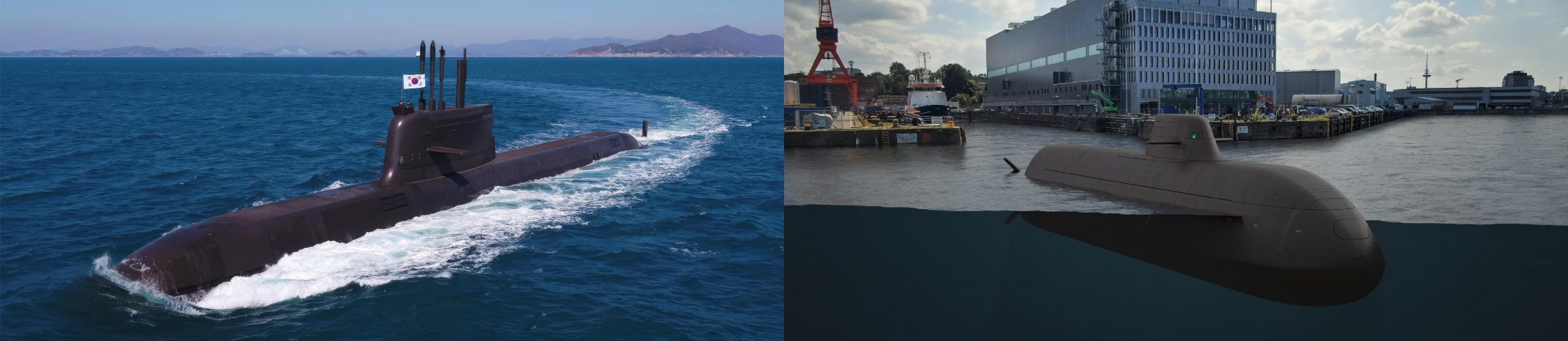
The government’s impending decision on procuring new submarines for the navy could provide some real substance to its Indo-Pacific initiatives. In particular, Ottawa’s selection of South Korea’s KSS-III (Batch 2) would be a powerful indicator that Canada was serious about giving more policy emphasis to the Indo-Pacific region.
Navy traditionalists will argue that Canada should stay the course with its European allies to counter a real and present Russian threat. In this view, buying the German TKMS Type 212CD submarine makes sense for logistical and interoperability reasons.
However, if Ottawa is really serious about its longstanding intention to shift its policy focus more to the Indo-Pacific region, then the South Korean Hanwha Ocean submarine becomes an attractive option.[2]
In the latter case, South Korea itself could function as a theatre maintenance depot for Canadian submarines, and as a Forward Operations Base for the RCN as a whole.[3]
Of course, choosing either submarine would not automatically rule out operations in either the northern European or the Indo-Pacific region. In fact, some commentators have raised the possibility of a split purchase with Ottawa purchasing subs from both Germany and South Korea. However, PM Carney was quick to quash this suggestion.[4]
Ideally, Ottawa would have issued clear, updated Foreign and Defence Policy Statements long before the CPSP had been initiated to reveal Canada’s foreign policy priorities. However, Global Affairs Canada has only recently announced that a new foreign policy document is in the works with an as yet to be determined release date.[5]
A decision on the submarine selection is expected as early as June 2026. Time will tell whether or not Canada’s choice of submarine will come to be a cornerstone of a new policy orientation and emphasis for our country.
Notes
1. Ottawa, Government of Canada, Global Affairs Canada, Canada’s Indo-Pacific Strategy, 3 December 2022.
2. Philippe Lagassé, “Canadian subs from a South Korean Perspective,” Debating Canadian Defence, 21 April 2026.
3. Julie Kim, “Advancing Canada-Republic of Korea Maritime Security Cooperation,” Canadian Global Affairs Institute, March 2026, 5.
4. “Submarine contract won’t be split between suppliers: Carney,” http://www.canadianmanufacturing.com , 24 September 2025.
5. Neil Moss, “Anand to convene envoys in June as feds prepare new foreign policy paper,” HillTimes, 22 April 2026.
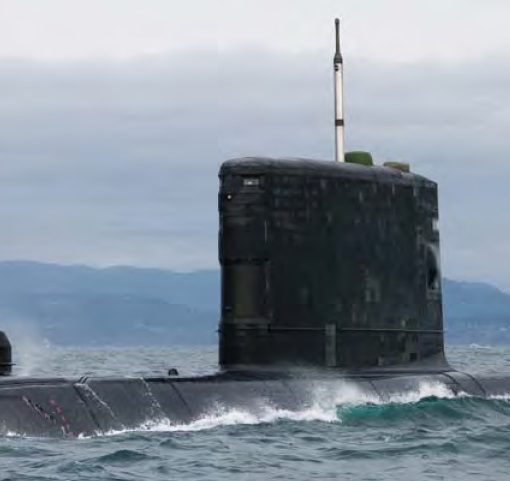
Image: A photo of a KSS-III Batch I on the left and a rendering of the Type 212 CD on the right. Credit: Republic of Korea Navy, ThyssenKrupp Marine Systems


3 thoughts on “To Pivot or Not to Pivot?”
I do think it is a wise move not to split the procurement for practical reasons as well as logistical ones.
As for the two choices, I have always favoured the Type 212CD given our NATO allies will be using them. However, if we want to advance our Indo-Pacific holdings then most certainly the South Korean option is very much the preferred bet.
Hi Dan, While I agree, one logically could expect that if the RCN assesses either submarine class as adequate for the RCN (and I believe RCN has indicated that), then either an Indo-Pacific orientation or a predominantly Euro-Atlantic orientation could be a defining factor. However perhaps Ottawa considers those foreign policy considerations are sufficiently balanced, and thus Ottawa has elected to let schedule and industrial offsets be the deciding factor. I think Ottawa has been very open in stating that those two factors (schedule & industrial offsets) will be their deciding criteria. These are interesting and, from a future procurement perspective with programs such as this, hopeful times for the RCN.
Lee,
I agree with you that it is likely that schedule and industrial benefits/offsets are going to be key factors in the ultimate decision. I would like to see the schedule receive much higher priority in these uncertain and dangerous times. However, I fear that, like so often in past defence procurements, industrial offsets will resonate with our politicians, and thereby the RCN’s pressing needs will be much delayed.