By Ted Barnes, 18 February 2026
Major (Ret’d) Les Mader's ‘tripwire corvette’ proposal, as described in the recent issue of Canadian Naval Review, confuses political grievance with practical naval strategy. It suggests provoking confrontation at sea with vulnerable ships and expecting deterrence, which is not a sound strategic approach.
Canada is already deploying a blue-water continental corvette, addressing Mader’s concerns about lacking heavily armed ships. This new vessel is in its capability phase, built for endurance and credible force projection across the Atlantic, Pacific and Arctic. Therefore, an additional ideologically driven fleet is unnecessary, as current programs meet real continental defence needs, although it's unclear if Mr. Mader is aware of this project or not.
The article ignores the ongoing reality that Canada is fundamentally and continuously integrated with the US military, both operationally and legally and I surmise many Canadians are also not. Given joint operations, systems, military sales and protocols like NORAD and 2nd Fleet, it is inconsistent to propose provoking US naval forces while relying on shared resources and coordination. This contradiction undermines the feasibility of such proposals.
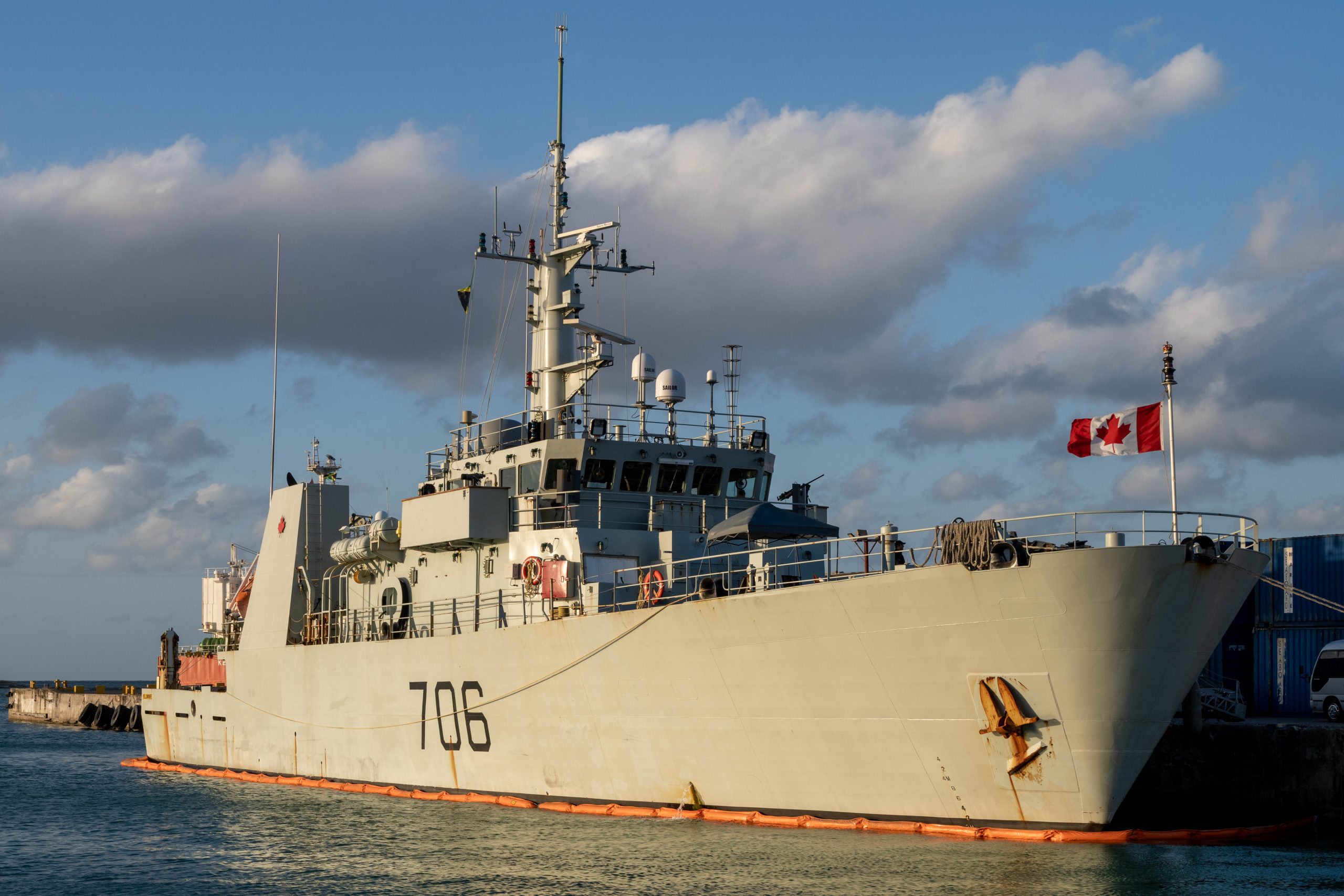
Despite practical realities, HMCS Yellowknife is currently working with the US Coast Guard on Operation Caribbe with a USCG boarding team embedded, reflecting standard cooperation between Canadian and US forces. Suggesting a fleet concept based on confrontation with this partner ignores how Canada ensures its own security today.
The selective invocation of Israel’s Saar 6 only further exposes the problem. The Saar 6 works because it is embedded in a dense national Israeli air defence and strike architecture operating in confined waters, not because it is some mystical small ship with oversized bravado. Applying that logic to Canada's three ocean, ice-affected environment without considering endurance, survivability, logistics, or escalation control is not real analysis, it's just empty rhetoric about hardware.
Most troubling is the article’s acceptance of escalation as a feature rather than a failure. Tripwires work only when backed by overwhelming escalation of dominance and political clarity, not when they are designed to be expendable irritants daring a superior force to react. Canada does not deter by daring the United States to sink a corvette. It deters itself by being credible, interoperable, persistent and indispensable within alliance frameworks that matter.
Canada needs practical, reliable ships to work effectively with allies, not vessels built for online praise or grievance signaling. Despite the rough waters Canada and the United States are experiencing, the United States is still our ally. A navy based on such narratives lacks true strength and sovereignty.
Image: HMCS YELLOWKNIFE rests alongside the jetty in Montego Bay, Jamaica, as the sun sets
during a port visit in support of Operation CARIBBE on 10 February 2026. Credit: Canadian Armed Forces Imagery Technician.


7 thoughts on “Why Canada Does Not Need a ‘Tripwire’ Navy”
Good afternoon Ted,
It seems clear that our views about possible future Canada-USA relations diverge fundamentally. Yours appears to be summed up by your comment that “It [Canada] deters [sic?] itself by being credible, interoperable, persistent and indispensable within alliance frameworks that matter.” This statement assumes that the USA is a reliable, trustworthy, rules/treaty-respecting ally, neighbour, and trade partner.
I believe that this assumption is far from valid, both now and going forward. This view is driven by two fundamental beliefs:
– The forces that put Trump into the White House, especially the second time, are not going to disappear whenever he leaves the presidency.
– The USA is displaying the signs of a great power in relative decline which is handling the change poorly.
I further believe that there are at least six reasons why Canada must consider how to be able to resist American military pressure.
The first of these is that Trump has already shattered so many American democratic rules and expectations that it is not certain that future presidents will elevate their behaviour back to an earlier, higher standard. It is entirely possible that they will instead expand on his precedent to sink even lower in their personal and official actions.
Second, such a continued decline in presidential behaviour is made more likely by the United States Supreme Court 2024 ruling that “… the nature of Presidential power entitles a former President to absolute immunity from criminal prosecution for actions within his conclusive and preclusive constitutional authority. And he is entitled to at least presumptive immunity from prosecution for all his official acts.” Clearly, such immunity also applies to presidents while they are in office. Combining such immunity with the presidential pardon powers makes it is entirely plausible that some American president(s) will: commit criminal/authoritarian acts; claim immunity; and use the presidential pardon powers to recruit and protect the necessary accomplices.
The third reason to be concerned about Canada’s future is the fact that the USA is trapped in the cycle of earlier declining great powers that emphasize the tangible symbols of power – such as expensive military forces – rather than investing in the strengths – human, economic, and governmental – that underpin that power. Thus, like its predecessors, the USA may well be tempted to use its current military strength to try to arrest its eclipse.
Fourth, attacking Canada would follow on logically from the Trump administration’s imperialist attitude, which is found in the American National Security Strategy of November 2025. This document states, among other things, that: “… the United States will reassert and enforce the Monroe Doctrine to restore American preeminence in the Western Hemisphere, and to protect our homeland and our access to key geographies throughout the region.” The January 2026 decapitation strike against Venezuela seems to indicate how this assertiveness could be applied in the Western Hemisphere against any country displeasing to/coveted by the USA. Trump’s subsequent comment that “American dominance in the Western hemisphere will never be questioned again,” his threats to annex Greenland the “hard way” if necessary, and his stated belief that he has unbridled personal power to act internationally appear to sum up a new American attitude.
Fifth, such an action would be entirely consistent with the USA’s increasingly frequent use since 1990 of military force in its international relations. An attack on Canada could be presented to the American population as simply a continuation of the successful approach used against: Grenada in 1983; Panama in 1989; and Venezuela in 2026. The perceived great success of these operations could actually lead Americans to expect that a coup de main attack on Canada would achieve their goals easily. Therefore, it is far from inconceivable that the Trump administration would seek to use force to solve its ‘problems’ with Canada, believing that such actions will be quick and easy.
Sixth, having declared itself to be dominant in the Western Hemisphere, the USA will likely look askance at any Canadian attempts to diversify its trade relations to other countries in order to reduce its exposure to American economic pressure. This hostility is likely to be particularly strong should Canada become close economically to China and/or Canada’s trade dependency on the USA is significantly reduced.
Therefore, for these reasons, my commentaries in CNR 21.1 and 21.3 suggest how the CAF and RCN could seek to prepare for potential hostilities – as is their fundamental mandate! They do not seek online praise or signal grievance.
Ubique,
Les
Les,
You are right about one thing up front — our views diverge fundamentally. But the divergence is less about whether the United States could behave badly and more about how Canada should responsibly prepare for an uncertain future without drifting into strategic self harm.
Your argument rests on a chain of assumptions that when examined together begin to collapse under their own weight.
First acknowledging that the political forces behind Trump are persistent does not automatically translate into a conclusion that the United States ceases to be a functioning alliance partner or becomes a likely military aggressor against Canada. Democracies can be messy cyclical and internally contradictory without abandoning every treaty obligation or alliance interest. NATO and NORAD integrated defence industries, intelligence sharing and combined operational commands are not expressions of presidential temperament. They are institutional realities built over decades and embedded far deeper than any one administration.
Second the Supreme Court ruling you cite is concerning from a governance perspective but extrapolating from it to an inevitable slide into unchecked authoritarian foreign aggression ignores several realities. Continued constraint imposed by Congress, the courts, the military chain of command and critically the professional military ethic of the US armed forces still matters. American civil military relations are not perfect but neither are they a personal militia awaiting orders to invade a treaty ally.
Third the declining great power lashes out analogy is historically seductive but strategically shallow. The United States is not a hollowed out empire clinging to symbols of power while its foundations rot. It remains the world’s largest economy by market capitalization the central node of global finance, the technological leader in defence systems and the keystone of the Western alliance system. Decline narratives become dangerous when they are used to justify worst case planning divorced from probability and consequence.
Fourth the invocation of the Monroe Doctrine and the Venezuela strike dramatically overstates their relevance to Canada. Whatever one thinks of those actions, they occurred outside alliance frameworks against states with no mutual defence treaties, no integrated command structures and no shared industrial or economic ecosystems. Canada is not Grenada, Panama or Venezuela. Treating it as such requires assuming a total collapse of American strategic rationality that would precede not follow any conflict with Canada.
You also appear to gloss over the practical reality of how deeply integrated Canada and the United States already are at the operational level. There are hundreds of CAF personnel working inside the United States today actively cooperating in the joint defence of North America through North American Aerospace Defense Command and with the United States Second Fleet. Canadian and American forces conduct continuous joint operations including maritime security missions such as Operation Caribbe where HMCS Yellowknife is currently deployed. Canadian warships routinely conduct port visits in the United States and operate seamlessly with US forces at sea. This level of daily integration cooperation and trust is not what a credible threat relationship looks like. It is the opposite.
Fifth the idea that an attack on Canada could be sold domestically as a quick and easy operation ignores both geography and reality. Canada is not a coup de main target. It is vast inhospitable, economically intertwined with the United States and deeply embedded in US homeland defence architecture. Any military action against Canada would immediately fracture NORAD, destabilize NATO, trigger economic self destruction and fundamentally weaken United States’ global power. That is not how rational even aggressive great powers behave when they are trying to preserve dominance.
Sixth trade diversification is not a casus belli. Canada has been diversifying trade for decades. The United States may apply economic pressure through tariffs, regulatory leverage or market access threats but equating economic coercion with imminent military action is a category error. States use economic tools precisely because they are preferable to war.
Where your argument ultimately falters is in conflating prudent contingency planning with primary threat orientation. Yes the CAF and RCN exist to defend Canada against all potential threats. But defence planning must be anchored in likelihood scale and strategic coherence. Designing force structures around resisting a hypothetical US invasion risks diverting finite resources away from real present and alliance relevant challenges such as Arctic sovereignty enforcement, undersea domain awareness, continental air and missile defence and high end warfighting alongside allies.
Credibility, interoperability, persistence and indispensability are not acts of naivete. They are acts of leverage. They ensure that Canada is not weak isolated or strategically irrelevant but embedded so deeply in alliance systems that coercion becomes counterproductive and conflict irrational.
Preparing for uncertainty is wise. Preparing as though the United States is Canada’s primary future adversary is not.
Good afternoon Ted,
It is my understanding that your thesis about American benevolence towards Canada rests on the theory that: What has been is what will be. I believe that this view ignores the likelihood that Trump and his electoral coalition represent a new force in American politics that wishes to smash the status quo of the past 80 years. Further, given the numbers who voted for Trump in 2024, I also believe that it is likely that this coalition will continue to be important or dominant politically long after he eventually leaves the White House.
If I am correct, alliance structures, institutional realities, peacetime military integration including between Canada and the USA, the restraining role of Congress and the courts, and the professional ethos of the American military will not cause the USA to treat Canada someday as anything other than a target to be converted into a weak, obedient source of raw materials and energy. In such circumstances, Canadians will need to have already looked to their defences or find themselves as, at best, a ‘frozen Puerto Rico.’ In this best-case, subservient scenario, we would have American citizenship but no power to influence national decisions, due to having no seats in Congress and thus no Electoral College votes. Our fate could also be far worse.
Therefore, my two recent CNR commentaries seek to suggest how the Canadian government could (discretely) enhance the CAF in order to be able to meet a potential threat. At the same time, I continue to argue for a ‘dual track’ defence strategy that also allows Canada to contribute to NATO/coalition expeditionary missions in defence of our allies and overseas interests.
I find that this approach provides future Canadians with a range of options in any crisis.
The following paragraphs will touch more directly on some of the points that you raised.
“[T]he professional military ethic of the US armed forces” that you feel will protect Canada is exactly what will cause American military personnel to follow orders to use force against Canada or Canadian interests. They will simply require a duly-issued order through their chain of command, perhaps supported by some publicly stated pretext to (by way of examples):
– Conduct coup de mains in southern Canada to achieve a political goal, likely in conjunction with Canadian quislings.
– Seize parts of Canada’s northern territories ‘to defend the American homeland.’
– Blockade seaborne trade from Vancouver to China in support of some invented American ‘sanctions.’
It does not matter how well CAF members work daily alongside their American counterparts; these Americans are not making policy. This comes from Trump and is transmitted by Hegseth.
The relative decline of the USA, vis-à-vis China and India at least, is an unquestionable fact. So far, the USA retains the economic power that you describe; decline takes time. However, Trump’s actions are accelerating the process. He is pushing his allies and trading partners to move away towards new/expanded relations with seemingly more dependable countries. At the same time, he is undermining the health and education of the American population, which are vital to economic strength, in order, among other things, to increase military spending to USD1.5T. This seems to me to be the very embodiment of the historian Paul Kennedy’s classic observation about declining Great Powers.
Finally, coup de main operations are not telegraphed beforehand. There are already Canadian scenarios that have been touched on in the press where a no-notice operation, like Grenada, or a long-prepared one, like Panama, could be launched without any forewarning. This does not mean that they will succeed; history is full of political leaders who thought that their desired military action would solve their problem(s) easily: Putin in 2022, Saddam Hussein in 1980 and 1990, and the Argentine junta in 1982. However, once launched, coup de mains can take on a (bloody) life of their own; just ask Putin.
In closing, it seems clear that Trump is not motivated by respect for treaties, his word, or morality. His attempt to seize Greenland seems to show that he will only back down when resisted and given a ‘victorious’ off-ramp. Thus, when he decides to settle his ‘Canadian problem’ we had better be ready to convince him that his desired outcome will cost too much.
I will close with two quotes that I find particularly pertinent.
“Hope is not a strategy.”
“When someone shows you who they are, believe them the first time.”
Ubique,
Les
Les,
You frame this as prudence. In reality, it reads like strategic fatalism dressed up as foresight.
You assume that the United States is on an inevitable trajectory toward treating Canada as a target for coercion or annexation. That alliance structures, NORAD integration, shared basing, embedded personnel, judicial constraints, Congressional oversight, and eighty years of continental defence cooperation will simply dissolve at the issuance of a “duly-issued order.” That is not analysis. That is speculation built on worst case extrapolation.
Let’s ground this in reality.
We currently have hundreds of Canadian Armed Forces personnel serving in the United States in integrated billets under North American Aerospace Defense Command and alongside U.S. 2nd Fleet. Canadian and American officers sit in the same operations rooms, share intelligence feeds, co-author contingency plans, and coordinate daily aerospace warning and maritime defence of the continent. That is not theoretical integration. That is structural interdependence.
Right now, HMCS Yellowknife is deployed on Operation Caribbe with a U.S. Coast Guard Law Enforcement Detachment embarked. Canadian sailors and American LEDET personnel operate side by side enforcing maritime law in the Caribbean. Our ships routinely conduct U.S. port visits. Our sailors train at U.S. schools. American aircraft deploy to Canadian bases. This is not the posture of two states sleepwalking toward invasion.
You suggest that the professional military ethic of the U.S. armed forces would guarantee obedience to an order to conduct coup de main operations in southern Canada or seize northern territory. You are correct that professional militaries follow lawful orders. What you omit is that the U.S. system requires those orders to move through political, legal, operational, and strategic filters. The notion that a complex, no notice seizure of Canadian territory could occur without massive political, economic, and alliance consequences is implausible. It would detonate NATO cohesion overnight, fracture NORAD, crash markets, and trigger Congressional revolt. The United States does not exist in a vacuum.
You cite Grenada and Panama. Those were operations against small states outside an integrated continental defence architecture, not a G7 neighbour with binational command structures, deep industrial interdependence, and decades of shared planning. The comparison is structurally unsound.
You warn of Greenland. Yet Greenland is governed within the Kingdom of Denmark, a NATO ally with sovereign agency. The situation is politically complex, yes, but again, rhetoric is not an amphibious landing.
Where I do agree with you is this: Canada must invest seriously in its defence. Not because Washington is poised to seize Vancouver. But because the world is unstable. Because China is expanding maritime reach. Because Russia operates in the Arctic. Because trade routes matter. Because sovereignty requires capability.
We absolutely should strengthen the CAF. We should recapitalize the Navy, modernize the Army, harden northern infrastructure, and ensure that NORAD modernization is fully funded. We should pursue a dual track strategy that allows credible continental defence and meaningful NATO contributions. That is not controversial. That is responsible policy.
What is counterproductive is framing the United States as a looming occupier while simultaneously relying on the same United States for aerospace warning, ballistic missile detection, joint logistics, and operational integration.
You argue that hope is not a strategy.
Agreed.
But neither is strategic paranoia.
Canada deters by being credible, interoperable, persistent, and indispensable within the alliance frameworks that matter. We increase our leverage not by theatrically anticipating annexation, but by deepening capability and ensuring that any crisis calculus always favours cooperation over confrontation.
If someday a U.S. administration were reckless enough to contemplate coercion, the most powerful deterrent would not be rhetorical suspicion. It would be the enormous political, economic, military, and alliance cost such an action would impose on Washington.
Strengthen the CAF. Yes.
Prepare for contingencies. Yes.
But do not mistake political turbulence for inevitability.
Good afternoon Ted,
This topic seems to be of little interest to anyone other than the two of us. Thus, we are de facto having a private argument about, essentially, the health of the USA’s democracy and the state of its public discourse. Clearly, you do not accept my arguments and I find yours unconvincing.
Therefore, we can either continue a pointless exchange or we can agree to disagree (my preference).
Ubique,
Les
P.S. Trump’s attack on Iran introduces a new consideration; has he just arrived at his “September 1939” moment? Time will tell. L
Les / Ted – thank you for this exchange. The issue of how to frame, rank, and respond to the strategic challenges facing Canada (and the allies) is never time wasted. I hazard to guess that a great many CNR readers have paid careful attention to your debate.
Thank you Barnacle.
Ubique,
Les