By Les Mader, 8 January 2026
Since the 2020 publication of a visionary article by Colonel Brian Wentzell, the Canadian Naval Review (CNR) and the Canadian Army Journal (CAJ) have published a total of 14 articles on the creation of a Canadian Arctic amphibious capability and/or the strategic context pertinent to it. In his article Colonel Wentzell discussed Canada’s ability to deploy a [basic] Arctic amphibious capability using existing ships, personnel and helicopters. Subsequent articles built on his idea and raised the additional possibility of creating an intermediate Arctic amphibious capability that employed existing soldiers and helicopters which were transported by to-be-developed, specialist Arctic amphibious ships.
From the articles, it is clear that such a capability could carry out some or all of the following tasks, depending upon the resources devoted to it:
- Deploying land presence forces to the Canadian Arctic, and supporting them ashore, as they contain/confront intruders while the government seeks to settle a foreign incursion through diplomacy.
- Contributing to overseas crisis response operations alongside NATO and/or coalition partners.
- Conducting non-combatant evacuation operations to rescue Canadians, and other innocents.
- Providing disaster relief and humanitarian assistance in littoral areas in Canada or overseas.
- Employing the amphibious ships belonging to the capability for sealift operations, should they be so capable.
Recent comments by Vice-Admiral Topshee, Commander of the Royal Canadian Navy, raise the possibility that some level of such a capability might actually be developed.
Navy ponders concept of Canadian-built amphibious landing ship for Arctic operations | CBC News
Thus, in order to assist in the thinking on the shape of a Canadian Arctic amphibious capability, and its possible implementation, this post seeks to bring together all the recent, relevant CNR and CAJ articles in a single list.
The general approach found in all of the articles is to maximize the possibility of the Arctic amphibious capability actually being developed and successful by minimizing its costs and any unnecessary duplication of existing CAF formations and units.
The strategic context for this amphibious capability is driven by climate change’s effects on the Arctic and Canada’s worsening geo-strategic situation. This context for, and the general utility of, such a capability are discussed at the following articles:
- CNR 17.3 pp 20 and 21.
- CNR 20.2 pp 15-20.
- CNR 20.3 pp 28-31.
- CNR 21.1 pp 20-23.
The general shape of the basic Canadian Arctic amphibious capability is described at CNR 15.2 pp 36 and 37 while the equivalent discussion for the intermediate capability level is found at CNR 16.1 pp 32-34.
Various aspects of the command and control of Canadian amphibious forces are discussed at:
- Canadian Army Journal (CAJ) 19.2 pp 72-74 (Canadian Army Journal 19.2 (publications.gc.ca)).
- CNR 17.2 pp 33 and 34.
- CNR 19.3 pp 33-35.
The basic level of capability would use Arctic and Offshore Patrol Ships and Protecteur-class supply ships (when sea-ice permits) as the required amphibious vessels. The intermediate level would require the development and construction of specialized amphibious vessels. The suggested working names for the two notional ship designs are:
- Landing Platform Arctic (LPA).
- Landing Ship Infantry (Arctic) (LSI(A)).
More details about these two designs are found at:
- CNR 16.1 pp 33 and 34.
- CNR 17.1 pp 33-35.
- CNR 18.1 pp 31-34.
- CNR 18.2 pp 23-27.
- CNR 18.3 pp 30-32.
The various articles recommend that the marine infantry required by this new capability be found by reroling one to three of the army’s existing infantry battalions. These approaches are discussed at:
- CNR 15.2 p 37.
- CNR 16.1 p 33.
- CAJ 19.2 pp 70-75.
An initial discussion of the helicopters and hovercraft required to transport the marine infantry to/from their ships is found at:
- Helicopters – CNR 17.2 pp 32-35.
- Hovercraft (Landing Craft Air Cushion) – CNR 18.1 pp 34-36.
It is my personal belief that Canada should develop an intermediate amphibious capability level that employs four ships possibly a mixture of two LSI(A)s and two LPAs, supported by:
- A permanent task force command and control capability based in Kingston, Ontario.
- Three adapted Canadian Army infantry battalions.
- Two Maritime Tactical Helicopter Squadrons (one per fleet).
- One hovercraft flotilla per fleet.
It is hoped that the above information is useful to the readers of the Broadsides Forum. I look forward to any comments that it might inspire.
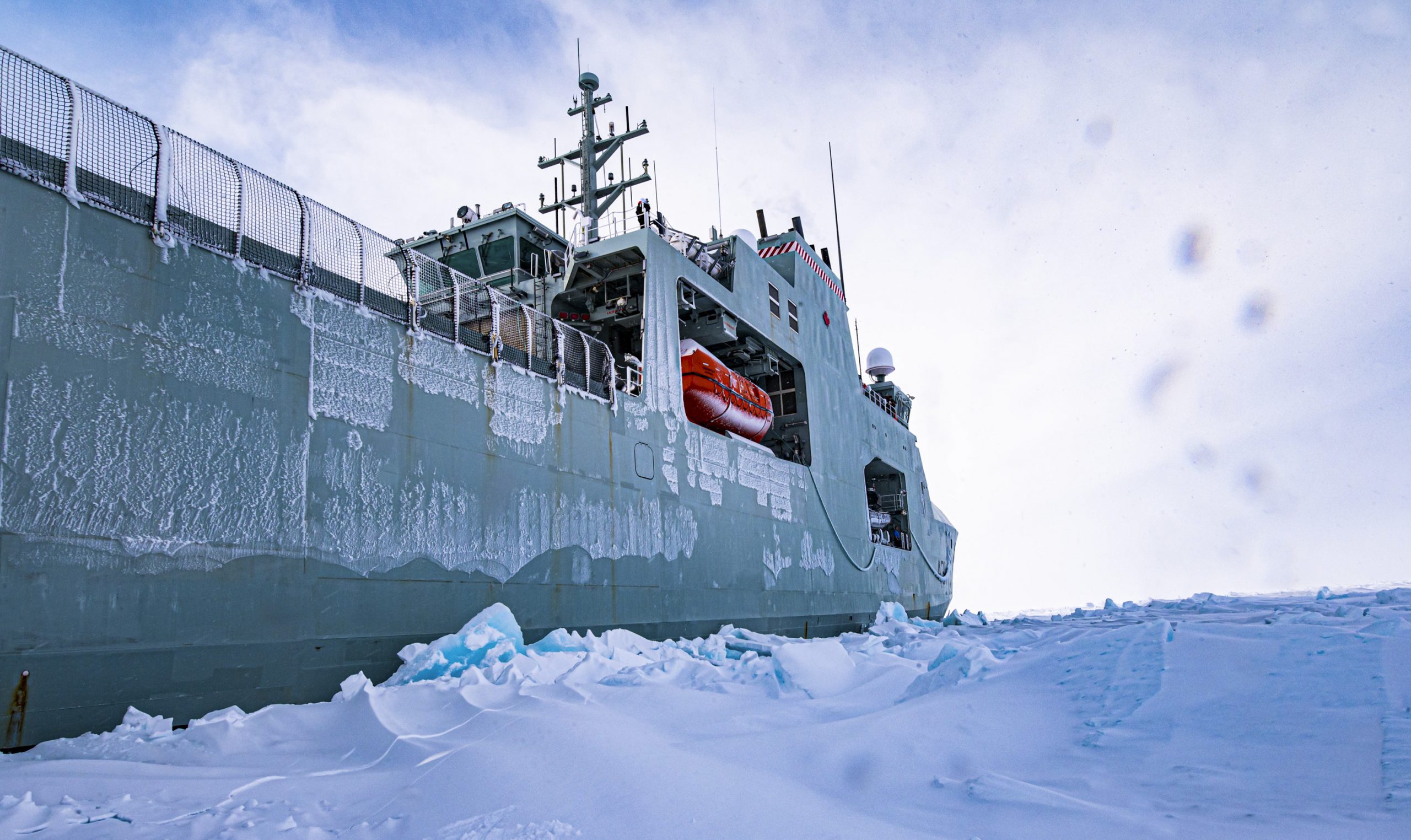
Image: HMCS MARGARET BROOKE parked in ice for as they prepare to take samples of the ice conducted by civilian contractors in the Labrador sea during ice trials on February 27th 2022. Credit: S2 Taylor Congdon, Canadian Armed Forces Photo


4 thoughts on “Some Thoughts on A Canadian Arctic Amphibious Capability”
Every few years the idea of a Canadian amphibious capability resurfaces in Broadsides and related journals, usually framed as a modest, incremental evolution of existing forces rather than a leap to a full spectrum amphibious navy. Les Mader’s survey of the literature is thorough and fair, and it correctly notes that this is not a new conversation. But completeness of argument does not equate to priority and that is where the case begins to unravel. Canada has no shortage of well-reasoned ‘nice to have’ capabilities; what it lacks is the fiscal, personnel and industrial slack to pursue them all at once. Amphibious lift, Arctic-themed or otherwise, sits very low on that list when measured against more immediate and acknowledged gaps: submarines, sustainment, trained personnel, Arctic infrastructure, and the simple ability to keep the fleet and air force we already own fully operational.
The Arctic argument in particular tends to overstate what amphibious ships actually buy us. The notion that landing forces from the sea meaningfully strengthens sovereignty in the High North ignores geography and logistics. Most realistic Arctic contingencies hinge on airlift, local presence, ISR and sustainment not ship-to-shore manoeuvre against an opposing force. The RCN’s Arctic and Offshore Patrol Vessels were never designed to be amphibious assault platforms, and stretching them into that role risks diluting their already well-defined constabulary and presence missions. Even the intermediate concepts, purpose-built Landing Ship Infantry (Arctic) or Landing Platform Arctic imply new hull classes, new training pipelines, new doctrine and new crews, all in an institution already struggling to crew and sustain its core fleets.
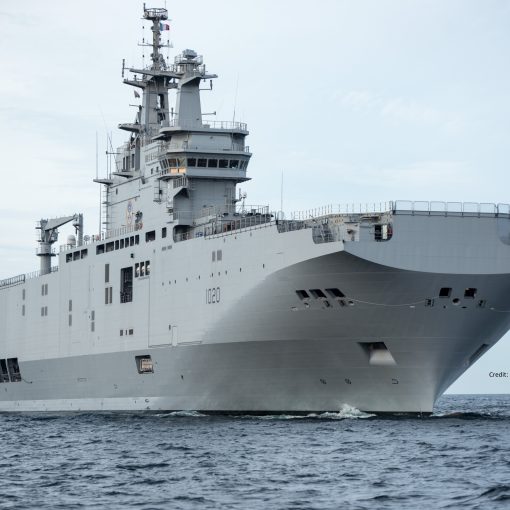
Canada has flirted with this path before. The closest we came to a genuine amphibious capability was examining the French Mistral-class ships, ultimately sold to Egypt. That episode is instructive. It was not rejected because amphibious ships are inherently foolish, but because the downstream costs in people, support and opportunity were wildly out of proportion to the marginal utility they offered Canada. That logic has not changed. If anything, today’s constrained personnel system and strained procurement environment make it even less forgiving. Creating ‘marine infantry’ by giving existing battalions a role may look tidy on paper, but it quietly assumes away the impact on the Army’s existing commitments and readiness much as naval papers often assume sailors, helicopters and dockyard capacity will simply materialize.
Recent remarks by Angus Topshee should be read carefully. When senior leaders describe concepts as ‘thought exercises,’ they are often signalling exactly this tension: intellectual exploration without an implied commitment to build. The RCN and CAF are already attempting to recapitalize surface combatants, replace submarines, regenerate the supply chain, and stabilize recruiting and training. Against that backdrop, an Arctic amphibious task force complete with bespoke ships, hovercraft flotillas and standing headquarters looks less like prudent hedging and more like strategic distraction.
If Canada ever does decide to go all in on amphibious lift, there is a far more sensible and affordable path than inventing bespoke Arctic landing ships. A commercial off-the-shelf (COTS) approach adapted sealift or offshore vessels with stern ramps, robust cranes and modular systems such as Mexeflote-style causeway ferries would deliver most of the practical utility at a fraction of the cost and complexity. Such ships would emphasize logistics, mobility and flexibility rather than assault glamour, align better with Canada’s actual operating concepts, and avoid locking the CAF into another unique, low-density fleet with high sustainment risk.
None of this is to say amphibious operations are useless, or that Canada should never contribute to them alongside allies. We already do, selectively and sensibly through coalition frameworks that leverage allied platforms rather than duplicating them at national expense. The danger is mistaking conceptual elegance for necessity. Until Canada has addressed its first-order problems crews, sustainment, under-ice capability and credible Arctic logistics, amphibious ships will remain what they have always been in the Canadian context: an interesting idea, periodically rediscovered, but firmly at the bottom of the list of priories for the CAF.
Thank you, Rick, for this sensible comment. I would add another point: at current build rates, Canada’s shipyards are booked solid until about 2045 and the only yard currently building armed vessels is booked further out than that. If we have, or can make, spare capacity before then, that capacity would be better used accelerating the build rate, and increasing the total number of destroyers, corvettes and support ships. If Canada begins to consider a new hull class in 2038, we will be in plenty of time.
Hello Richard. I have decided, because of the seriousness of this topic to re-publish my thoughts on Les Mader’s article “Some Thoughts on A Canadian Arctic Amphibious Capability” as well. So, where do I begin. A Canadian Arctic Polar Class 2 Amphibious Sea Lift Capability is not a “modest incremental evolution” as you say, but a sorely needed priority that Canada requires in a rapidly changing geopolitical world now and in the long term. It is not a ‘nice to have’ capability, but rather an urgent priority for Canada right now! The fact that Canada is strongly considering a Polar Class 2 Strategic Sea Lift Capability speaks volumes to a capability that is long overdue and I believe will be a much-needed capability for Canada in the not-too-distant future. Canada is the only G7 country without an amphibious sea lift capability. Yes, Canada has flirted with this capability before with the French Mistral Class LHD but there are other options as well including; The Spanish Juan Carlos LHD; The Italian Trieste Class LHA; The German Blohm Voss Class LHD design and the America Class LHA. In 2024 I wrote an Article for the Canadian Naval Review called “A Strategic Canadian Amphibious Sealift Capability in CNR Vol. 13-4. It can be viewed at: https://www.navalreview.ca/wp-content/uploads/CNR_pdf_full/cnr_vol13_4.pdf.
The problem with all of these LHD/LHA Sealift vessel designs is that they all do not have an Arctic Polar Class 2 rating which means that this Canadian Amphibious Sealift Capability has not been built….yet. The Diefenbaker Class Polar Class 2 now being built by both Davie & SeaSpan shipyards are the closest to what would be required for a Canadian amphibious sealift capability. This capability will not be cheap however, and will probably be well over 30,000 + tonnes & over 180 meters long with a wider beam & deeper draft than what is now being built for the Canadian Coast Guard (CCG). A fleet of at least 4 of these Polar Class 2 amphibious sealift ships for sealift operations and Humanitarian Assistance & Disaster Relief (HA/DR) will be required. Based on the Polar Class 2 Ice Breakers being built now, this ship can be built with Canadian ingenuity & know-how. With Canada quickly attaining its NATO goals of 2% of GDP this year & going to 5% of GDP by 2030, with more trained personnel, this capability will happen. It took Australia however over 20 years to gain this capability so it will be a slow process.
Hi, and I can republish some of my arguments as well.
David, I don’t question the seriousness of the issue, but I do disagree on urgency.
A Polar Class 2 amphibious sealift fleet would not be a modest evolution of existing RCN or joint capabilities. It would represent a major shift in doctrine, force structure, crewing, sustainment, and political intent. Canada does not currently have the mission sets, concepts of operations, trained personnel, or institutional experience to justify treating a PC2 amphibious capability as a near term priority.
The Arctic challenges Canada faces today are about presence, surveillance, logistics, sovereignty enforcement, and resilience not large scale over the shore amphibious operations. The G7 comparison is also misleading. Most allied amphibious fleets exist for expeditionary power projection, not homeland defence. Canada has long contributed to NATO through high end niche capabilities rather than duplicating allied amphibious mass, and that has been a deliberate and largely successful choice.
While it’s true that existing LHD/LHA designs aren’t PC2 rated, that fact actually cuts against the argument for urgency. A 30,000–40,000-tonne PC2 amphibious ship would be a bespoke, first of class design with significant technical, schedule, and cost risk. Given existing challenges in crewing and sustainment, such ships would almost certainly come at the expense of escorts, submarines, MCM renewal and badly needed Arctic infrastructure ashore.
HA/DR is often cited as justification, but Canada already conducts these missions effectively using airlift, AOPS, commercial and chartered sealift, and allied support. A PC2 amphibious assault ship would spend most of its service life performing tasks that do not require PC2 icebreaking or a well deck making it an expensive solution to a narrow problem.
If Canada ever decides to “go all in” on Arctic sealift, a far more realistic approach would be a COTS based logistics ship: ice strengthened, with a stern ramp, heavy cranes, modular accommodation and Mexeflote-style connectors. That would deliver most of the practical benefit at a fraction of the cost and disruption.
This is an interesting concept and worth studying, but presenting a PC2 amphibious fleet as an urgent national priority does not align with Canada’s current threat environment, force structure, or readiness realities unless we are seeing Yanks under our collective beds again.