By Dr. Ann Griffiths, 4 January 2026
Happy New Year! Now that January is here, we all need something to look forward to – other than bills for all those things you bought for Christmas! Fret no longer, you can look forward to the upcoming CNR issue.
As usual, the new issue of CNR contains a variety of interesting articles. Our first article was the winning essay of the 2025 CNMT Essay Competition. It’s called “Pirates and Partnerships: An Examination of Maritime Non-State Actors,” by Edward Khitab. Khitab uses the example of the Sea Shepherd Conservation Society to examine the nature and increasing number of maritime non-state actors -- and concludes that the RCN needs to start paying attention to them. The second article, “The Strategic Utility of Aircraft Carriers in China’s Ambitions in East Asia,” discusses the rapid growth of China’s aircraft carrier capability and how and where Beijing would likely use them in the case of war. The third article is “Why Does Canada have a Navy? Reflecting on the Canadian Leaders at Sea Program.” In this article, the author addresses a simple question that was asked while he was participating in the CLaS program, and considers what a navy represents and why Canada has one. The final essay, “SS Nerissa: A Tragic Footnote to History,” tells the little-known story of the last voyage of SS Nerissa that was sunk by a U-boat while transporting troops and civilians across the Atlantic in the Second World War.
If that isn’t enough to spark your interest, we have our usual Making Waves commentaries. We have a commentary about hydrography in the Arctic. Sound boring? It’s not. If Canada is getting submarines that are expected to operate in the Arctic, Ottawa needs to act now to map the seafloor there. We have a commentary about the many historic discussions about moving the Coast Guard into the defence department. We have a commentary about the unthinkable – i.e., having naval ships that can act as ‘tripwires’ in the event that the United States decides to blockade Canada. We have an account of a conference in Australia, Canadian interest in East Asia, and preparing for Russia in the Arctic.
And, of course, we have our regular columns. “A View from the West” looks at North Korea’s increasing focus on its navy. “Dollars and Sense” examines the defence-related parts of Budget 2025, and “Warship Developments” updates us on several interesting recent naval decisions.
In addition to all this great information, we have our usual amazing photos!
Stay tuned. In a few weeks, the issue will be in the mailbox of people who are lucky enough to be subscribers! It’s not too late for you to subscribe. See below for the Table of Contents.
Table of Contents
Vol. 21, No. 3 (Winter 2026)
Editorial: Possibilities and Pitfalls
Ann Griffiths
Winner of the 2025 CNMT Essay Competition
Pirates and Partnerships: An Examination of Maritime Non-State Actors
Edward Khitab
The Strategic Utility of Aircraft Carriers in China’s Ambitions in East Asia
Adam P. MacDonald
Why Does Canada have a Navy? Reflecting on the Canadian Leaders at Sea Program
John Walsh
SS Nerissa: A Tragic Footnote to History
Robert L. Willett
Making Waves
Canadian Arctic Hydrography: Proceed with Alacrity
Tom Tulloch
The DND-CCG Merger: Back to the Future?
Dan Middlemiss
A ‘Tripwire’ Corvette for the RCN
Major (Ret’d) Les Mader
The Canadian Armed Forces and East Asia
Mark Soo
Notes on RAN Seapower 2025
Brett Witthoeft
Canada Must Prepare for the Arctic to be the Next Ukraine
Jay Heisler
A View from the West: Uncharted Waters: North Korea’s New Emphasis on Naval Development
Lily Baker-McCue
Dollars and Sense: Budget 2025 Provides Transformational Funding but Unclear Direction
Dave Perry
Warship Developments: Snippets
Doug Thomas
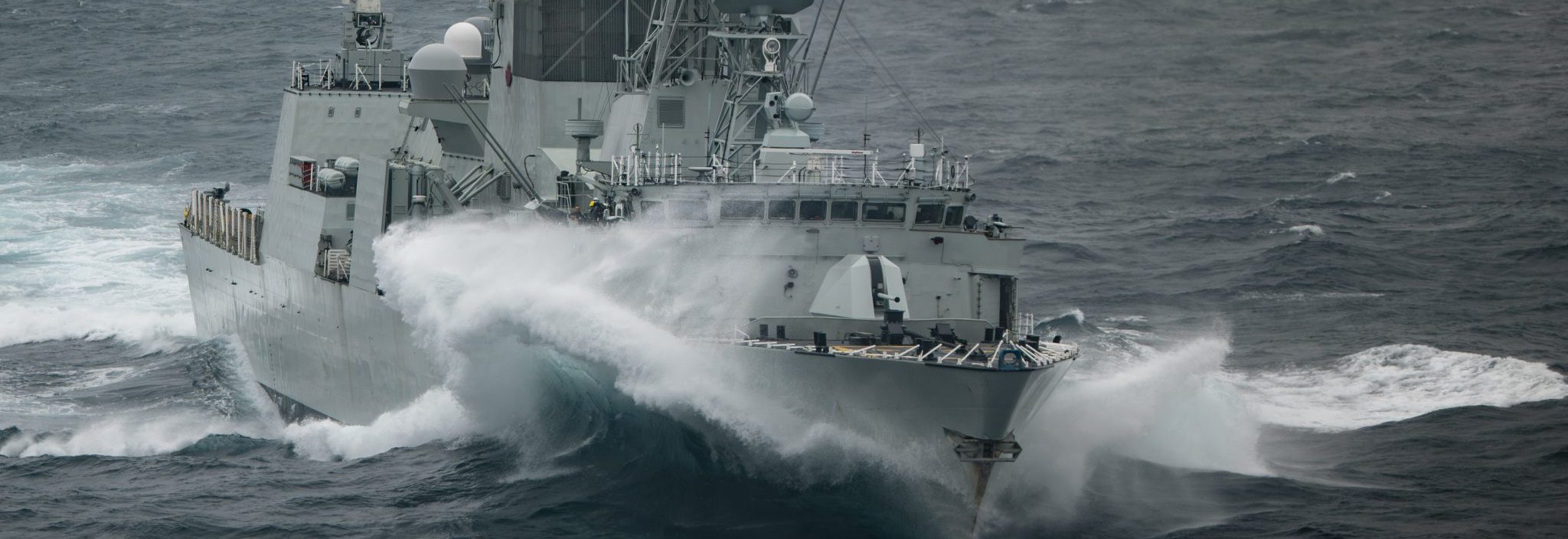
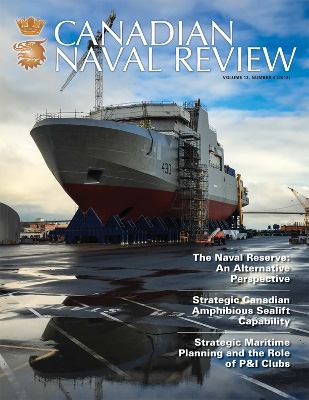
Cover Image: His Majesty’s Canadian Ship Regina prepares to conduct a Replenishment At Sea with Naval Replenishment Unit Asterix during Operation LATITUDE on 15 August, 2025. Please credit: S3 Owen Davis, Canadian Armed Forces


12 thoughts on “Preview: Canadian Naval Review Vol. 21, No. 3 (2026)”
“We have a commentary about the unthinkable…”
Perhaps you should say “horrific” rather than unthinkable. A country that is prepared to ignore its own laws in order to kidnap a foreign leader who was no threat to them is a country that might commit any crime whatsoever against anyone whatsoever. No one should assume they are safe.
Plainly, America intends harm to its neighbors just as Russia or China are a threat to theirs, and Canada must act accordingly. I am heartsick.
Let’s dispense with the selective outrage. No one batted an eye when Noriega was taken down, and few today deny that Panama was better off afterward. Nor has anyone seriously engaged with the fact that there were visible demonstrations welcoming regime change in Venezuela, or that the brutality of the Maduro regime was extensively documented including videos of protesters being run over by armored vehicles. The Biden–Harris administration itself placed a $25 million bounty on his arrest; Trudeau openly called Maduro out when he refused to abide by election results; and Canada severed diplomatic legitimacy long before Trump entered the picture. Venezuela was actively supplying oil to Russia and China, and in bed with the cartels are we really meant to pretend interrupting that flow is a moral failing? Yes, of course this is about access to oil and resources; great powers have always acted accordingly. But if the choice is American access versus Russian or Chinese leverage in the hemisphere, the answer is neither complicated nor tragic. To be “heartsick” over the removal of a corrupt, violent autocrat long condemned by democratic governments is not moral clarity, it’s willful amnesia.
Good morning Ted,
You are completely missing the reason why people are concerned!
Ubique,
Les
Trump will ultimately do what he thinks he can get away with and that’s precisely why fears of Canada, Greenland, or other allied democracies being next don’t hold up under scrutiny. The political, military, economic and public opposition to any such move would be overwhelming and immediate, both domestically in the United States and internationally, creating constraints no amount of bluster can erase. That reality has always mattered, even for leaders who enjoy testing boundaries. If anything, history shows the limits of American power when it runs headlong into unified resistance, Cuba being a reminder that even at the height of US confidence, some things simply couldn’t be pulled off. Colombia, Cuba, or other non-allied states might tempt a different calculus if chaos and ambiguity prevail but Canada or Greenland? Not likely. Frankly, that’s not where the real risk lies, and it’s not what keeps me up at night.
Ted, the issue is broader than that. The Administration’s national security strategy all but laid out a plan to revive the Monroe Doctrine, but the actual implementation comes with so many implications for the conduct of international relations. The (re-)construction of spheres of influence, and their enforcement/coercion by force of arms, is a step backward. Even repressive regimes lacking democratic legitimacy have to be given their due. The exception (under the UN Charter) is if they have committed military aggression against another state, which was NOT the case here.
Then there’s the ‘strategy’ itself. Why leave a regime in place and the security forces intact, thinking that it will be more amenable than it was when the bus driver was in power? True, Delcy Rodriguez et al may be unnerved by the dispatch of their leader, but there’s not a moderate bone in their body politic. Does the US think it can really regulate Venezuelan affairs from offshore? At least in Panama there were troops on the ground.
Mr. Trump didn’t even mention democratic transition, which makes this look like old-fashioned gunboat diplomacy. It thus serves to embarrass those who might be inclined to see the upside of the intervention as a prelude to political renewal.
Add to this the threats against Greenland’s sovereignty and you have all the makings of a rogue superpower – at least in this hemisphere. How do we constructively partner with a state that is wielding power erratically and for narrow ends? How pragmatic can one be before our commitment to a rules-based is fatally undermined and we settle for a latter-day version of the Melian Dialogue?
This argument overstates both the legal and factual position. Venezuela was not a ‘normal’ sovereign state minding its own affairs. The Maduro regime had long crossed the line from repression into transnational criminality, including narco trafficking and the use of state security forces against civilians, which is why Canada, the EU, and much of the hemisphere severed relations well before the US action. That matters under international practice: while the UN Charter restricts force, it does not obligate states to indefinitely tolerate regimes that have collapsed into criminal enterprises and generate regional instability. Nor is this ‘gunboat diplomacy’ in the Panama sense, the United States has not occupied Venezuela, dismantled its institutions, or installed a client government. Leaving Venezuelan institutions intact reflects a deliberate choice to avoid state collapse and civil war, not a belief that the remaining leadership is suddenly moderate or legitimate. I would imagine we’ll see forced elections now to democratically elect a leader.
Invoking the Monroe Doctrine as proof of hemispheric imperialism confuses rhetoric with reality. The modern US posture is explicitly framed around countering Chinese and Russian penetration in the Americas, not redrawing borders or enforcing colonial spheres of influence by force. If Washington were actually acting as a rogue superpower, we would already see annexations, occupations, or treaty violations, none of which has occurred. Greenland remains firmly under Danish sovereignty, with no legal or military mechanism for seizure, and Canada’s sovereignty is not remotely in question. The uncomfortable truth is that great powers have always enforced order unevenly, but the United States is still operating within a system of alliances, domestic legal constraints and multilateral institutions.
Michael, your pain is shared. The international system is devolving to that of the 19th century. The authoritarianism, illiberalism and avarice of this administration is truly frightening.
For the foreseeable future, the defence of the homeland must come first. Forget about going to the South China Sea. Consider deleting Aegis from the next tranches of the River-class and replace with European/Canadian systems. Source those submarines from the RoK NOW!
Good morning Barnacle,
Agree entirely!
Ubique,
Les
Barnacle Bill, I understand the anxiety, but this reads more like strategic whiplash than sober defence planning. Retreating inward, abandoning forward engagement and stripping Aegis out of the River class as a symbolic break from the United States would not make Canada safer, it would make us weaker, poorer and less relevant. Aegis is not an “American political choice,” it is the backbone of allied naval air and missile defence, used precisely because it guarantees interoperability in coalition operations. Deleting it mid-program to make a point about Washington would be ruinously expensive, technically disruptive and strategically self defeating.
The South China Sea is not a discretionary sideshow but a proving ground for the rules-based order that underwrites Canadian trade and security. Walking away does nothing to defend the homeland it merely signals retreat. We still need to buy the submarines from the RoK but not as a defence against the USA.
Ted, I don’t say these things because I enjoy being a Cassandra. In November 2020 I had hoped that we’d seen the back of MAGA. Yet, the Administration is withdrawing from what you stated to be the “rules-based order that underwrites Canadian security.” I sorely wish it were not the case, but it’s clear to me that this president chafes at rules and norms. He would dearly like to rule without restrictions at home, and his contempt for the postwar trade/security consensus is manifest. We need to get ahead of the curve. It is no vice to adopt hedging strategies to deal with uncertainty, even in the face of short-term costs to this or that program. The UK’s Type 26 architecture is easily replicated, even if it is less capable. (While we’re at it, let’s add more VLS cells.)
If Aegis is the key to strength, relevance and prosperity, what does that say about NATO members/navies who have not bought it? And your point about it being the backbone of ‘allied’ IAMD may be technically correct (especially with regard to Aegis Ashore), but it strikes me as ironic given that the Trump Administration is doing all it can to alienate the very allies upon which integrated missile defence depends. One cannot buy into the concept of alliance if the hegemon is acting according to a completely different value system and no longer sees its interests as ones to be constructively reconciled with those with whom it has partnered for so many decades. When DT says that the United States will acquire Greenland “the easy way or the hard way,” what do you think he means? Or that is just a negotiating tactic? Either way, it should be beneath a great state to even suggest appropriating territory belonging to another. Again, strong-arming erodes trust, which is not easily rebuilt.
As to the China Seas, the absence of a trustworthy hegemon makes balancing against the PRC that much more risky. Risks are willingly shared if there is trust. Mindful of the administration’s trade policies, many Canadians will find it strange that we would push back militarily against PRC assertiveness in Asia while our main ‘ally’ is asserting droit d’intervention in South America, pledging to do so throughout the Western Hemisphere, and publicly articulating a commitment to take sides in European electoral politics.
We need >15 RCDs, submarines, and all those other things as a matter of everyday national security interest. (We should also welcome any effort to preserve NORAD.) But I fear that they are needed more than ever now as a ‘defence against help’.
Hi Barnacle,
Well said!!!
My one concern is your wish to purchase 15+ RCDs. My commentary in CNR 21.1 suggests a somewhat different naval force structure. I would be very interested in hearing your thoughts on it.
Ubique,
Les
The problem with this argument is not that it worries about uncertainty, but that it treats rhetorical turbulence as structural collapse. US administrations have challenged norms, bullied allies, and blown holes in diplomatic etiquette before without the alliance system disintegrating or Canada needing to redesign its force structure around worst case political psychology. The rules-based order is not upheld by tone or temperament; it is upheld by power, institutions and converging interests. Washington can be abrasive, transactional and norm-bending while still remaining fundamentally anchored to alliances because those alliances serve enduring US strategic needs. Planning as if the system itself is already failing is not foresight, it is extrapolation driven by anxiety rather than evidence.
The Aegis discussion suffers from the same distortion. Aegis is not a loyalty oath, nor is it the sole gateway to relevance or interoperability. We currently have many sailors in the United States in two locations learning about AEGIS and when our first RCD’s are in the water we’ll have sailors on US ships gaining experience and US sailors on Canadian ships training RCN sailors. Many NATO navies contribute meaningfully to deterrence and IAMD without owning the full system, because interoperability is about standards, data, doctrine and predictability, not everyone buying the same gold-plated combat suite. Fragmenting away from proven architectures in the name of ‘hedging’ would reduce Canada’s ability to integrate with allies in an actual crisis, not enhance it. Trust in alliances is built through consistent, usable capability and operational credibility, not through bespoke force designs meant to signal political discomfort with the hegemon of the day.
Yes, Canada absolutely should be aiming for a larger, more credible force structure in the medium to long term but that case stands on its own merits, not as a reaction to American behaviour. A fleet of roughly 15 River-class destroyers, 12 conventional submarines, 2 AORs, and a still-to-be-determined number of continental corvettes reflects geography, workload and basic arithmetic across three oceans and the Arctic. Those corvettes, moreover, are trending toward light frigates, not Kingston-class nostalgia pieces, because presence without survivability is not presence at all. Submarines, destroyers, AORs, and credible corvettes are not a ‘defence against help,’ they ensure that help, when it comes, is shaped by Canadian interests. Strategic adulthood means building depth, credibility and consistency because Canada needs them not because Washington’s politics happen to be turbulent this cycle.