By Dr. Ann Griffiths, 7 December 2025
The D.J. Trump administration recently released a new National Security Strategy. While the introduction by President Trump is fanciful to say the least, the strategy asks the questions that all countries should ask when writing a national security strategy. Under the heading “President Trump’s Necessary, Welcome Correction,” the introduction says “The questions before us now are: 1) What should the United States want? 2) What are our available means to get it? and 3) How can we connect ends and means into a viable National Security Strategy?” These are questions that need to be answered by every country.
The strategy moves on to (sort of) answer the questions. At home, the United States wants the usual things – peace, economic success, control over borders, good infrastructure, etc. The strategy lays out what the country wants from the world. This includes a cooperative Western Hemisphere (adding a ‘Trump Corollary’ to the Monroe Doctrine), undoing “the damage” other countries have done to the US economy, supporting the freedom and security of Europe “while restoring Europe’s civilizational self-confidence and Western identity,” preventing an opponent from dominating the Middle East, and making sure that US technology and standards “drive the world forward.” Nothing surprising there, although some of the phrasing could be objected to. The section about the available means to achieve its goals naturally lays out the strengths of the US military, and extolls how the Trump administration has made the military stronger. Eyebrows in Canada and Europe could be raised at the mention of how US soft power has been strengthened and the importance of allies. But I’ll let you make your own decision about the tone of the strategy by giving you the following quotation:
“President Trump’s foreign policy is pragmatic without being “pragmatist,” realistic without being “realist,” principled without being “idealistic,” muscular without being “hawkish,” and restrained without being “dovish.” It is not grounded in traditional, political ideology. It is motivated above all by what works for America—or, in two words, “America First.” President Trump has cemented his legacy as The President of Peace. In addition to the remarkable success achieved during his first term with the historic Abraham Accords, President Trump has leveraged his dealmaking ability to secure unprecedented peace in eight conflicts throughout the world over the course of just eight months of his second term.”
If you remove all the praise lavished on the President, the strategy might be a useful guide for the United States for next few years – and the document would be considerably shorter. As it is, it’s a testament to the way things are right now in Washington. Read the document at https://www.whitehouse.gov/wp-content/uploads/2025/12/2025-National-Security-Strategy.pdf
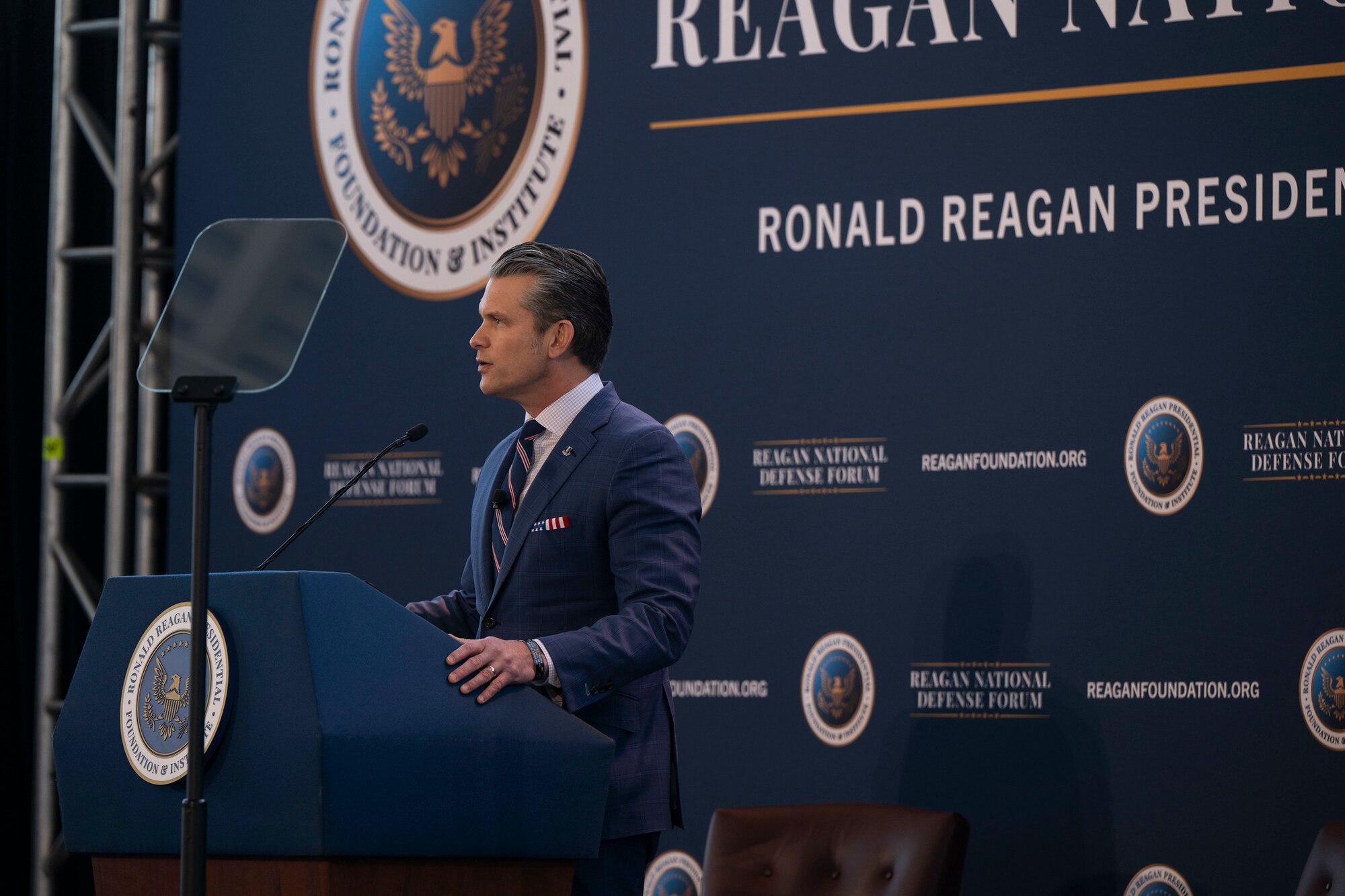
Image: Secretary of War Pete Hegseth delivers the Reagan National Defense Forum keynote speech outlining the new National Security Strategy in Simi Valley, Calif., 6 December, 2025. Credit: US Air Force Staff Sgt. Madelyn Keech




7 thoughts on “The New US National Security Strategy”
Good afternoon,
Fyi, attached is a link to a commentary about this new strategy.
https://warontherocks.com/2025/12/ten-jolting-takeaways-from-trumps-new-national-security-strategy/
It contains the following specific comments about some of the strategy’s more disturbing aspects:
– “This is an America that is not necessarily retreating from the world stage but consolidating its power through bullying and dealmaking.”
– “The strategy states that the United States will “assert and enforce a ‘Trump Corollary’ to the Monroe Doctrine” to keep the Western Hemisphere free of “hostile foreign incursion or ownership of key assets” while ensuring stability sufficient to prevent mass migration and protect critical supply chains.”
– “What emerges is not a traditional assessment of allied capability or political will but a cultural test for geopolitical trustworthiness.”
– “It positions the United States to judge the internal order of its partners through the lens of ideological compatibility rather than institutional capacity or shared interests. In doing so, the strategy folds the culture war into alliance management and treats domestic cultural narratives as strategic tools rather than purely political ones.”
– Ref NATO countries’ commitment to spend 5% of their GDP on defence, “It treats compliance as a condition for political favor. If enforced, it would trigger severe budgetary and political shocks across Europe and beyond.”
– “The assertions about sovereignty in the text expose a double standard: America is not to be messed with and yet the Trump administration sees no issue with inserting itself into the domestic political debates of allies, namely Germany.”
– “For both allies and adversaries, the shock is not only the specific policies, but the message that the United States now sees its security in a more personalized, inwardly focused, and narrower way than before.”
Looking at the strategy itself, it should be noted that:
– its only reference to the world’s climate is: “We reject the disastrous “climate change” and “Net Zero” ideologies that have so greatly harmed Europe, threaten the United States, and subsidize our adversaries.” (page 14). Thus, climate change is considered not to exist and thus is not a threat to the USA or the rest of the world.
– With respect to the ‘Trump Corollary,’ it states “… and we want to ensure our continued access to key strategic locations. In other words, we will assert and enforce a “Trump Corollary” to the Monroe Doctrine;” (page 5). This could indicate that the territories of the nations of the western hemisphere are theirs only as long as the USA does not want some or all of them.
My personal impression about the complete text about the ‘Trump Corollary’ is that it seems to indicate that these nations’ role is to act as subservient subjects whose purpose is to support the USA’s comfort, wealth, and dominance.
Given all of the above, I cannot help but fear that the USA is headed towards trying to become a regional hegemon in the Americas which will not tolerate any deviation by its ‘subordinate’ states from its (twisted) view of reality. The consequences for Canada (and the rest of the world) of such a toxic drive for hegemony will very likely be tragic and irreparable.
Ubique,
Les
Les, I get the instinct to clutch pearls at every rhetorical thunderclap coming out of Washington but let’s pump the brakes before we declare the Trump NSS the blueprint for a North American Reichskommissariat.
First: let the Americans write their own foreign policy, just as we would riot if they tried to write ours. The United States moving toward a more transactional, interest-based posture isn’t some shocking betrayal of the international order, it is the international order. States pursue interests. Always have.
Second: the ‘Trump Corollary’ isn’t new imperial scripture, it’s the Monroe Doctrine with New York real estate branding. Every administration since 1823 has asserted hemispheric primacy, from Kennedy blockading Cuba to Obama telling China to stay out of Latin American telecoms. Pretending this is a sudden leap toward annexing the hemisphere is ahistorical at best.
Third: yes, the NSS is laced with ideological chest thumping, culture war signalling, and a 5% GDP fantasy no NATO treasury will ever adopt. So what? The so what for Canada is not to panic but to position to use the moment to reinforce NORAD modernization, harden supply chains, and remind Washington that reliable allies don’t need babysitting or lecturing. This is an opportunity to anchor our own Arctic, continental and industrial strategy, not an excuse to retreat in horror because the United States is talking louder than usual.
Finally: calling the document a roadmap to American ‘hegemony’ over Canada overstates both US capability and appetite. The United States can barely pass a budget, let alone micromanage Ottawa’s ‘internal ideological compatibility.’ We should keep our eyes open, yes but fear-mongering about the United States turning Canada into a client state helps no one, least of all Canadians.
Hello Dr. Griffiths. As it stands right now, Canada has had a National Security Policy (Securing An Open Society) that has been in effect since 2004. Canada’s defence policy, Our North, Strong and Free (ONSAF), to strengthen Canada’s sovereignty, security, and prosperity, and drive economic growth in this pivotal moment. But things have changed drastically over the past 21 yrs (read Donald J. Trump) and our National Security Policy document is woefully out of date and in desperate need of being updated to reflect the Canada of today, tomorrow & beyond for the foreseeable future- 1. To be fair, a new ‘draft’ document has been produced but is still sitting on PM Carney’s desk for a while now, and has yet to be introduced as legislation-2. I have read the USA’s National Security Strategy (November 2025) with some interest and at times, fear. Perhaps this document should have been entitled the POTUS’s National Security Strategy instead. On page 17 (Expand) it reads: “As we deepen our partnerships with countries with whom America presently has strong relations, we must look to expand our network in the region. We want other nations to see us as their partner of first choice, and we will (through various means) discourage their collaboration with others”. Do I read 51st State in there somewhere? The rest is just more DJT Bovine Scatology or perhaps giving his Project 2025 more credence.
https://toronto.citynews.ca/2025/10/12/shifting-global-picture-disrupted-canadas-national-security-strategy-update-memo/
https://opencanada.org/canadas-national-security-time-for-a-new-national-strategy-and-new-security-partners/
David Dunlop isn’t wrong that Canada’s National Security Policy is older than most of today’s junior officers but blaming Trump for a 21-year Canadian failure to think strategically is exactly how we got here. We’ve treated national security like optional coursework since 2004, and now we’re shocked the world didn’t freeze in place while Ottawa hit snooze.
And that line about reading “51st State” into the U.S. NSS? Come on. Every American NSS for the last two decades has used the same boilerplate about being the “partner of choice.” It’s not annexation it’s geopolitics 101. They want allies lined up with them, not with Beijing or Moscow. Last I checked, that’s been the foundation of NORAD, NATO, and Five Eyes since before any of us were born.
The real issue isn’t Trump’s tone it’s Canada’s vacuum of strategy. We’ve had a draft national security plan sitting around because we still can’t decide what our interests are, let alone how to defend them. That’s not on Washington. That’s on us.
Instead of clutching pearls over American wording, maybe Canada should finally articulate a national security strategy that isn’t held together with duct tape, nostalgia, and hope. Because if we don’t define our interests, someone else will and it won’t be because the U.S. secretly wants a 51st state. It’ll be because Canada keeps refusing to show up.
Hello Richard. I agree that what POTUS does south of the border is his own business. National Security is…their business but when it seems to imply that Canada must ‘tough the line’ and follow DJT’s lead, Canada must draw the line there. We should have developed and put into law the update to our own Canadian National Security Policy by now. You are quite correct that we are so far behind, we think that we are first and that is on us! But one thing is always clear with the POTUS in office now. Take him at his word because if we don’t, Canada does at its own peril!
If Washington wants to write its foreign policy in Trump flavoured hyperbole, that’s their business just as we guard our own sovereignty, they’re entitled to theirs. Easy for Canadians to climb onto the moral high ground when we’re not the ones carrying the global load. The real question for us is: so what? The substance of U.S. strategy hasn’t changed, hemisphere control, tech dominance, and denying rivals space only the packaging has. Instead of hand wringing or treating this as proof the U.S. is drifting away, we should see it as an opportunity to re-engage, shape the agenda where we can, and build relevance. Isolating or scolding the Americans won’t get us a larger voice showing up with capability, commitment, and ideas will.
The American President cannot be trusted to keep his word. The End.