By Jeff G. Gilmour, 22 April 2026
A recent analysis by the BBC pointed out that the UK is especially dependent on its undersea cables and pipelines for both its data and its energy.[1] More than 90 per cent of internet traffic travels by these undersea cables. There are ‘clusters’ where these cables come ashore from both the Atlantic and the North Sea. About 60 cables connect the UK to global networks. It is next to impossible to monitor every metre of these undersea cables that lie at the bottom of the ocean.
Recently, Russia has become very interested in these underwater cables. GUGI, or more formally the Main Directorate for Deep-Sea Research, which was established in the 1960s, is unofficially known as the ‘underwater spetsnaz’ (i.e., Soviet/Russian elite special forces).[2] The outfit consists of smaller submarines, launched from a mother ship, which have manipulative arms that can cut cables. In addition, it has nuclear submarines which can spy on the location of these cables or place monitoring devices on the sea floor.
A 2025 report from the UK’s Committee on National Security said that it wasn’t confident the country could prevent such attacks or recover within an acceptance time period.[3] Ken Giles, a Russian expert at Chatham House, told the BBC that potential sabotage to cables should not be seen as an isolated phenomenon. It should, rather be seen as part of a program of targeting critical communications infrastructure by Russia.[4]
Royal Navy vessels were deployed to monitor Russian activity in the region and to prevent any attacks on British cables and pipelines by Russian submarines that spent more than a month in the north and around the British Isles and the North Sea earlier in the year.[5]
Britain accused Russia of using the distraction of events in the Middle East to try and conduct covert operations in the north.
[1] Frank Gardner, “UK’s dependency on undersea cables comes with vulnerability,” BBC News, 9 April, 2026.
[2] Vitaly Shevchenko, “What is GUGI?” BBC News, 16 June 2025.
[3] Ibid, footnote 1.
[4] Ibid, footnote 1.
[5] CBC News, “UK military deployed to deter threat to undersea cables and Russian submarine presence,” April 9, 2026.
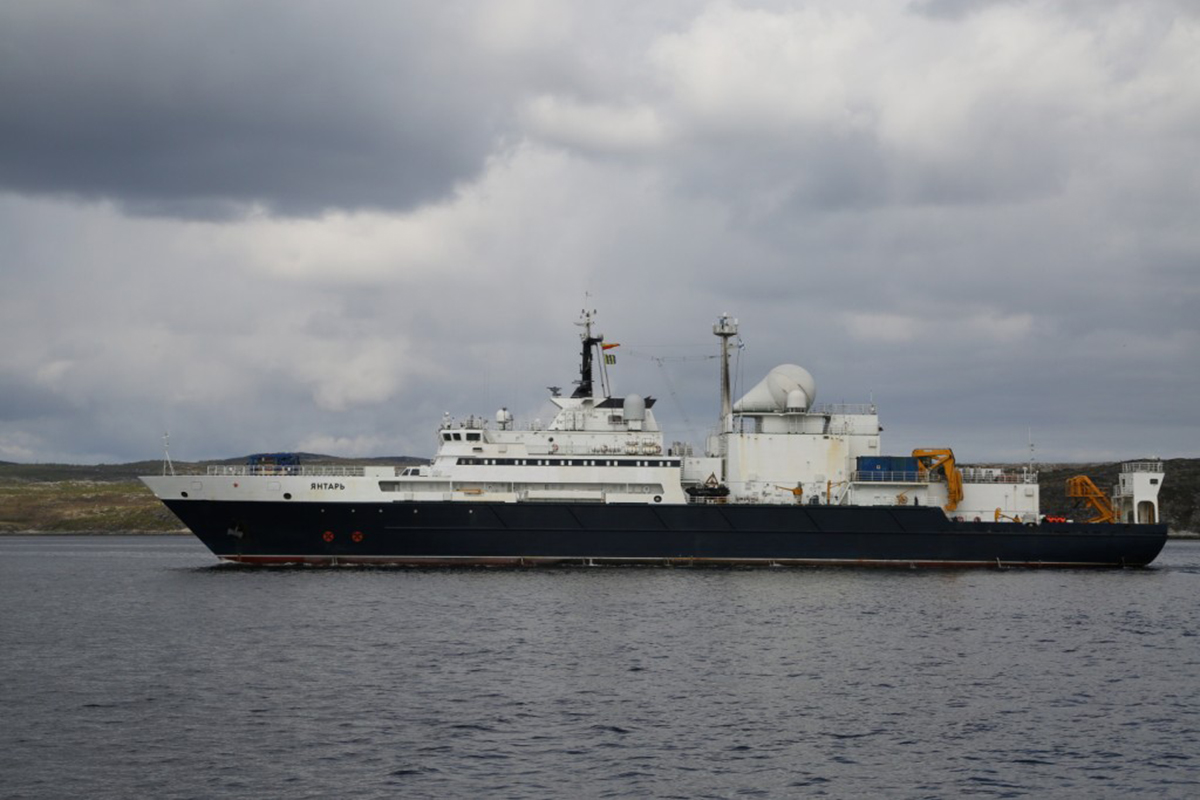
Image: A photo of the Russian deep sea research vessel Yantar. Credit: Andrey Luzik, Mil.ru