By Brett Witthoeft, 19 June 2026
[This is an excerpt of an article in Vol. 22, No. 1 of Canadian Naval Review. For the full free access article, click on the link below.]
In 2021, the then-head of US Indo-Pacific Command, USN Admiral Phil Davidson, popularized the idea that China could move against Taiwan as early as 2027.1 Admiral Davidson did not pluck that date from thin air – in 2017, Chinese President Xi Jinping set 2027 as the year in which the People’s Liberation Army (PLA) should be competent in basic joint operations, interpreted as the ability to invade Taiwan. Xi also set 2035 as when the PLA should be fully competent in joint operations and assisted by advanced technology such as Artificial Intelligence (AI). The year 2049 is when the PLA should be a ‘world-class military’ able to defend Chinese interests globally. With now just one year until Admiral Davidson’s predicted invasion date, it is worth looking at what China has been doing to meet the 2027 goal.
First up is the raw ability to move against Taiwan, namely building the ships, planes and missiles not only to soften Taiwanese defences and protect hundreds of thousands of Chinese troops as they cross the Taiwan Strait, but also to feed, fuel and rearm them and prevent foreign intervention over weeks, if not months. On this front, the PLA has made extraordinary advances. Supported by massive shipbuilding capability, the PLA Navy (PLAN) became the largest navy in the world some time around 2015-16, and now operates three aircraft carriers, with a fourth (possibly nuclear-powered) on the way.2 The PLA Rocket Force (PLARF), which would be tasked with firing missiles at Taiwan’s defences and command-and-control centres, and deterring the United States and allies, has established a full arsenal of ballistic and cruise missiles, including the much-touted DF-21 and DF-26 ‘carrier-killer’ and ‘Guam-killer’ missiles.3 The PLA Air Force (PLAAF) is ready to battle for air superiority over the strait and protect convoys of troops as they cross, with at least 1,300 fourth-generation aircraft, modern standoff bombers, and a full suite of supporting radar and transport aircraft.4
If the PLA does have one significant obstacle to its invasion plans, it is a lack of amphibious ships – it operates 12 Landing Platform Docks and Landing Helicopter Docks, with a 13th beginning sea trials in November 2025.5 However, the PLAN has anticipated this problem and has taken steps to mitigate it, including requiring commercial ships to support PLA operations since 2016, and experimenting with modifying civilian cargo ships into shallow-draft landing craft.6
However, it is one thing to build a major military, and another altogether to train the separate military branches into one that can smoothly work together under extreme stress over an extended period. The PLA has been working toward exactly that, with large-scale, joint exercises around Taiwan beginning in 2022.
The first such exercise occurred in August 2022, after then-US House Speaker Nancy Pelosi visited Taiwan. The PLA set up seven exercise zones around Taiwan – including at the approaches to the critical Taiwanese ports of Taipei and Kaohsiung – where the PLAN practiced clearing paths for amphibious vessels, blockading key areas, striking sea targets and defending against aerial strikes. A comprehensive mix of PLAAF aircraft flooded across the strait for aerial superiority drills, and the PLARF launched missiles both at Taiwan’s outlying islands in the strait and over Taiwan into waters near Japan’s Yonaguni Island.7 In all, the 2022 exercise demonstrated for the first time that the PLA could jointly operate over seven days to achieve a major military objective.
Subsequent exercises built on the basic plan established in 2022. The inaugural Joint Sword in 2023 did not have formal exercise zones per se, but Taiwan was encircled by the PLA as it had been in 2022, and the Shandong aircraft carrier group conducted air drills off southeast Taiwan for the first time. As well, unofficial PLA activity continued for weeks after the exercise formally ended, showing an ability for sustained operations. The Joint Sword 2024A and 2024B exercises revived exercise zones not only around Taiwan proper, but also around Taiwan’s outlying islands near the Chinese mainland for the first time. The 2024 Joint Swords took several notable further steps, such as bringing in the China Coast Guard (CCG) – including one of the CCG’s massive 12,000-ton Zhaotou cutters – to assert coercive law enforcement control within the Taiwan Strait.8 Furthermore, the PLAN’s first aircraft carrier, Liaoning, conducted drills east of Taiwan for the first time.
… The result of these years of exercising is that the PLA has a basic, proven plan for joint operations to encircle Taiwan and deter outside interference. At this point, tweaks such as extending the length of the drills, including more civilian vessels and simulating opposing forces can be added to expand the PLA’s comfort zone.
…
To read the full article, go to https://www.navalreview.ca/wp-content/uploads/public/vol22num1/cnr_vol22_1_Witthoeft.pdf
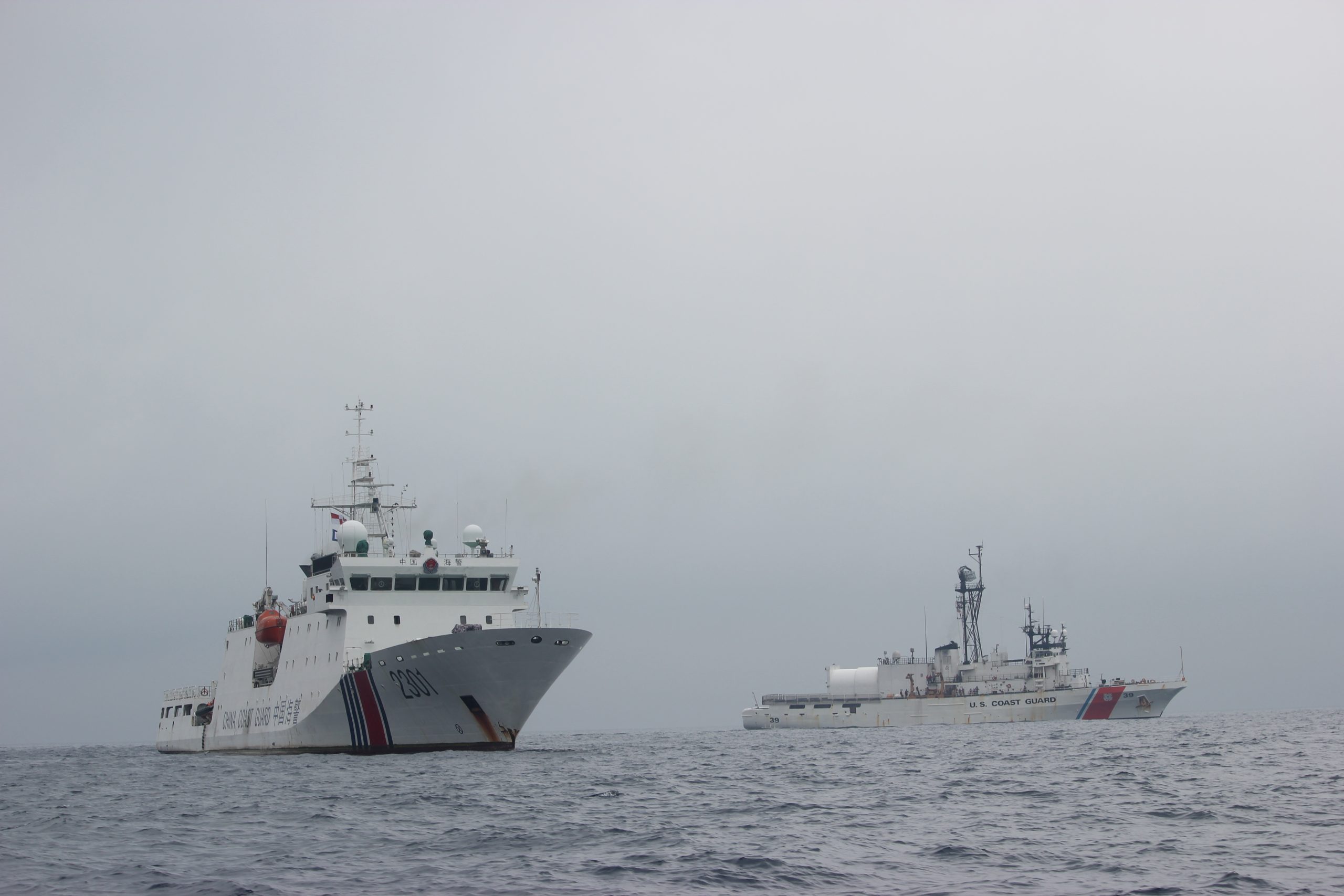
Image: The crew of the USCGC Alex Haley (WMEC 39) transfers custody of the detained fishing vessel Run Da to a People's Republic of China Coast Guard patrol vessel in the Sea of Japan, June 21, 2018. The Alex Haley and PRC Coast Guard crews detained the Run Da suspected of illegal high seas drift net fishing. Credit: U.S. Coast Guard.