By Alec Rembowski, 19 April 2026
Canadians are living in a time of increasing geopolitical uncertainty. This is, in part, a result of the re-emergence of great power competition. Some of the key conflicts include: the Russo-Ukraine War (2014-present), the Yemeni Civil War (2014-present), and the current war between the United States-Israel and Iran initiated on 28 February 2026 and continuing to the present. All these conflicts in one form or another have an impact on Sea Lines of Communication (SLOCs). These SLOCs are vital to sustaining trade relations between states that adhere to the rules-based international system and the globalized economy. It is logical to assume that competition over these SLOCs will be a prominent characteristic of conflicts and great power competition throughout the rest of the 21st century. We can see this competition demonstrated with the United States and Iran currently competing for control over the Strait of Hormuz.
It is plausible that elements of the Canadian Armed Forces (CAF) may find themselves conducting operations in conflict zones along coastal regions like the Baltic Sea, Strait of Hormuz, Bab-el-Mandeb and the Indo-Pacific region. These regions all possess restricted passages for important SLOCs. As such, leveraging joint and combined fire support from the maritime domain may be the only possible means to engage targets on the land of these coastal areas. Therefore, the Royal Canadian Navy (RCN) needs to be prepared to deliver Naval Surface Fire Support (NSFS) to CAF and allied units as part of the combined and joint all arms team.[1]
Over recent decades the CAF has lost its NSFS capability. This is primarily due to the RCN being unable to sustain the capability, resulting in a reduced skillset and corporate knowledge across the CAF.[2] Along with this, Canada does not have an adequate training range where this capability can be practiced. However, Canada’s defence landscape is changing with the implementation of a new defence policy Our North Strong and Free: A Renewed Vision for Canada’s Defence, and Canada has recently achieved the 2% Gross Domestic Product defence spending target in accordance with NATO targets.[3] Similarly, the RCN is now conducting a strategic review to determine how the organization can best address the rapidly evolving global security environment.
Production of the first of the RCN’s River-class Destroyers (RCD), formally known as the Canadian Surface Combatant (CSC) project, began in April 2025.[4] The RCDs will be equipped with a 127mm (5 inch) main gun system, Raytheon Tomahawk Missiles, and Kongsberg Naval Strike Missiles.[5] The armaments aboard the RCDs enable the CAF to rebuild an effective NSFS capability.
The RCN is not the only CAF agency that is responsible for generating an NSFS capability. Other parties of interest, including the Canadian Army and Canadian Special Operation Force Command (CANSOFCOM), need to work with the RCN as partners to sustain this capability. However, without the participation of the RCN, the CAF cannot hope to generate an effective NSFS capability.
The Canadian Army has a limited commitment to sustaining its NSFS capability. The Canadian Army sends a small number of artillery personnel to the US Marine Corps Naval Gun Fire Liaison Officer (NGLO) course located in Coronato, California. However, with limited spots available annually and no capability to conduct live fire exercises in Canada, there are limited sustained competency opportunities for Canadian Army personnel. Only by developing strong partnerships with the RCN and CANSOFCOM can the CAF hope to sustain this critical joint fire capability across the entire force.
As a seafaring military force, the CAF needs to make a deliberate effort domestically to generate and sustain a credible NSFS capability. The RCN needs to be a leading partner in this effort alongside other CAF parties of interest. Developing this capability will not only empower Canadian and allied land forces but also the RCN which would gain the capability to deliver joint fires to land-based targets. This would enhance the overall credibility of the CAF as a leading military in the NATO alliance and other coalition groups and enable the CAF to take a more active role in defending SLOCs in the defence of the rules-based international system.
[1] Alec Rembowski, “Naval Fire Support: Force Generating a Canadian Naval Fire Support Capability.” Briefing Note, Naval Association of Canada, February 2026. https://76af1b57-9a2d-4a3b-b4b5-38e252782728.filesusr.com/ugd/e9367f_d8a699971e8d440f938d5d0d4a978ebd.pdf
[2] K.D. Vanderzwaag, “Establishing a Naval Gunfire Cell at the RCAS,” The Long Course Journal, 2023, 22.
[3] Department of National Defence, “Canada achieves the 2% of gross domestic product defence spending benchmark,” Government of Canada, 26 March 2026; and Department of National Defence. “Our North, Strong and Free: A Renewed Vision for Canada’s Defence.” Government of Canada, 2024. https://www.canada.ca/en/department-national-defence/corporate/reports-publications/north-strong-free-2024.html
[4] Department of National Defence, “River-class Destroyer Project: Project Summery,” Government of Canada, 3 October 2025. https://www.canada.ca/en/department-national-defence/services/procurement/canadian-surface-combatant.html
[5] Department of National Defence, “River-Class Destroyer Fact Sheet,” Government of Canada, 27 January 2026. https://www.canada.ca/en/navy/corporate/fleet-units/surface/river-class-destroyer/fact-sheet.html
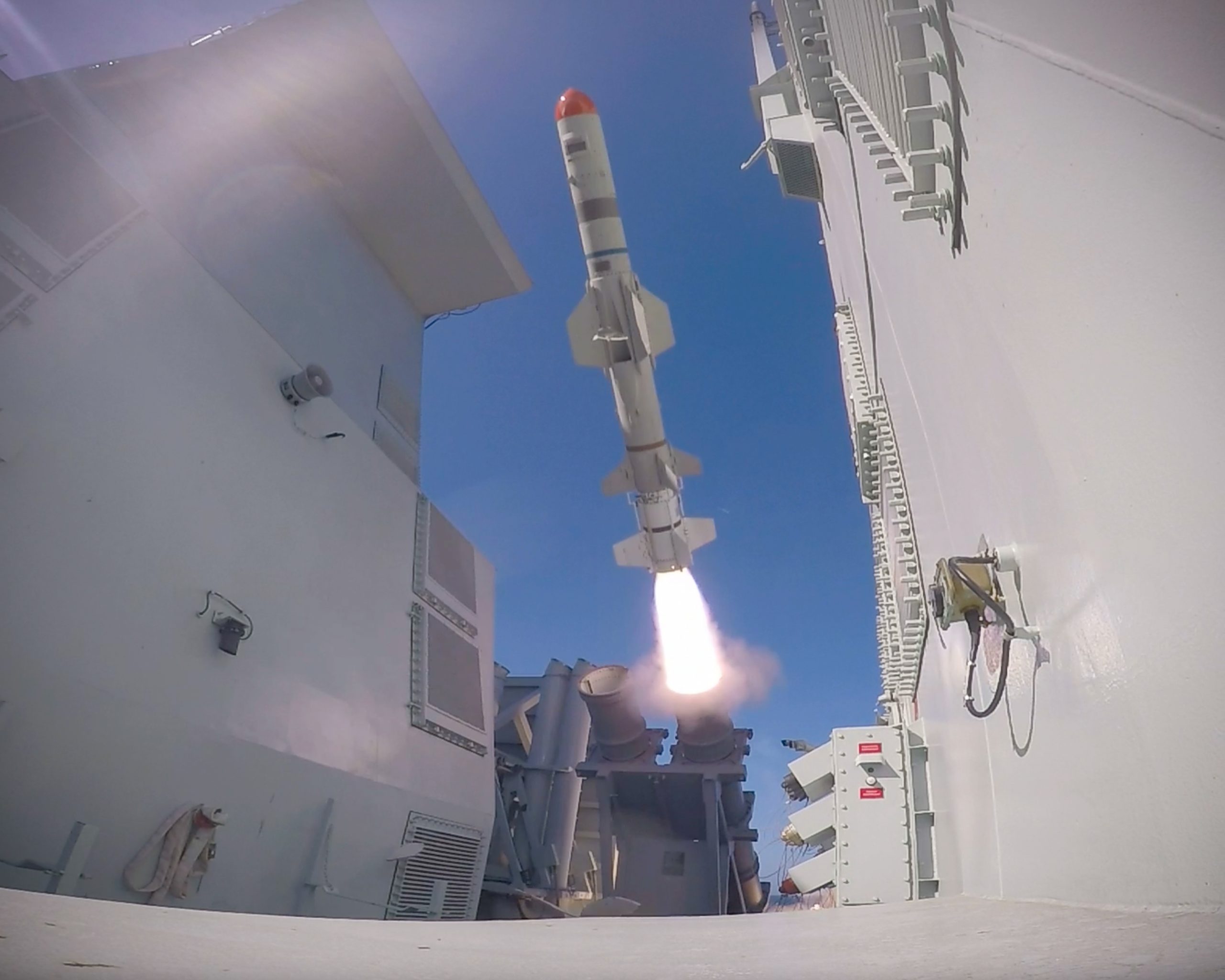
Image: On October 23, 2024, HMCS Regina conducted JOLTEX (Joint Littoral Training Exercise), firing a Harpoon missile towards a slow moving target off the coast of Los Angeles, California. Credit: RCN


One thought on “Re-establishing the RCN’s Naval Surface Fire Support Capability”
Thanks Alec. For certain the Raytheon Tomahawk Missiles, and Kongsberg Naval Strike Missiles provide greatly enhanced (albeit expensive per missile) capabilities for NSFS. Still, as noted, I think the 127mm can also contribute via Naval Gunfire support.
I also concur with a view that the 127mm BAE gun (and even previous with Leonardo Volcano before it was replaced in the planning) that re-establishing the RCN’s Naval Surface Fire Support (NSFS) capability is a necessary function for the RCN to be able to fulfill if called upon. I agree that the 127mm can contribute to providing such a NSFS functionality, if it has the embarked munitions.
I wonder how well the latest Command and Control Systems (such as CMS-330 and Aegis) are in terms of supporting the NSFS capability of the BAE 127mm gun? My recollection is the human is very much in the loop when providing naval gunfire support (or it least that was the case many decades ago) and I assume that is still the case today. That of course means good software and a good training system for the operators. My hope is, that despite manning shortages, the RCN is giving this the attention they believe appropriate, given they also have many other even higher priority items.
Thanks again for the article.