By James Hutton, 9 December 2025
An Amazon receipt was rejected because it lacked a street address. A Canadian veteran, compensated for service-related prostate cancer that left him severely incontinent, submitted a claim for incontinence pads purchased online. The claim took seconds to deny - a missing box on a form that any frontline employee could have resolved with ten seconds of critical thinking. This is not an aberration. This is the system working exactly as designed.
My name is James Hutton. I served nearly 30 years in the Canadian Armed Forces and was exposed to harmful chemicals that later caused prostate cancer. Surgery saved my life but left me with severe incontinence and complete erectile dysfunction. My case was straightforward - clear service record, comprehensive medical evidence, no family history of cancer.
It took 46 months to navigate Veterans Affairs Canada (VAC). Marie-Ève Doucet, a CF-18 technician who developed a rare brain tumor from chemical exposure, fought for the same length of time. Our cases are not outliers. They are the norm.
The Machinery of Denial
The Veterans Well-Being Act states unambiguously: veterans shall receive the benefit of the doubt in disability claims. Yet at every stage, the default is denial. The burden falls on those who accepted unlimited liability to prove, re-prove and prove again that their injuries deserve support.
After my surgery, I discovered an over-the-counter product that collects leakage in a discreet leg bag. This device gave me back my life. VAC had already approved my pad claims - the medical necessity established, the service connection confirmed.
The claim for the leg bag was denied. I needed a prescription for an over-the-counter product.
The bureaucratic cost of processing my appeal? Likely thousands of dollars. The human cost? Another reminder that the system views veterans as adversaries attempting fraud.
Where the System Breaks Down
The most egregious dysfunction occurs in the Assessment Phase. After entitlement is granted, the process should simply match the condition's severity to criteria in the Table of Disabilities. For incontinence requiring more than two pads per day, the rating should be 13. This is not subjective.
In February 2025, Veterans with Cancer Inc. reviewed every assessment appeal completed by the Veterans Review and Appeal Board (VRAB) over one year. The finding: 91.5% resulted in the original assessment being increased. In June, CBC journalists confirmed this research, finding that 90% of VAC decisions are overturned on review. Nine out of ten times, when a veteran challenges VAC's assessment, the veteran wins. This is not a system making good-faith errors. This is systemic undervaluation.
My file reached a physician - I'll call him Dr. FD - with a 50-year-old medical credential. He requested “post-operative Urology Reports.” I made an appointment with my urologist to obtain them, only to learn these reports don't exist outside hospital environments. There are no tests to measure degrees of incontinence or erectile dysfunction; urologists document what patients describe. All this information was already in my file. Dr. FD knew this. Yet he asked for documents he knew didn't exist, then wrote that their absence “was not acceptable.” This obstruction added 13 months to my wait time.
Eventually, I requested a VRAB hearing. The panel significantly increased my rating. The taxpayer burden for a single VRAB review? Thousands of dollars. The correct assessment could have been rendered with a 15-minute phone call.
The Human Toll
Between 2014 and 2024, 5,888 cancer-related claims were submitted to VAC. Of these, 4,035 were denied. Of those denied, only 552 veterans requested a VRAB review. What happened to the other 3,483? They gave up. Veterans who survived combat, training accidents, chemical exposure and cancer were defeated by paperwork.
The Auditor General found that in 2021, first-time applicants waited nearly 10 months for decisions—more than double VAC's reported standard. But VAC manipulates its metrics, stopping the clock each time a decision is made rather than tracking total time in the system. Veterans routinely wait three to five years for final resolution. In 2022, VAC managed 43,227 files with 943 employees. Today, the caseload has exploded to 80,256 files. The mathematics of collapse are simple.
Five Reforms That Could Transform the System
The solutions are neither complex nor expensive:
1. Remove Physicians from Standard Assessments. Most assessments could be efficiently completed by trained non-medical staff. Reserve medical expertise for genuinely complex cases.
2. Mandate Direct Veteran Contact. Require every decision-maker to conduct at least one 15-minute recorded phone call with the veteran before rendering a decision. A phone call costs nothing. A VRAB review costs thousands of dollars.
3. End the ‘Stop the Clock’ Deception. Measure and report actual time veterans spend in the system, from initial application to final resolution.
4. Empower Frontline Critical Thinking. Train staff to solve problems, not just enforce process. Most veteran claims are straightforward.
5. Root Out Insurance Mentality. The 91.5% reversal rate reveals systemic bias. Retrain or remove decision-makers who approach veterans as adversaries.
A Choice
When Canadians join the Armed Forces, they accept unlimited liability - they may be required to risk their lives for government-assigned missions. In return, the government accepts a reciprocal obligation: to provide care and compensation to those injured in service.
The current Veterans Affairs system violates this covenant. It can be fixed. The solutions exist. The only missing ingredient is the institutional courage to prioritize veterans over process. My straightforward case consumed four years. Thousands more are fighting now. Thousands more have given up. The waiting war must end. Those who survived the first battle deserve better than to be defeated by the second.
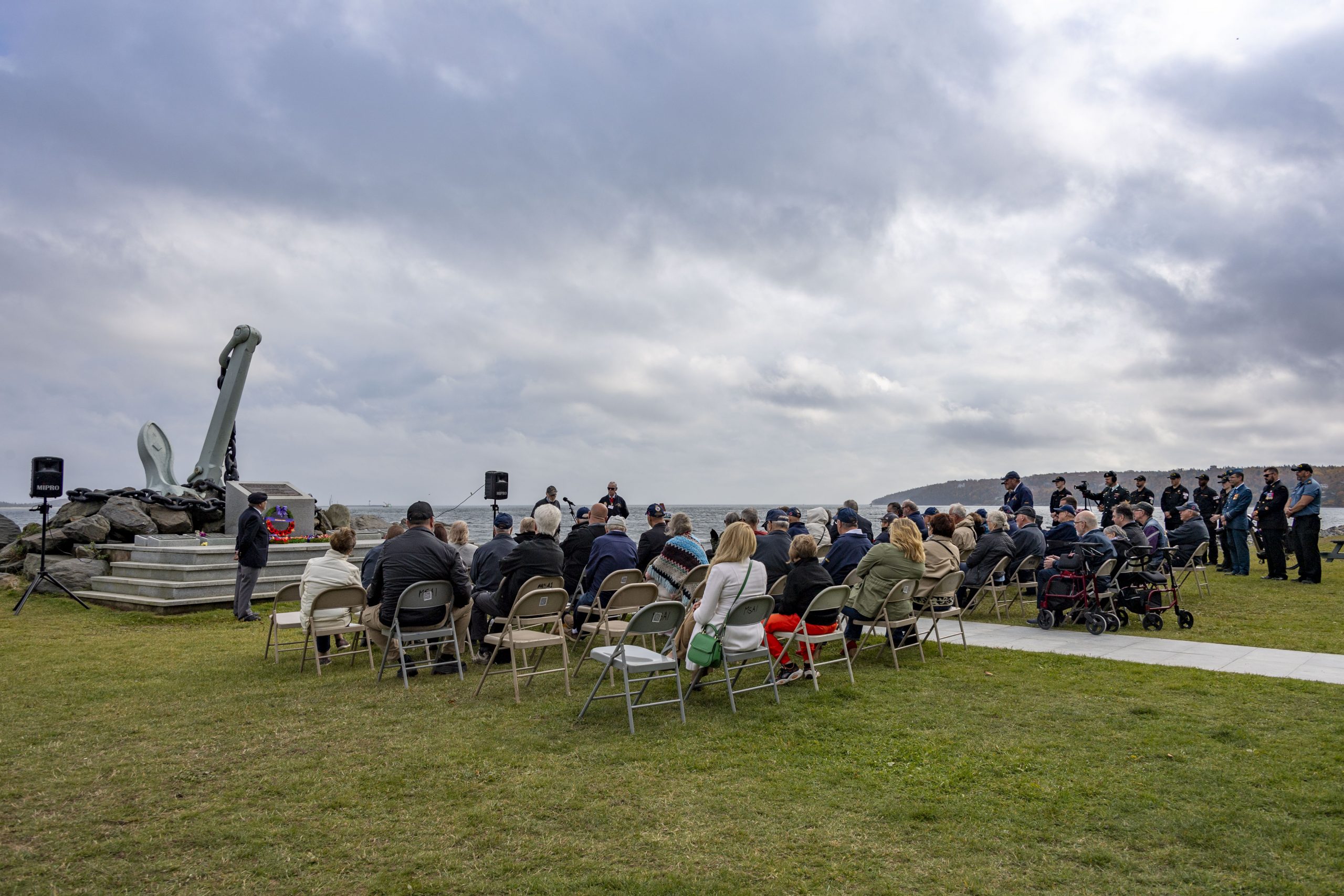
Image: Retired Service Members of HMCS KOOTENAY gathers for the 55th Anniversary of the HMCS KOOTENAY explosion in honour of those who passed and to remember this tragic historic event that help implemented many of the safety training conducted today at the Kootenay Disaster Control Training Facility (DCTF) where sailors receive lifesaving disaster control training. The event is held at the DCTF Kootenay as well as at Point Pleasant Park’s Bonaventure Anchor memorial in Halifax Nova Scotia. on 23 October 2024. Please Credit: MCpl Jaclyn Buell Imagery Technician, Formation Imagery Technician, Trinity