By Moderator, 21 March 2026
If Canada had to list its three closest friends, the list would probably be the United States, United Kingdom and Australia. It’s possible that the United States won’t make the list for much longer, but the UK and Australia are middle powers from which Canada can learn. It’s interesting, therefore, to look at the view from these countries about the situation in the Middle East. There are some interesting articles examining possible naval responses, scenarios and repercussions. I will mention two of them here.
US President Donald Trump has, in his ill-advised war with Iran, made demands on other countries to sort out the mess in the Strait of Hormuz. The initial reaction from countries he has asked has been lukewarm at best, but the UK seems to be wavering a bit now. There’s an interesting article in Naval Lookout, “If called upon, what assets could the Royal Navy send to the Gulf?” (https://www.navylookout.com/if-called-upon-what-assets-could-the-royal-navy-send-to-the-gulf/). What is the answer to this question? The article outlines the RN’s current naval assets. Based on this, whatever the British Prime Minister decides, he’ll be constrained by the state of the navy -- the surface fleet is a shadow of its former self and any naval assets deployed into the Gulf would be at risk because of inadequate air defence. The article concludes “[i]n addition to the SSN likely already in the region, at best the RN probably could send one frigate, one destroyer, some armed helicopters and a limited autonomous minehunting capability to the Gulf. A couple of warships would not offer a sustained presence or allow contingency for damage, breakdowns, or crew rest. Only in a broad coalition with the navies of many other nations could there be the number of escorts to achieve any kind of strategic effect.”
In terms of Australia, another interesting article -- Jennifer Parker, “Crisis in Middle East exposes Australia’s maritime vulnerability” -- has examined the state and focus of the Royal Australian Navy (RAN) in light of the US/Israel war on Iran. The war has made clear the dependence Australia has on energy imports via the sea, and the fact that it needs to take its dependence on maritime trade more seriously. Contrary to what a recent Defence Strategic Review recommended, the navy, rather than a coast guard, still takes care of most border protection and enforcement activities. The author argues that “A properly structured coastguard should carry this burden so the navy can focus on protecting trade and operating forward.” And more attention needs to be paid to increasing the capabilities of the navy – including frigates, destroyers and submarines. As the author notes, “The Hunter frigate program, the planned acquisition of Mogami-class frigates and AUKUS all point in the right direction. But they are not moving fast enough.” Now that Australia is increasingly concerned about imports coming from (or through) the Middle East, “Capability gaps that directly affect the protection of trade must be addressed urgently. Naval logistics, mine warfare and hydrography all require urgent investment. The latter two are areas where Australia can build sovereign capacity relatively quickly, but only if government is prepared to prioritise them.” See Jennifer Parker, “Crisis in Middle East exposes Australia’s maritime vulnerability,” https://www.aspistrategist.org.au/crisis-in-middle-east-exposes-australias-maritime-vulnerability/
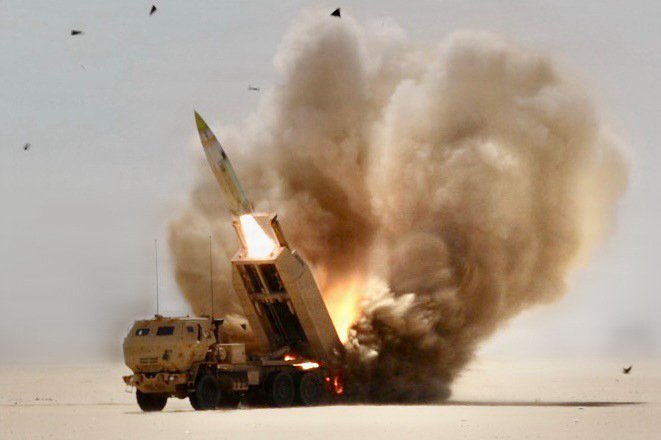
Image: A US M142 High Mobility Artillery Rocket Systems (HIMARS) conducts a live-fire mission during Operation Epic Fury in the U.S. Central Command area of responsibility. (U.S. Army Photo)




2 thoughts on “Australia and the UK: Reactions/Responses to events in the Middle East”
Australia is about to over take the UK in procurement, currently they have plans for 11 Mogami-class frigates, 6 Hunter-class (T26 derivatives) and the present 3 Hobart-class DDGs.
The Aussie fleet is recovering and once built (if all are) that would put the Australia escort fleet at 20 ships. This doesn’t include other platforms they will invest in such as the SSN Aukus, nor does it account for the 2 Canberra class LPH.
The Aussie fleet is growing and yes like many I’d love to see a medium-sized carrier to join them but alas likely it won’t happen.
The UK on the other hand is in a shambles. It has gone from disaster to disaster. The T23 frigates are all life expired (designed for 18 years service), the T26 program is now on a knife edge with build slots going to the Norwegian navy with no firm commitment to replace.
The T83 program is well stalled as of right now, we have no amphibious capability (forget the Bay-class), T45 still have some issues especially with availability, the submarine fleet is falling apart at the seams — many haven’t been to sea for quite some time and CASD setting ever bigger records for patrol length.
With regards to minehunting, the UK is incredibly limited after winding down its options in the Gulf this year and having the last mine hunters basically laid up.
With regards to the question of what could the RN send to the Gulf, the answer is not much.
T23s that remain are required for TAPS in home waters, they function as part of CASD, at best we could send a single T45 but right now the 2 operational ones are spoken for so rather unlikely to suspend those ops. (1 in Cypress, 1 to joint NATO ex).
Overall I think the picture is bleak for the UK but brighter for the Australians.
However it should be noted that the USA started the war, then started to whine about allies not helping and NATO being ineffective, complaining about old assets (forgetting most of the USN assets are much older) and that they don’t need help.
A lot of mixed signals from the POTUS which isn’t being recieved favourably globally.
So helping the United States open the straight of Hormuz is 100 % against Canada’s national interest. People need to start thinking differently when it comes to the United States, and a new learned instinct. The United States is transactional, they think in America first values and see everything through that lens. Think about Ukraine and the mMinerals and the blackmail for resources, look at Venezuela and its oil, Greenland and its minerals. Cuba is being starved into surrender, Iran is being flattened and civilians are being blown to hell. Canada needs to stop thinking like a friend and ally of the US. They view us as an enemy / target / mark / opportunity. So Canada and Canadians need to start thinking like a predator, I mean Predator in every sense of the word (let that sink in). I’m not talking about the King Lion type big-talk-chest-puffed-out kind, but the same kind of predator as a Hyena ‘Big Bite.’ Think about how the dirty, mangy, flea-ridden hyena survives…through pack strength, discipline, strong family bond, violence of action at speed and without remorse and untamed brutality WHEN you have the advantage and stack the deck in your favour.
Think about it, ever see a hyena win a fight 1 v 1 against a lion? Hell no. Hyenas will jump a lion 20 v 1 and steal his food and kill him too. Hyenas will go out of their way to track down lion cubs and kill them when they’re young….No need to let them grow up, they are just another threat. Hyenas have the most powerful bite out of any land animal on earth, but they don’t pick a fight with a lion. Instead they survive, bide their time, scavenge corpses to eat, they do whatever BUT the minute a lion MAKES ONE MISTAKE …maybe he gets inured on a hunt, maybe he went down a cliff side and pulled his leg the wrong way, whatever it is, the hyenas attack with out hesitation.
Trump started a trade War including 50 % Tariff on Canadian Aluminum, because of this over 40,000 Canadians have lost their job. Since then Trump has been ordering aluminum from UAW and Bahrain, he attacked Iran and used A LOT OF WEAPONS / Missiles / Missile defence systems etc. The WEAPONS the United States was firing off like bottle rockets / Missiles / Missile interceptors are made out of aluminum. Iran closed the Strait, US stockpiles of aluminum are GONE, they can’t rebuild anything at this point. The Canadian Government and Provincial Governments own all the Hydro plants in Canada (Strategic resource). Aluminum is EXTREMLY Hydro power intensive… our government is leveraging that ‘it would be a shame if the power went off and you went out of business and the government seized your smelter as a strategic resources’…this is keeping the smelters in Canada ‘compliant’ with Canadian policy to sell more into the EU, which is where all our aluminum has been going. This stacks more pressure on the US, they are in deep trouble …everyone knows it including IRAN ….Be the hyena, DO NOT help the US or try help or do anything you want to do. If you are a Canadian business owner, NOW is a great time to be a predator…The lion broke his leg…..