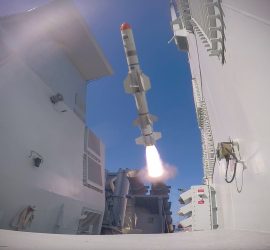
Winner of the 2026 CNMT Essay Contest: Vulnerable Arteries
By C.A.M Al Wahi, 10 November 2026
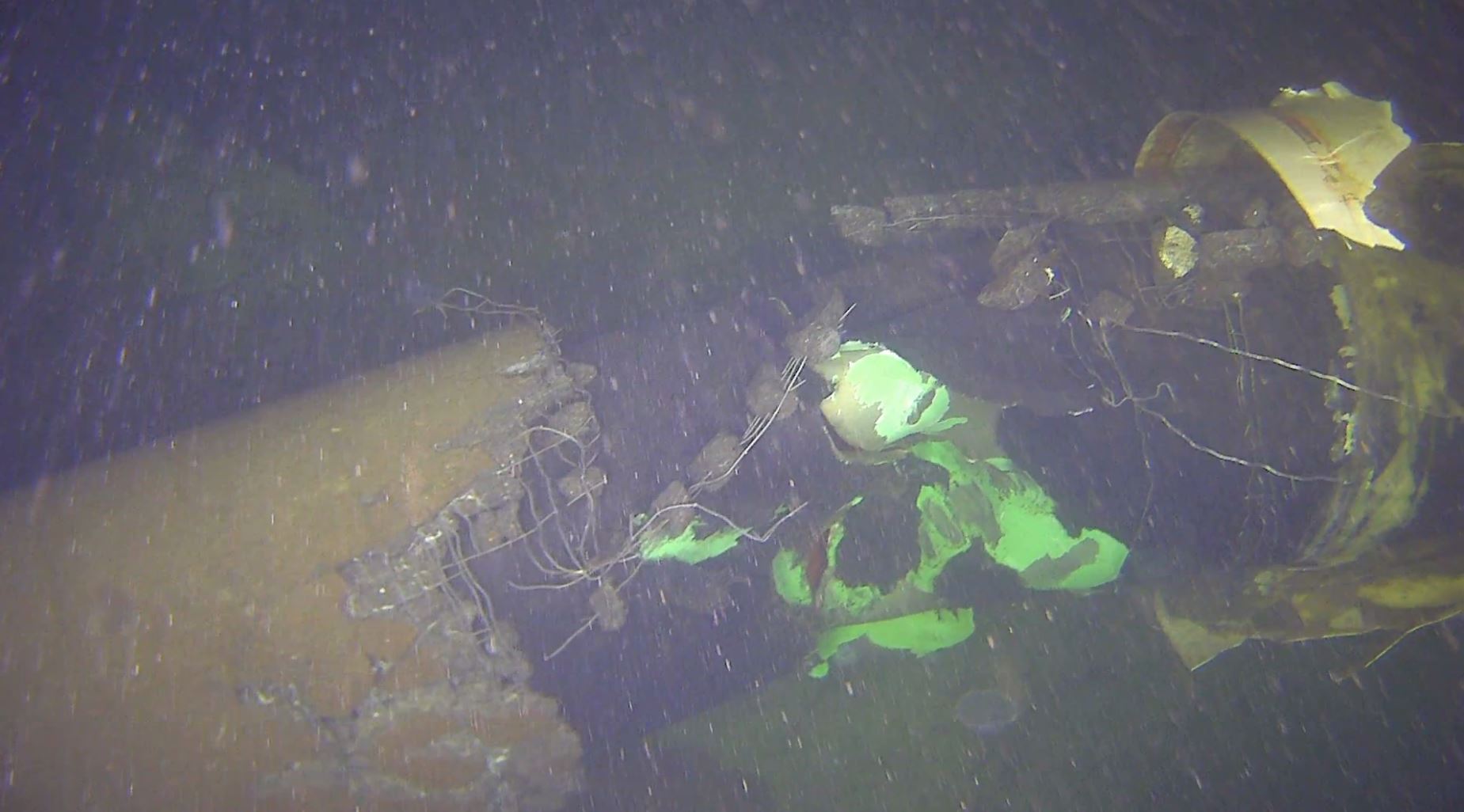
On 8 October 2023 the Balticconnector gas pipeline connecting Finland and Estonia ruptured, simultaneously severing a telecommunications cable running in the same corridor. Finnish investigators established that the Hong Kong-registered cargo vessel NewNew Polar Bear had dragged its anchor across the seabed. Almost three years on, the only criminal proceeding is against the ship’s master in a Hong Kong court, a forum with no connection to the states that suffered the damage.1 A year earlier, explosive charges shattered the Nord Stream 1 and 2 pipelines under the Baltic Sea. German prosecutors charged a Ukrainian national in July 2026, but a Polish court has refused to surrender a second suspect and no state has been held to account.2 These two incidents share a defining characteristic: the actors responsible understood that attacking infrastructure below the surface yields maximum strategic effect at minimum legal and political risk.
These are proof-of-concept examples of a type of infrastructure warfare that is directly relevant to Canada’s maritime approaches, cable corridors and offshore assets – and to a maritime security doctrine that is unprepared. The ocean floor, long treated as a passive substrata beneath the real business of naval power, has become contested geopolitical terrain.
This article argues that Canada must reconceptualize critical subsea infrastructure protection as a primary naval security mission, building an integrated ‘seabed-to-space’ maritime domain awareness framework that combines Royal Canadian Navy (RCN) capabilities, Canadian Coast Guard (CCG) assets, NATO cooperation, advanced underwater surveillance technologies and a coherent grey-zone deterrence doctrine. The argument is not that Canada must achieve undersea dominance, an ambition beyond any middle power, but that it must develop the detection, deterrence and response capacity appropriate to a state the geography of which places it at the intersection of the North Atlantic, the Arctic and the world’s most consequential transatlantic cable corridors. (In the interest of brevity, this article focuses on the Atlantic and Arctic coasts of Canada, but the same arguments apply to the Pacific coast.)
Trending now:
- Winner of the 2026 CNMT Essay Contest: Vulnerable Arteries
- The Plan for a Stronger Canada: Naval Strategy
- A New Canadian Defence Plan: Coming Soon?
- Canadian Shipyards Should Share the Cost of Backing Suppliers
- CNR sponsors: visit page
Latest CNR: Vol. 22 No. 2 (2026)
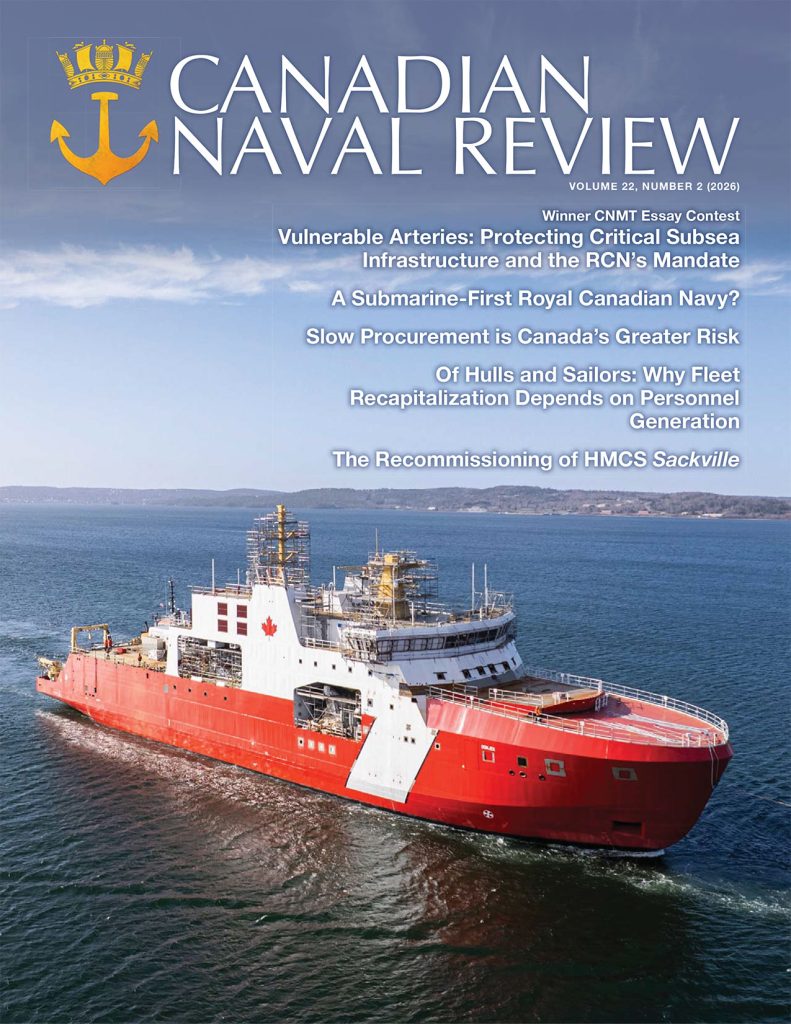
Download Vol. 22.2 in PDF format (subscribers only, unless supported by a link to a free access article). Adobe Acrobat Reader or a similar Portable Document Format (PDF) viewer is required to read the electronic issue.
Subscribers can access the full issue of CNR. Non-subscribers can access only selected articles via links provided below. Click on Subscriptions to purchase your electronic subscription, and get full access to all issues as they are published.
Alas, summer is over. But it’s not just snow and sleet and ice coming in the future – the fall issue of CNR is coming too! The latest issue is now available, and here is a preview of what’s in the issue.
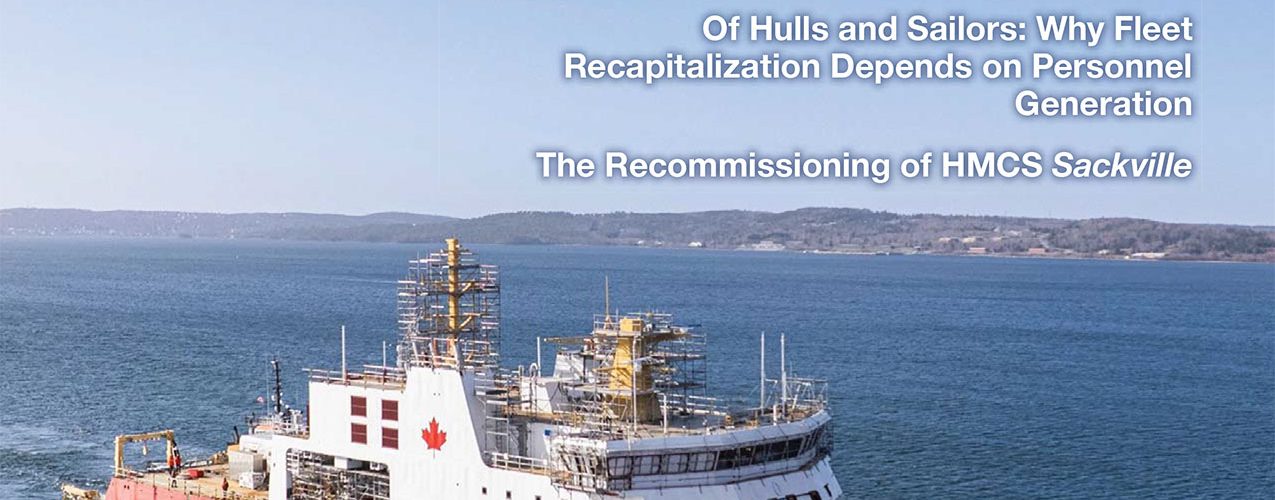
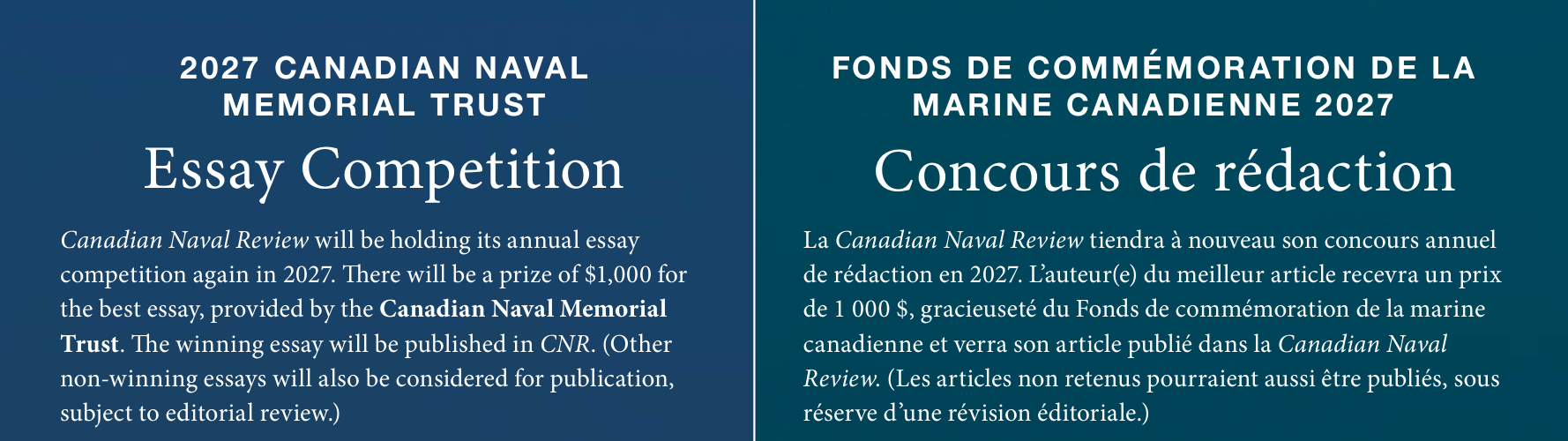
In his Editorial “The Art of Naval Thought,” Brian Santarpia notes that “the RCN dedicates relatively little effort to professional education in the foundations of strategic thought,” and that this is unfortunate. To start off the line-up of interesting articles, we have the winning essay of the 2026 CNMT essay competition. The author, C.A.M. Al Wahi, won with an impressive essay entitled “Vulnerable Arteries: Protecting Critical Subsea Infrastructure and the RCN’s Mandate.” Our second article, “A Submarine-First Royal Canadian Navy?” argues that, as Canada’s main strategic asset, submarines should receive more focus in the RCN. Our third article, “Slow Procurement is Canada’s Greater Risk,” outlines problems and solutions in the military procurement process from the perspective of a Canadian company. The next article, “Of Hulls and Sailors: Why Fleet Recapitalization Depends on Personnel Generation,” focuses on the importance of ensuring there are enough trained personnel as a crucial element of naval capability. The final article discusses HMCS Sackville and the ship’s recommissioning ceremony in the spring.
We have a good selection of Making Waves commentaries. There is material about the future US Arctic Security Cutters, discussion of the importance of trained personnel, underwater surveillance in the Arctic, and suggestions about the design of Canadian amphibious forces.
And, of course, we have our regular columns. In “Allies of Necessity: Japan and South Korea,” “A View from the West” looks at the uneasy relationship between two key players in the Indo-Pacific region. “Dollars and Sense” examines the shift from austerity to abundance in defence, and “Warship Developments” updates us on Tomahawks and aircraft carriers.
No issue of CNR would be complete without the amazing photos! And there are many of them!
Stay tuned. In a few weeks, the issue will be available to people who are lucky enough to be subscribers! It’s not too late for you to subscribe. See here for the Table of Contents.
CNR resources
- CNR Archives
- Subject Index for CNR Articles
- Broadsides Forum - Join the Discussion
- Submissions to Canadian Naval Review
- Subscriptions - unlock access to all CNR materials
- Sponsor page
- Free CNR articles and PDF downloads
- Follow us on Bluesky and LinkedIn
- Donate to CNR
- Special offer
Read more: CNR Archives (75 magazines in PDF) and Subject Index
Looking for Books about Maritime Matters?
Over the last 20 years, Canadian Naval Review has published over 200 book reviews. These books cover a variety of topics but they all relate to maritime matters, history, or security and defence at sea. This is an amazing resource. Go through the list of reviews, pick out a few books that look interesting, read the reviews, and then order the books from your nearest bookstore or from the publisher. See the list of book reviews at https://www.navalreview.ca/book-reviews/